

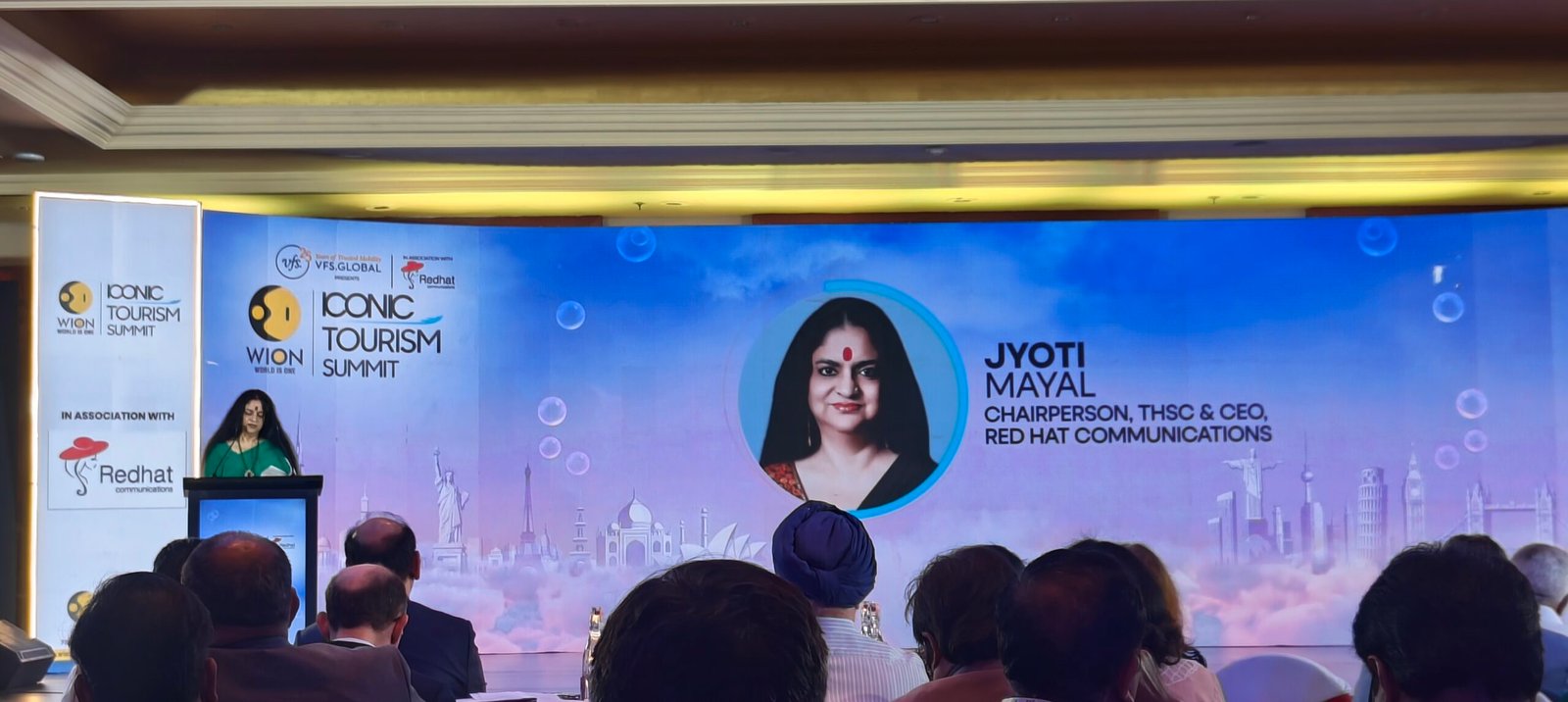
Tourism must move beyond arrivals and infrastructure to create experiences, empower communities and build a more inclusive ecosystem, Jyoti Mayal, Chairperson, Tourism & Hospitality Skill Council (THSC) and CEO, Red Hat Communications, said at the WION ICONIC Travel & Tourism Summit in New Delhi.
Welcoming diplomats, policymakers, industry leaders, entrepreneurs and tourism stakeholders at the summit, Mayal said WION Iconic Summit had evolved from a simple idea into a platform for meaningful dialogue, collaboration and action across the tourism sector.
“The strength of this summit lies not in the event itself, but in the quality of the conversations it inspires and the calibre of leaders it brings together,” she said. “We are not merely discussing the future of tourism. We are helping shape it.”
The summit, held in association with Red Hat Communications, brought together voices from across travel, tourism, hospitality, aviation and related sectors at a time when the industry is undergoing rapid transformation.
Tourism is being reinvented
Mayal observed that tourism was no longer simply recovering from the disruptions of recent years; it was being fundamentally reshaped by technology, changing consumer expectations and new forms of travel.
“Technology is transforming customer journeys, artificial intelligence is reshaping marketing, service delivery and business operations, while celebrities influence investment decisions and travel behaviour,” she said.
At the same time, travellers are becoming more discerning. “Today’s traveller is seeking experiences that are authentic, immersive, purposeful and deeply personal,” she said.
Tourism, she added, now extends far beyond hotels and airlines to encompass hospitality, aviation, MICE, weddings, wellness, medical tourism, food, culture, heritage, cuisine, entertainment, technology, entrepreneurship and community development.
The scale of India’s tourism and travel market underlines the opportunity. According to the Ministry of Tourism, India recorded 20.22 million international tourist arrivals in 2025, including 9.15 million foreign tourist arrivals and 11.07 million NRI arrivals. Indian nationals recorded 32.83 million departures abroad, while domestic tourist visits reached around 4.29 billion. Tourism-related foreign-exchange earnings stood at approximately ₹2.7 lakh crore.
“These numbers are more than statistics,” Mayal said. “They represent livelihoods, entrepreneurship, community development and India’s growing influence in the global tourism landscape.”
From competition to collaboration
Drawing on her recent participation in the BRICS Women’s Business Alliance, Mayal said one message had emerged clearly from discussions among participating countries: the future of tourism will depend on collaboration.
The conversations covered artificial intelligence, sustainability, destination development, entrepreneurship, women’s economic participation, skilling and digital transformation.
“The conversation was not about competition. It was about collaboration, shared learning and building stronger tourism ecosystems together,” she said.
She argued that India is particularly well positioned to lead this new phase, given its cultural diversity, entrepreneurial energy, innovation and growing infrastructure.
New airports, regional connectivity, highways, expressways and rail networks are improving access, while spiritual and religious tourism, tribal and rural tourism are receiving greater attention. Yet infrastructure alone, she cautioned, will not define the future.
“Experience will,” she said. “The traveller of tomorrow seeks authenticity over standardisation, connection over consumption and meaning over mere movement.”
Putting local stories on the tourism map
For Mayal, one of India’s greatest tourism opportunities lies in its local communities and their stories.
Travellers increasingly want to interact with local communities, understand traditions, experience regional cuisine and discover experiences that cannot simply be replicated elsewhere.
She painted a picture of local handicrafts becoming part of tourism experiences, regional cuisines becoming destination attractions, and storytelling, performing arts and traditional crafts becoming integral to the visitor experience.
“When tourism celebrates local identity, everyone benefits,” she said. “The traveller gains authenticity, the destination gains distinction, and the community gains prosperity.”
This philosophy, she noted, aligns with the One District, One Product approach, which can help identify and promote distinctive crafts, cuisines, traditions, heritage assets, natural landscapes, wellness practices and festivals across India’s districts. “Every district in India has a story waiting to be told,” she said.
Developing those stories into tourism experiences, she argued, could create employment, support local enterprises, preserve heritage and empower communities.
“Tourism should not bring visitors to a destination. It should bring opportunity to the people who live there,” Mayal said.
The human side of Tourism 4.0
She placed particular emphasis on the future of tourism’s workforce.
Artificial intelligence, she said, will transform the industry by improving personalisation, supporting decision-making and creating new possibilities. But technology cannot replace the human qualities that lie at the heart of hospitality.
“Technology can automate a process, but it cannot replace empathy. Technology provides information, but it cannot create trust. Technology can enhance experiences, but people create memories.”
She called for a new approach to skilling that combines AI and digital literacy with communication, creativity, cultural sensitivity, adaptability, problem-solving and emotional intelligence.
THSC, she said, is working with governments and industry to connect tourism growth with local employment. Among the initiatives she highlighted was a partnership with the Mission Shakti Department in Odisha, through which 12,000 women self-help group members are to be trained over three years, creating opportunities for entrepreneurship and economic empowerment.
As tourism expands into rural, tribal, heritage, wellness and spiritual destinations, local communities must become active participants in that growth.
“People in these regions should not have to leave their communities in search of opportunity. Opportunity should reach them,” she said.
Five priorities for the next decade
Looking ahead, Mayal identified innovation, sustainability, skills and human capital, inclusivity, and collaboration as five themes that will shape tourism over the coming decade.
Innovation will require the industry to harness AI, analytics, immersive technologies and digital transformation. Sustainability must ensure that destinations are protected while tourism grows. Skills and human capital will remain central because, as Mayal put it, “technology supports experiences, but people create them”.
Inclusivity, meanwhile, must ensure that women, youth, artisans, entrepreneurs and local communities participate in tourism’s growth.
And collaboration between government, industry, academia, investors, technology companies and local stakeholders will be essential.
Reflecting on her years in the tourism and hospitality sector, Mayal returned to a simple principle: “Tourism succeeds when people succeed.”
She linked the success of tourism not merely to visitor numbers but to thriving communities, empowered entrepreneurs, stronger participation by women, preserved heritage and visitors returning home with meaningful memories.
Measuring tourism differently
Closing her address, Mayal called for a broader understanding of what constitutes tourism success.
“The future will not be shaped by those who simply respond to change. It is shaped by those who lead it,” she said, expressing her belief that India is ready to play a leading role in the next phase of global tourism.
She left the audience with a final thought: tourism growth should not be measured only in arrivals, revenue or infrastructure.
“It should be measured in lives improved, communities empowered, heritage preserved and dreams realised.”


Leave a Reply