

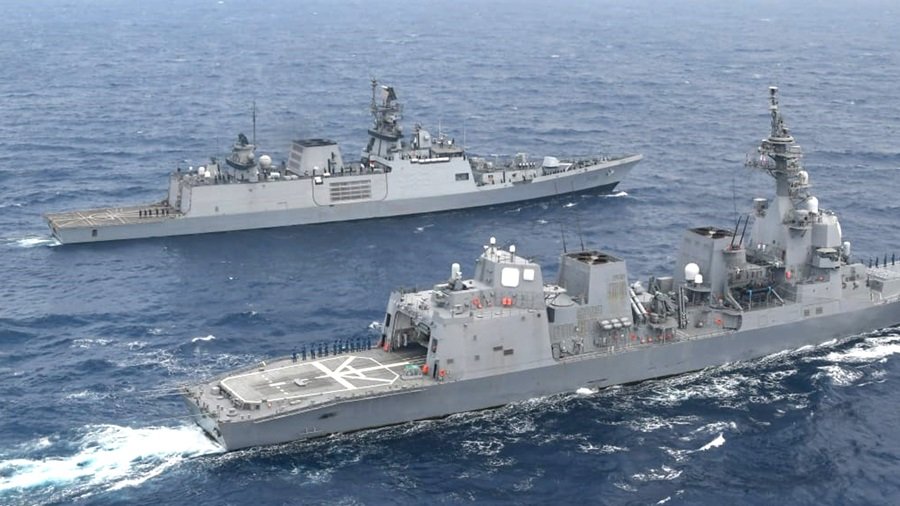
The Indo-Pacific is undergoing a profound realignment, defined by a cynical struggle for strategic positioning beneath the threshold of war. This space is characterised by advanced anti-access/area denial networks, grey-zone coercion, and commons contests,makingtraditional maritime security outdated.[i] To the national security establishment and the Indian Navy, the answer has been made in the gradual professionalisation and intensification of Maritime Partnership Exercises (MPX) out of its regular diplomatic interactions into a formal part of the warfighting strategy of India. Such exercises have become the predominant way of testing the tactical ideas, toughening the command and controldesigns, and achieving the integrated multi-domain systems required to provide credible deterrence and, should the need arise, decisive defeat in a disputed maritime environment.[ii] It is an active cycle of training in high anticipation, which is the proactive solution of India to an increasingly complex threat array, turning a diffused web of friendly navies into an integrative and interoperative coalition mass.
The force behind this development is the calculated and accurate threat of the People’sLiberation Army Navyand the related maritime forces. The Chinese naval build-up is not only quantitative but qualitative as it has advanced Type 055 destroyers, nuclear-powered attack submarines, as well as an increasing carrier strike group.[iii] What is more sinister is the implementation of a three-warfare approach, which incorporates legal, media, and psychological campaigns with the violent application of maritime militia and coast guard vessels to distort the water and constitute legal claims over the territory. That produces a super-stratum layer of threat in which a crisis can easily grow out of civilian swarming of vessels to a coordinated but still cyber-based attack on a port infrastructural environment, which is then succeeded by the introduction of blue-water assets.[iv]India’s MPXneeds to be acquainted with a range of conflicts, both humanitarian help and disaster relief tasks under duress and full-scale warfare. This is seen in the Exercise Malabar involving the United States, Japan and Australia, which has evolved to incorporate advanced anti-submarine warfare prosecutions in high-sea acoustic environmentsand incorporated air defence exercises, all of which are obvious rehearsals of the sea control and sea denial operations in critical chokepoints.[v]
At an operational level, the worth of these exercises would be quantified in terms of hardening of particular key warfighting enablers. Naval warfare is an environment replete with sensors; the one that can most effectively turn sensor data into action wins. The MPX, similar to Varuna with France and Konkan with the United Kingdom, is a work laboratory to realise interoperability in the intelligence, surveillance, and reconnaissancefusion. They rehearse matching Indian P-8I Poseidon planes with ally planes as US P-8As, Japanese P-1s and French Atlantiques, forming a joint operational image offered by harmonious data interchange and communications protocols.[vi] This continuous sensor hookup is reducing sensor-to-shooter track, so that a radar image of a Japanese destroyer will trigger an Indian naval horseman to look at the surface, or a sound image on a sonar of an Australian frigate will be investigated by an air patrol ship. Moreover, training crews to work in a degraded electromagnetic spectrum and ensure C2 integrity despite advanced intrusion activities is becoming a dedicated electronic warfareand cyber-defence strand feature of exercises, as critical a non-kinetic front as any missile fighting.
Fig. 1:India’s maritime capability building in the Indo-Pacific Source
Sources: Kiran, G. S. K., & Saikia, P. (2025). India’s maritime cooperation in the Indo-Pacific: Understanding India’s capacity-building mechanisms. Taylor & Francis. (world). https://www.tandfonline.com/doi/abs/10.1080/18366503.2025.2550074
The underlining of this coalition warfighting capability is logistics and sustainment, which is frequently ignored. The extent to which a fleet can reach is not determined by its size but by the strength of its logistical tail. Only MPX provides a viable basis to confirm the intricate categories of underlying agreements, such as the Logistics Exchange Memorandum of Agreement (LEMOA) and the Mutual Logistics Support Agreement (MLSA).[vii] The ballet of replenishment at sea (RAS), in which thousands of tons of fuel and stores are exchanged between the vessels in passing, is a perishable art, which is practised with care by the RN. Helicopters and personnel cross-decking, sharing of submarine tender support or expeditions into the maintenance facilities onshore are all practised, taking a coalition, which had been deemed a theoretical entity, and turning it into a logistically viable and persistent presence in the IORand further afield. This deprives an opponent of the potential strategic benefit of just outlasting a temporary multilateral formation, which, as we will see, also means that a coalition can continue to operate at operational tempo and station-keep over lengthy periods.[viii]
In the future, India’s MPXisgoing towards the full spectrummulti-domain operations, focusingon integrating the Indian Air Force and Army assets to form an all-domain, joint kill web. The Su-30MKI,equipped with BrahMos missiles and AWACS systems, are inherently a multiplier in terms of forces in the maritime strike and aerial surveillance, respectively.[ix]The BrahMos regiments will strengthen the mosaic of coastal defence and provide an A2/AD bubble that stretches out of the shoreline. These aspects will probably be included in future operations at sea to train how to defend the critical assets of the Andaman and Nicobar Command, or carrying out long-range maritime interdiction operationsboth by air and land.[x]
The tests on indigenous systems on next-generation offshore patrol vessels and unmanned surface vessels to network-centric warfare suites in a consortium setting will accelerate their operational ability and prove to partners that India has a defence industrial base capable of providing an interoperable technology.In Conclusion, India’s Maritime Partnership Exercises have evolved into a consistent military campaign, enhancing national security through integrated deterrence. These exercises operationalise India’s Security and Growth for All in the Region (SAGAR) into enhanced warfighting interoperability; these exercises demonstrate India’s critical capacity to underwrite regional stability as a core architect of a networked security order. The MPX portfolio reflects India’s purposeful military strategy and statecraft.
[i] Kamara, H. M. (2020, March 31). Countering A2/AD in the Indo-Pacific: A Potential Change for the Army and Joint Force > National Defense University Press > News Article View. National Defense University Press. https://ndupress.ndu.edu/Media/News/News-Article-View/Article/2106530/countering-a2ad-in-the-indo-pacific-a-potential-change-for-the-army-and-joint-f/
[ii] Deshpande, S. (2024, July 1). Increased deployment, joint exercises, foreign training & faster aid—Indian Navy’s growing footprint. The Print. https://theprint.in/defence/indian-navys-growing-footprint-foreign-deployment-training-allied-personnel-backyard-aid/2154505/
[iii] Joe, R. (2026, January 19). The Growth of China’s Navy: Past, Present, and Future. The Diplomat. https://thediplomat.com/2026/01/the-growth-of-chinas-navy-past-present-and-future/
[iv] Singh, G. (2026, January 19). China Overtakes Russia in Nuclear Submarines; PLA Navy Races to Project Power Beyond Indo-Pacific. The Eurasian Times. https://www.eurasiantimes.com/china-overtakes-russia-in-nuclear-submarines-pla-navy-races-to-project-power-beyond-indo-pacific/
[v]Stampoulis, P. (2017, November 21). The Indian Navy’s Master DefensePlan |Center for International Maritime Security. CIMSEC. https://cimsec.org/indian-navys-master-defense-plan/
[vi]U.S., Indian navies conduct bilateral training near Diego Garcia. (2025, October 27). Commander, U.S. 7th Fleet. http://www.c7f.navy.mil/Media/News/Display/Article/4325918/us-indian-navies-conduct-bilateral-training-near-diego-garcia
[vii] Holthaus, J. (2022, April 13). Using Logistics to Strengthen and Expand the Quad. South Asian Voices. https://southasianvoices.org/using-logistics-to-strengthen-and-expand-the-quad/
[viii] Heckmann, L. (2024, May 8). JUST IN: Indo-Pacific Exercises Present Necessary Challenges for Army. National Defense. https://www.nationaldefensemagazine.org/articles/2024/5/8/just-in-indo-pacific-exercises-present-necessary-challenges-for-army
[ix][ix] Air Marshal Anil Khosla. (2025, September 4). Distributed Maritime Operations: Applicability in the Indian Context. Indus Research. https://indusresearch.in/distributed-maritime-operations-applicability-in-the-indian-context-by-air-mshl-anil-khosla-retd/
[x]Brahmos:-A force Multiplier of Indian Army,Navy and Airforce. Indian Defence News. Retrieved January 28, 2026, from https://defenceupdate.in/brahmos/



Leave a Reply