

India assumed the BRICS presidency in January 2026 at a moment of exceptional geopolitical uncertainty. The international system is simultaneously grappling with the protracted Russia–Ukraine war and the escalating conflict involving Iran, two crises that have profound implications for global security, energy markets, supply chains and the future of multilateral institutions. While the Ukraine conflict has continued to divide major powers and reshape the European security architecture, the Iran crisis has added another layer of instability to an already volatile West Asian region. Together, these developments present one of the most challenging strategic environments that BRICS has encountered since its inception.
The timing is particularly significant because both Russia and Iran occupy important positions within the expanded BRICS framework. Russia remains a founding member and one of the grouping’s principal strategic actors, while Iran, admitted as a full member in 2024, represents BRICS’ growing ambition to expand its influence across the Global South. Consequently, the two conflicts have tested not only the cohesion of the organisation but also its ability to reconcile competing national interests among an increasingly diverse membership.
India’s presidency is guided by the theme “Building for Resilience, Innovation, Cooperation and Sustainability,” reflecting its broader vision of strengthening the voice of the Global South while promoting pragmatic multilateralism. However, steering a grouping that now comprises eleven members with divergent geopolitical interests has become increasingly complex. The Russia–Ukraine war has long exposed differences within BRICS regarding questions of sovereignty, sanctions and European security. The Iran crisis has further highlighted fault lines among members sharply.
The grouping is increasingly diverse in its political systems, strategic priorities and security partnerships. While Russia views the Ukraine conflict through the lens of its confrontation with the West, countries such as India, Brazil and South Africa have largely avoided taking sides and instead advocated dialogue and peaceful settlement. Similarly, Iran’s expectation of political solidarity from fellow BRICS members during periods of military confrontation is complicated by the presence of countries such as the UAE, Saudi Arabia and Egypt, each of which has its own regional calculations and external partnerships.
These differences demonstrate that BRICS cannot realistically function as a unified geopolitical or anti-Western bloc. Rather, its strength lies in its ability to accommodate diverse perspectives while advancing common interests in areas such as development, economic cooperation, reform of global governance institutions and greater representation for the Global South. In this regard, the Ukraine and Iran crises serve as reminders that the future relevance of BRICS will depend less on political uniformity and more on its capacity to manage differences without undermining cooperation.
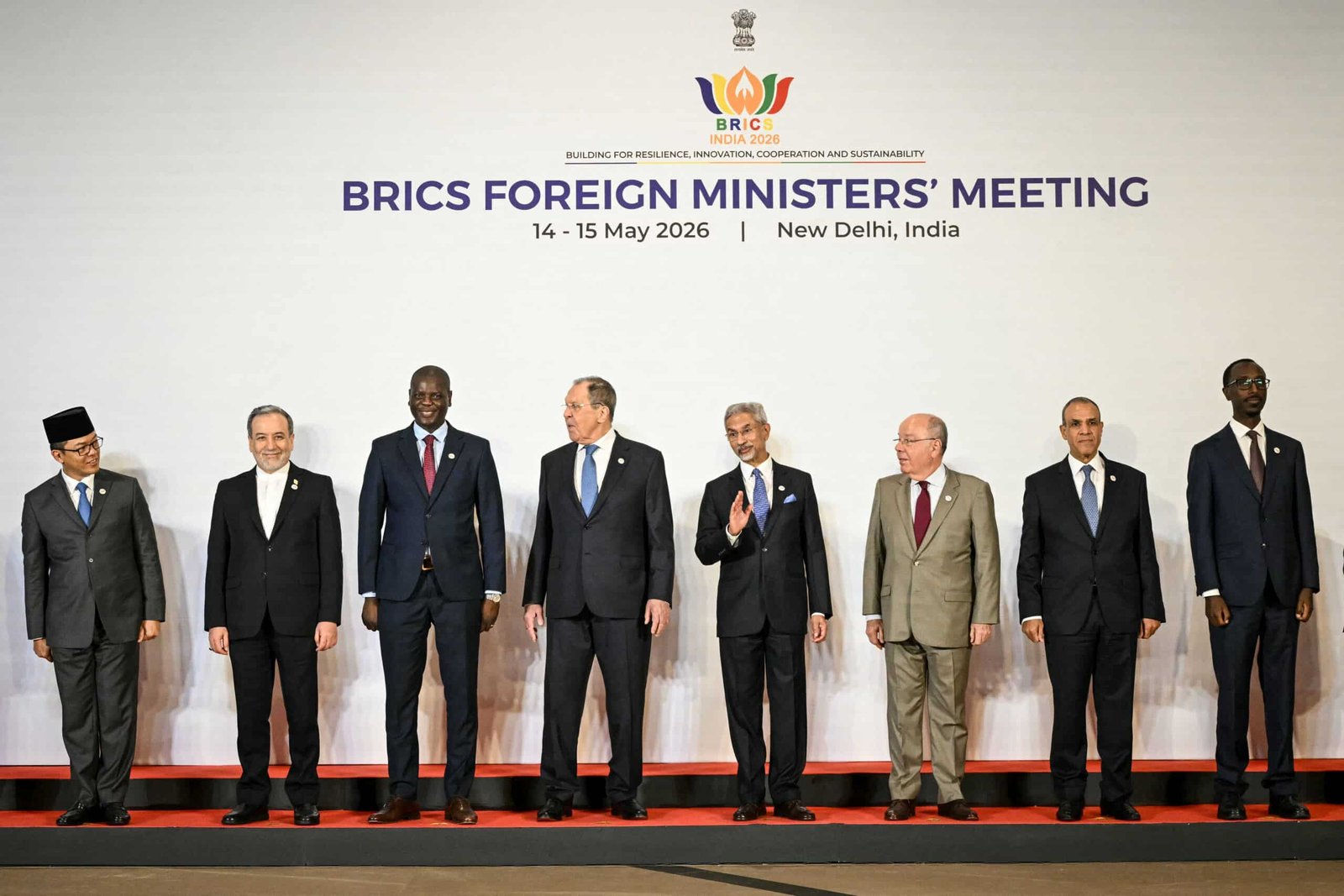
The 14-15 May 2026 BRICS Foreign Ministers’ Meeting in New Delhi highlighted the cooperation among the members despite the problems and divisions between the member countries. During the meeting, it was indicated that BRICS ministers were unable to arrive at a common position regarding the conflict involving Iran, resulting in the absence of a joint ministerial statement. India, as chair, instead issued a Chair’s Statement acknowledging differing perspectives among members regarding developments in West Asia. The disagreement reportedly centred on calls by Iran for a stronger condemnation of military actions against it, while Gulf states within BRICS held differing views. These developments underscore a fundamental reality—BRICS is no longer a relatively cohesive grouping of major emerging economies.
The inclusion of Iran in 2024 and Indonesia in 2025 has broadened the bloc’s representational legitimacy but has also imported regional rivalries and security disputes into its internal deliberations. Iran’s membership has transformed the organisation’s geopolitical profile. Tehran naturally expects political solidarity from fellow BRICS members during periods of external pressure. Yet several members maintain strategic partnerships with the United States, Israel, or Gulf rivals of Iran, making consensus difficult.
At first glance, such divisions may appear to weaken India’s presidency. In reality, they highlight why India’s role has become more important than ever. Unlike some BRICS members that approach international crises through ideological or bloc-based lenses, India enjoys credibility across competing camps. It maintains long-standing civilisational and strategic ties with Iran while simultaneously deepening partnerships with Israel, the United States, Saudi Arabia and the UAE. During the current crisis, New Delhi has consistently called for de-escalation, dialogue and diplomacy rather than alignment with any side. This balanced position reflects India’s larger foreign policy approach of strategic autonomy.
Such a posture gives India a unique advantage within BRICS. While China and Russia are often viewed through the prism of great-power competition with the West, India is perceived by many countries as a more credible bridge-builder. The expanded BRICS requires precisely this kind of leadership. As geopolitical divisions deepen globally, the bloc’s relevance will depend less on ideological unity and more on its ability to accommodate diversity while advancing common developmental objectives.
India’s presidency has therefore sought to shift attention towards areas where consensus remains achievable. Official priorities include resilience, innovation, cooperation and sustainability. Discussions have focused on health cooperation, digital public infrastructure, sustainable development, climate resilience, reform of global governance institutions and strengthening South-South cooperation. These issues resonate across the Global South irrespective of members’ geopolitical disagreements.
The Iran crisis also reinforces India’s long-standing argument that BRICS should not evolve into an anti-Western alliance. New Delhi has consistently viewed the grouping as a platform for reforming global governance rather than replacing one bloc with another. For India, BRICS derives strength from its diversity and its ability to represent multiple centres of power within an emerging multipolar order. The inability to reach consensus on Iran demonstrates the limitations of attempts to transform BRICS into a unified geopolitical front.
Indeed, the current crisis may ultimately strengthen India’s influence within the organisation. As internal divisions become more apparent, members are likely to value a chair that can preserve dialogue and prevent fragmentation. India’s diplomatic credibility stems from its capacity to engage simultaneously with rival powers and competing regional actors. In a BRICS that now includes both Iran and the UAE, as well as countries with differing perspectives on global conflicts, this balancing role becomes indispensable.
Moreover, India’s leadership arrives at a time when many developing countries are seeking alternatives to great-power polarisation. The Global South is increasingly interested in practical outcomes such as development financing, resilient supply chains, technology cooperation and reform of international institutions. India’s emphasis on these issues aligns closely with the aspirations of many BRICS members and partner countries. The success of its presidency will therefore be measured not by resolving every geopolitical dispute but by ensuring that such disputes do not derail the bloc’s developmental agenda.
The Iran crisis is thus both a challenge and a revealing moment for BRICS. It has exposed the complexities created by expansion and highlighted the difficulties of forging consensus among increasingly diverse members. Yet it has also demonstrated why India occupies a unique position within the grouping. Rather than choosing sides, New Delhi has chosen to preserve dialogue. Rather than allowing geopolitical disagreements to dominate the agenda, it has sought to redirect attention towards shared interests.
As BRICS enters a new phase of evolution, India’s presidency offers a model of leadership grounded not in ideological conformity but in strategic balance. In an era defined by fragmentation and conflict, that may prove to be the most valuable contribution India can make—not only to BRICS, but to the wider international order.



Leave a Reply