

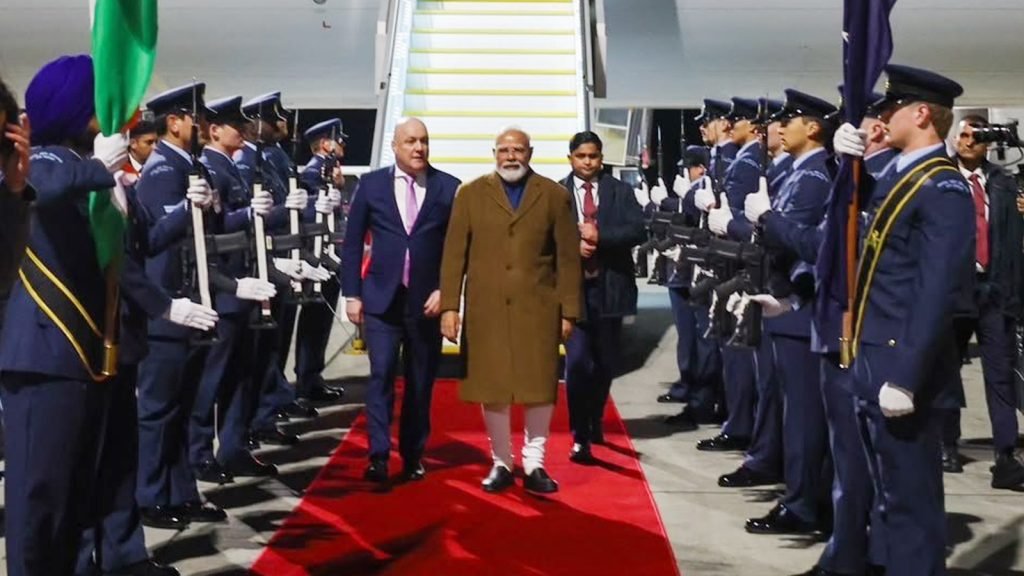
Indian Prime Minister Narendra Modi has charmed audiences in New Zealand during his first state visit to the island nation.
It is noted that Narendra Modi had earlier visited New Zealand in 2001, when he was a functionary of his party based in Delhi, before becoming the Chief Minister of Gujarat.
It is also noted that the last state visit to New Zealand by an Indian Prime Minister took place in 1988, when Rajiv Gandhi was the Prime Minister.
Prime Minister Narendra Modi arrived in New Zealand on the final leg of his three-nation visit.
Earlier, in his departure statement in New Delhi, the Prime Minister had said that his visit would “meaningfully build” upon the strong momentum in India-New Zealand ties, following Mr. Luxon’s visit to India in March 2025.
Earlier, the contours of the strategic partnership were sealed during the official visit of the Prime Minister of New Zealand, Rt Hon Christopher Luxon, to India from 16–20 March 2025. Prime Minister Luxon, who was on his first visit to India in his current capacity, visited New Delhi and Mumbai. He was also the Chief Guest at the annual Raisina Dialogue 2025.
Further, the security aspect was amplified by the recent signing of the trade deal between India and New Zealand.
It is understood that New Zealand, like India and Australia, has recognised the changing strategic outlook in the Indo-Pacific. China’s emergence as a major power was reflected in the Defence White Paper released in November 2010.
India has never explicitly stated that it wishes to form any sort of alliance with democratic nations against China. Neither does New Zealand wish to be part of any anti-Beijing alliance, particularly considering that it signed a Free Trade Agreement with China in April 2008—the first Western country to do so.
However, a diplomatic initiative between two democratic countries that share common values and interests in the Indo-Pacific region should be explored further. The challenge for India and New Zealand in forming an effective strategic relationship lies in finding consensus within their domestic constituencies for stronger strategic relationships with the United States in the years to come.
New Delhi has been quite reluctant to embrace a closer strategic relationship with the United States, or even with Australia or New Zealand.
As part of India’s power projection efforts in the Indo-Pacific, New Delhi has decided to strengthen its Eastern Fleet in Visakhapatnam and the tri-service command in the Andaman and Nicobar Islands. In the future, Southeast Asian countries such as Singapore and Malaysia will increasingly look to India, as well as the United States, for security. This coincides with New Zealand’s interests in the Indian Ocean littoral of Southeast Asia and its long-standing commitments under the Five Power Defence Arrangements. India’s increased power projection in the region could benefit New Zealand’s strategic interests there, which tend to parallel those of Australia. For instance, both India and Indonesia have decided to enhance their counter-terrorism mechanisms and maritime strategic cooperation, the latter primarily with China in mind.
India and New Zealand have a great deal in common. Both countries have democratic institutions based on the Westminster parliamentary system, are members of the Commonwealth, and have a keen interest in an international system that supports the rule of law and global stability.
From India’s point of view, having a partner in New Zealand provides an effective way to further its expanding strategic interests in the wider Indo-Pacific region.
This very much coincides with Wellington’s growing interest in the Indo-Pacific region. It should serve as a common thread for Indo-New Zealand relations in the future, although there will be challenges, such as building consensus for their strategic relationships with the United States and managing occasional differences over the Nuclear Non-Proliferation Treaty.
Further, Wellington and New Delhi might find common resonance in the evolving strategic alignment of Pacific Islands geopolitics and the wider canvas of the Indo-Pacific.
The visit of the Prime Minister also signals the importance of the changing strategic environment, particularly as the United States has renamed the US Indo-Pacific Command as the Pacific Command, wherein New Zealand is also compelled to make corresponding strategic arrangements.


Leave a Reply