

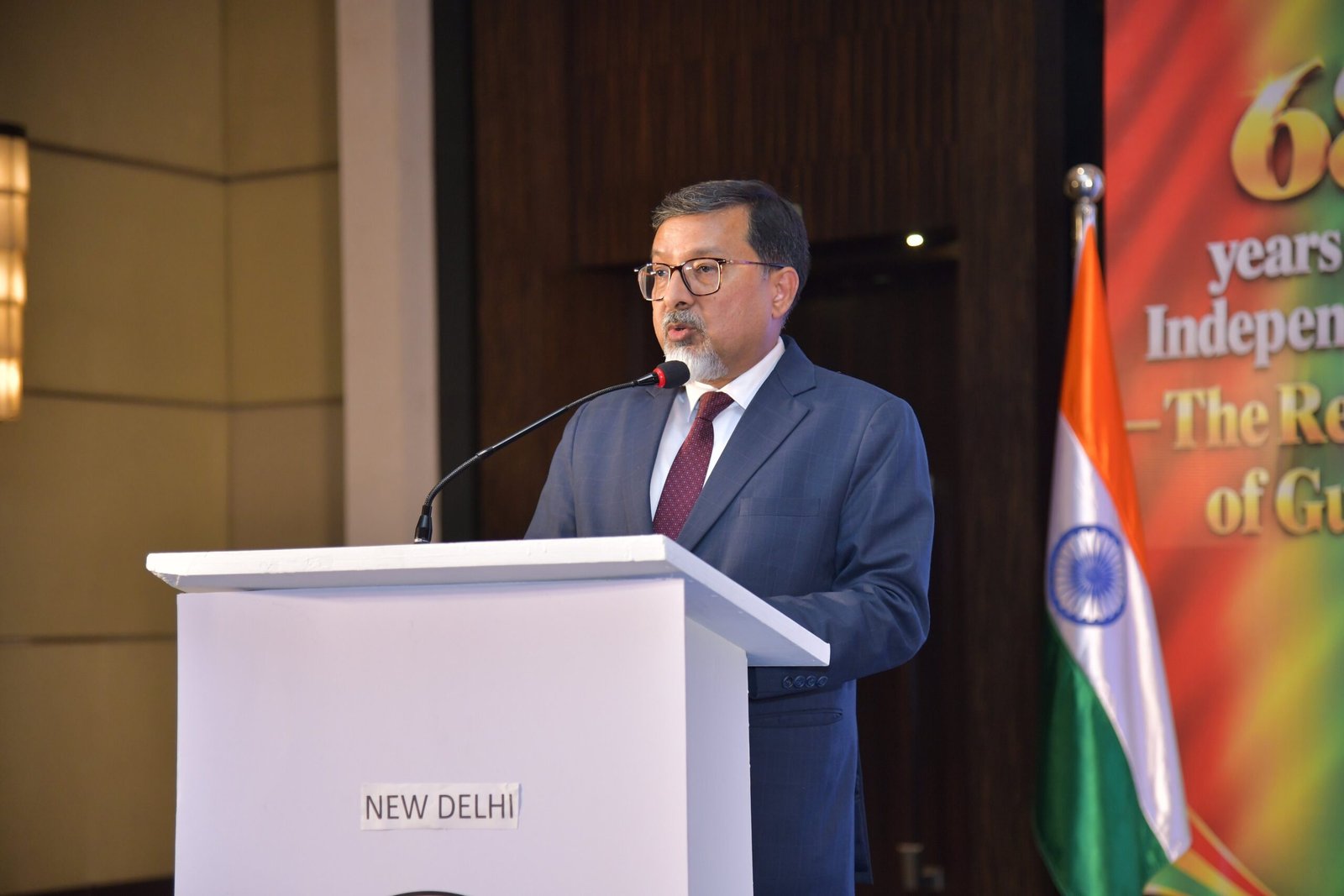
At Guinea’s 68th Independence anniversary in New Delhi, Secretary (Economic Relations), Ministry of External Affairs, Government of India, Shri Sudhakar Dalela highlighted the expanding India–Guinea partnership, with trade, investment, development cooperation, skills and Simandou 2040 emerging as key areas for the next phase of engagement.
India and Guinea are entering a new phase in their bilateral relationship, one increasingly shaped by economic opportunity, development cooperation and the priorities of a changing Global South. Addressing the deferred celebration of the 68th anniversary of the independence of the Republic of Guinea in New Delhi on 6 October 2026, Shri Sudhakar Dalela, Secretary, reaffirmed India’s commitment to strengthening ties with the West African nation.
Representing the Government of India as Chief Guest, Shri Dalela described the relationship as one founded on “mutual respect, shared historical experiences, and a common commitment to South-South cooperation.” He noted that bilateral ties have expanded in recent years across trade, investment, development cooperation and people-to-people connections.
The emphasis was not simply on the existing relationship, but on the possibilities of building a more substantive economic partnership.
From Friendship to Economic Partnership
India and Guinea have maintained diplomatic relations since Guinea’s independence in 1958. Over the years, institutional mechanisms and development partnerships have provided a foundation for closer engagement.
Shri Dalela pointed to the role of regular institutional dialogue in sustaining the relationship, noting that these mechanisms provide platforms for “identifying new areas of cooperation and translating common aspirations into concrete programmes of action.”
Economic cooperation is increasingly central to this engagement. According to the Ministry of External Affairs’ latest bilateral brief, India–Guinea trade stood at approximately US$2.08 billion in 2023–24, comprising Indian exports of about US$696.5 million and imports of approximately US$1.39 billion. The trade basket includes Indian exports such as pharmaceuticals, cereals and rice, engineering goods, textiles, transport equipment, chemicals and construction equipment, while India’s imports from Guinea include gold, minerals, cashew and other commodities.
Shri Dalela highlighted the growing presence of Indian businesses in Guinea, particularly in mining, manufacturing, pharmaceuticals and infrastructure.
The relationship therefore has an increasingly commercial dimension, one that can be expanded as Guinea seeks investment and technology to support its economic transformation.
Simandou 2040: A Platform for Transformation
A major focus of the evening was Guinea’s Simandou 2040 programme, which the Ambassador of Guinea, H.E. Mr. CONTE Alassane, had earlier described as a comprehensive economic transformation agenda extending well beyond mineral extraction.
For India, the programme presents opportunities to deepen cooperation through technology transfer, investment and capacity building.
Shri Dalela said that “India stands ready to support the vision through technology transfer, economic cooperation, capacity building, and investments in the strategic sectors of the Guinean economy.”
This approach aligns with India’s broader development partnership model, which places emphasis on supporting priorities identified by partner countries rather than imposing externally defined development models.
Simandou itself is already generating significant infrastructure and industrial activity. The SimFer consortium, involving the Government of Guinea, Rio Tinto and the Chinalco-led China Iron Ore Holdings consortium, reported progress in 2026 on rail and port infrastructure associated with the Simandou project. In September 2026, SimFer began staged commissioning of key infrastructure at its Morebaya port facilities.
The wider significance of Simandou 2040, however, lies in its potential to connect Guinea’s mineral wealth with infrastructure, energy, agriculture, manufacturing, skills and other sectors of the economy.
For Indian companies, this could create opportunities across the broader ecosystem surrounding Guinea’s transformation.
Opportunities Beyond Mining
He further identified several areas where Indian capabilities could complement Guinea’s development priorities.
Healthcare, information technology, vocational training and renewable energy were specifically highlighted as sectors with considerable potential for collaboration.
These areas build on an established foundation of Indian development cooperation. India has supported Guinea through capacity-building programmes including the Indian Technical and Economic Cooperation (ITEC) programme and scholarships administered through the Indian Council for Cultural Relations (ICCR). Current Embassy of India information indicates that Guinea has been allocated civilian ITEC slots, while Indian scholarship opportunities have also been extended to Guinean students.
The partnership in skills development is particularly relevant to Guinea’s current ambitions. As the country seeks to industrialise and develop local value chains, access to trained human resources will be as important as access to capital and technology.
This is also where the two countries’ development priorities intersect. India has accumulated experience in areas ranging from digital technologies and pharmaceuticals to agriculture, renewable energy, manufacturing and skills development, while Guinea is seeking to build productive capacity across these fields.
Development Cooperation and Capacity Building
India’s development partnership with Guinea extends beyond commercial engagement.
The Government of India has previously extended Lines of Credit to Guinea for areas including healthcare and water infrastructure. The MEA’s bilateral brief records a US$170 million Line of Credit for strengthening drinking-water supply infrastructure, as well as earlier credit support for Guinea’s health system.
Such cooperation reflects an important characteristic of India’s engagement with developing countries: development assistance is often combined with training, institutional capacity building, technology and economic cooperation.
He emphasised this philosophy during his address, noting that India’s development partnership is guided by the principle that cooperation should respond to “priorities identified by partner countries.”
This model is particularly relevant to Guinea as it seeks to build the skills and institutional capacity required to manage an increasingly complex economy.
People as the Bridge
Economic relations alone cannot define a bilateral partnership. Shri Dalela also underlined the importance of people-to-people ties, cultural exchanges and the Indian community in Guinea.
The Indian community has become an important bridge between the two countries, particularly through business and commercial networks. Cultural engagement has similarly provided opportunities for citizens of both countries to gain a deeper understanding of one another.
He recalled Guinea’s participation in cultural activities in India and expressed the hope that such exchanges would continue to expand.
These links matter because the next phase of India–Guinea relations will require not only governments and businesses, but also universities, research institutions, entrepreneurs and young people to become more closely connected.
A Shared South-South Agenda
The broader context of India–Guinea relations is India’s expanding engagement with Africa and the Global South.
Shri Dalela positioned the partnership within India’s wider commitment to South-South cooperation, with an emphasis on development, capacity building, technology and sustainable growth.
This approach has gained greater relevance amid disruptions to global supply chains and the search for more resilient economic partnerships. In a recent India–Africa policy address, Shri Dalela similarly highlighted the need for South-South cooperation in areas such as energy transition and climate action.
For Guinea, deeper engagement with India offers the possibility of diversifying partnerships while accessing technology, expertise and investment. For India, Guinea represents a resource-rich West African economy with opportunities across mining, infrastructure, agriculture, healthcare, energy and digital development.
The relationship is therefore moving towards a more multidimensional partnership — one that combines commerce with development cooperation and human-capacity building.


Leave a Reply