

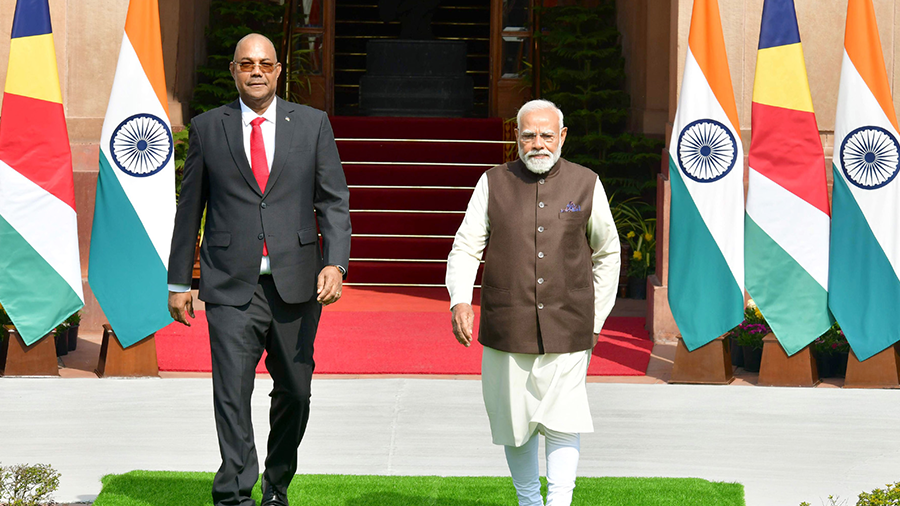
The first State Visit of Seychelles’ President Patrick Herminie to India from 5 to 10 February 2026 marked an important turning point in bilateral relations between the two Indian Ocean partners. More than a ceremonial diplomatic exchange, the visit reflected a strategic recalibration of ties shaped by maritime security concerns, development cooperation, healthcare partnerships, and shared priorities in sustainability and economic resilience.
The visit was particularly significant because it came at a symbolic moment: 2026 marks fifty years of diplomatic relations between India and Seychelles, which established ties soon after Seychelles gained independence in 1976. As President Herminie’s first official visit to India after assuming office in October 2025, the trip also set the tone for his administration’s foreign policy priorities and reaffirmed Seychelles’ commitment to strengthening its partnership with India.
Spanning engagements in Chennai, Mumbai and New Delhi, the visit combined sectoral cooperation with high-level political dialogue, resulting in major agreements, financial assistance, and a new strategic framework for bilateral cooperation.
Health Diplomacy in Chennai: A People-Centric Beginning
President Herminie began his visit in Chennai, a choice that reflected the growing importance of healthcare cooperation in India–Seychelles relations. Chennai has emerged as one of India’s leading medical destinations, attracting patients from across Africa and the Global South due to its advanced infrastructure and comparatively affordable treatment options.
During his stay, the President visited the Apollo Proton Cancer Centre, where discussions focused on expanding access for Seychellois citizens to specialised cancer treatment and exploring institutional partnerships in medical training and healthcare delivery. For Seychelles, which faces structural constraints typical of small island states, access to advanced medical technology abroad is a practical necessity. India’s healthcare ecosystem—particularly in specialised treatments such as oncology—offers an accessible alternative to more expensive Western systems.
This leg of the visit highlighted India’s expanding medical diplomacy, a key component of its engagement with developing nations. Cooperation in pharmaceuticals, training of healthcare professionals, and access to specialised treatment are likely to become long-term pillars of bilateral relations. The emphasis on healthcare also reflected a people-first approach, demonstrating how foreign policy engagement can directly improve citizens’ welfare.
Maritime Cooperation and the Blue Economy in Mumbai
From Chennai, President Herminie travelled to Mumbai, where the focus shifted to maritime collaboration and the blue economy. Given Seychelles’ location in the western Indian Ocean and its heavy dependence on marine resources, maritime security and ocean governance remain central to its national strategy.
In Mumbai, the President met with India’s Union Minister for Ports, Shipping and Waterways, Sarbananda Sonowal, to discuss cooperation in maritime trade, port development, and sustainable ocean management. The discussions emphasised shared interests in strengthening maritime connectivity, promoting sustainable fisheries, and enhancing ocean-based economic activities.
For Seychelles, collaboration with India offers access to technical expertise, investment opportunities, and capacity-building support in maritime infrastructure. For India, deeper engagement with Seychelles helps secure vital sea lanes in the Indian Ocean through which a significant portion of global trade flows. The discussions therefore reflected not only economic cooperation but also broader strategic convergence in maintaining stability in the Indian Ocean region.
The focus on the blue economy also underscored growing global attention to sustainable use of ocean resources. Both countries expressed interest in promoting environmentally responsible maritime development, reflecting a shared recognition of the ecological and economic importance of the oceans.
High-Level Diplomacy in New Delhi
The most consequential phase of the visit took place in New Delhi, where President Herminie engaged in high-level political and strategic discussions with India’s leadership. He was accorded a ceremonial welcome at Rashtrapati Bhavan by Droupadi Murmu, followed by delegation-level talks with Prime Minister Narendra Modi.
The talks reviewed the entire spectrum of bilateral relations and produced several key outcomes. Among the most significant was the adoption of a new strategic framework titled the India–Seychelles Joint Vision for Sustainability, Economic Growth and Security through Enhanced Linkages (SESEL). The framework aims to guide future cooperation across areas such as economic development, maritime security, climate resilience, digital governance, and capacity building.
The adoption of SESEL reflects the evolution of India–Seychelles relations from traditional development assistance toward a comprehensive strategic partnership. It provides a long-term roadmap for cooperation and signals a shared commitment to addressing emerging global challenges, particularly those affecting small island developing states.
President Herminie also paid homage at Rajghat to Mahatma Gandhi, a symbolic gesture that highlighted shared values of peace, sovereignty, and international cooperation underpinning bilateral ties.
Economic Assistance and Development Partnership
A major outcome of the visit was India’s announcement of a financial assistance package worth 175 million US dollars for Seychelles. The package includes a line of credit and grant assistance aimed at supporting infrastructure development, social housing projects, vocational training, and sustainable mobility initiatives.
This assistance reflects India’s development partnership model, which focuses on capacity building and long-term economic resilience rather than aid dependency. For Seychelles, which faces structural vulnerabilities due to its small size and geographic isolation, such support is crucial for strengthening economic stability and improving public infrastructure.
The financial package also reinforces India’s position as a key development partner in the Indian Ocean region. By investing in local capacity and institutional development, India seeks to build enduring partnerships based on mutual benefit and shared growth.
Expanding Sectoral Cooperation
Several agreements were signed during the visit covering healthcare, meteorology, digital governance, hydrography, ocean research, and cultural exchange. Cooperation in hydrography and maritime mapping is particularly important for Seychelles, which has a vast exclusive economic zone but limited domestic capacity for maritime surveillance and ocean research.
The recognition of Indian pharmaceutical standards and expanded cooperation in healthcare are expected to improve access to affordable medicines and strengthen public health systems in Seychelles. Agreements on capacity building and training programmes will also enable Seychellois professionals and civil servants to receive specialised training in Indian institutions.
Such sectoral cooperation reflects the multidimensional nature of the bilateral relationship, which now spans security, development, education, and technology.
Defence and Maritime Security Cooperation
Maritime security emerged as another central pillar of the visit. India extended assistance to strengthen Seychelles’ maritime capabilities, including support for surveillance and capacity building. Given Seychelles’ strategic location along major shipping routes, cooperation in maritime security is essential for addressing challenges such as piracy, illegal fishing, and transnational crime.
For India, strengthening Seychelles’ maritime capabilities contributes to regional stability and supports its broader objective of ensuring a secure and open Indian Ocean. For Seychelles, partnership with India enhances its ability to safeguard its maritime territory and economic resources.
The emphasis on maritime cooperation reflects growing geopolitical competition in the Indian Ocean, where major powers are increasingly seeking influence. The visit therefore reinforced India’s role as a trusted security partner for island states in the region.
Strategic and Geopolitical Significance
Beyond bilateral agreements, the visit carries broader geopolitical implications. Seychelles occupies a critical position near major maritime routes linking Africa, Asia, and the Middle East. Its partnership with India strengthens regional security architecture and enhances cooperation in maintaining stability in the western Indian Ocean.
The visit also highlighted the growing importance of climate cooperation. As a small island developing state, Seychelles faces severe risks from climate change, including rising sea levels and environmental degradation. India’s support for sustainable development and climate resilience aligns with Seychelles’ long-term priorities and reflects shared concerns about global environmental challenges.
More broadly, the visit reflects India’s expanding engagement with the Global South. By strengthening ties with developing countries, India seeks to promote South–South cooperation and position itself as a reliable partner in development and security.
A Partnership with Long-Term Implications
President Patrick Herminie’s State Visit to India represents more than a routine diplomatic engagement; it marks a transition in India–Seychelles relations toward a comprehensive strategic partnership. Through the adoption of a new cooperation framework, expanded development assistance, and deeper maritime collaboration, the visit has laid the foundation for sustained engagement across multiple sectors.
As both countries move forward under the new framework, their partnership is likely to play an increasingly important role in shaping economic cooperation, maritime governance, and regional stability in the Indian Ocean. The visit not only reaffirmed longstanding ties but also signalled a shared vision for a secure, sustainable, and interconnected future.


Leave a Reply