

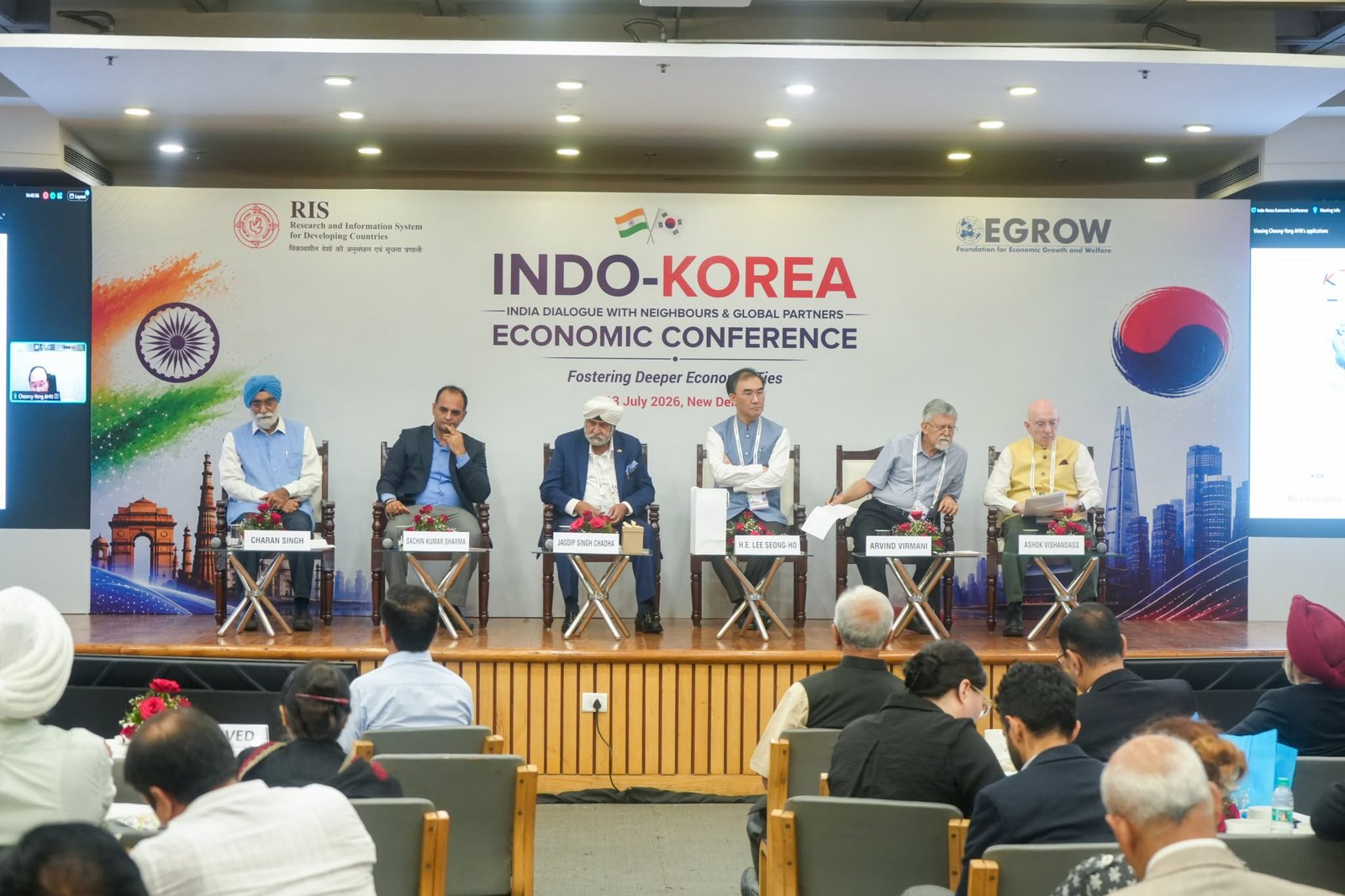
Highlighting the complementary strengths of India and the Republic of Korea, Mr. Jagdip Singh, Honorary Consul General of the Republic of Korea to Chandigarh and Chairman Emeritus of the Sigma Group of Companies, highlighted the immense potential for expanding bilateral cooperation in manufacturing, technology, innovation, and resilient supply chains while addressing the Indo–Korea Economic Conference organised by the Research and Information System for Developing Countries (RIS) in collaboration with the Egrow Foundation in New Delhi.
The conference brought together policymakers, academicians, industry leaders, and strategic experts to deliberate on strengthening the India–Republic of Korea economic partnership amid an evolving global economic landscape.
Welcoming the distinguished gathering, Mr. Singh acknowledged the presence of H.E. Lee Seong-ho, Ambassador of the Republic of Korea to India, alongside senior representatives from academia, industry, and policy institutions.
A Shared Historical Journey
Beginning his address on a historical note, Mr. Singh highlighted a unique bond shared by India and the Republic of Korea. “Both India and the Republic of Korea celebrate their Independence Day on 15 August. Korea regained its independence in 1945, while India attained independence in 1947. This shared milestone reminds us of our common historical journey and aspirations.”
He observed that the historical parallel reflects the resilience and determination of both nations as they emerged as vibrant democracies in Asia.
Five Decades of Diplomatic Relations
Reflecting on the evolution of bilateral relations, Mr. Singh noted that diplomatic ties between India and the Republic of Korea were established in 1973 and have steadily strengthened over the decades.
He recalled that the relationship was elevated to a Strategic Partnership in 2010 and further upgraded to a Special Strategic Partnership during Prime Minister Narendra Modi’s visit to Seoul in 2015.
He also noted that 2023 marked the 50th anniversary of the establishment of diplomatic relations between the two countries, an important milestone that reaffirmed their commitment to expanding cooperation across diverse sectors.
Responding to a Changing Global Economy
Speaking about the current geopolitical and economic environment, Mr. Singh said the India–Republic of Korea partnership is becoming increasingly significant as both countries navigate global uncertainties. “The India–Republic of Korea partnership is evolving within a challenging global economic landscape characterised by increasing geopolitical tensions, rising protectionism, and the growing need for resilient and diversified supply chains.”
He observed that both governments have undertaken comprehensive reviews of bilateral cooperation covering trade, investment, development cooperation, defence, security, science and technology, culture, and people-to-people exchanges.
According to him, new opportunities are emerging in several high-growth sectors, including critical and emerging technologies, semiconductors, green hydrogen, human resource mobility, and resilient supply chains.
Complementary Strengths Driving Growth
Highlighting the economic relationship, Mr. Singh noted that the Republic of Korea has emerged as one of India’s leading investors, with globally recognised Korean companies establishing a significant manufacturing and business presence in the country.
Companies such as Samsung, LG Electronics, Hyundai Motor Group, Kia, POSCO, and Doosan have played an important role in India’s industrial growth, technology transfer, and employment generation. “India offers a vast market, a competitive workforce, a rapidly expanding startup ecosystem, digital innovation, and a strong services sector. The Republic of Korea, on the other hand, brings technological excellence, global manufacturing leadership, advanced research and development capabilities, and world-class vocational and professional training systems.”
He said these complementary strengths create exceptional opportunities for deeper collaboration across manufacturing, advanced technology, innovation, and industrial development.
Addressing Trade Imbalances
While acknowledging the significant progress made in bilateral economic engagement, Mr. Singh also pointed out that challenges remain.
He observed that India continues to record a substantial trade deficit with the Republic of Korea, making it important for both countries to work towards a more balanced, sustainable, and mutually beneficial economic relationship. “I firmly believe that the common values shared by our two nations, including democracy, human rights, and the rule of law, provide a strong foundation for strengthening our partnership in the years ahead.”
Building Global Competitiveness Together
Mr. Singh expressed confidence that the conference would generate practical recommendations for expanding bilateral cooperation and enhancing global competitiveness.
He emphasised that the industrial structures of India and the Republic of Korea complement each other remarkably well, offering significant opportunities for joint growth across strategic sectors. “These complementary strengths create tremendous opportunities for collaboration across a wide range of sectors, generating mutual prosperity and shared growth.”
He further said the conference could serve as a catalyst for promoting sustainable manufacturing, innovation, and technology adoption. “I hope this initiative will serve as a strong platform for promoting sustainable manufacturing, innovation, and the exchange of best practices in resource efficiency, environmental compliance, workforce development, and technology adoption.”
Looking Ahead
Concluding his address, Mr. Singh expressed optimism that the conference would pave the way for future collaborations between India and the Republic of Korea. “I wish this initiative every success and hope its outcomes will inspire many similar initiatives in the future.”
As India and the Republic of Korea continue to deepen their Special Strategic Partnership, the conference reaffirmed the shared commitment of both countries to leveraging their complementary strengths in manufacturing, technology, clean energy, innovation, and resilient supply chains, contributing not only to bilateral prosperity but also to regional and global economic resilience.


Leave a Reply