

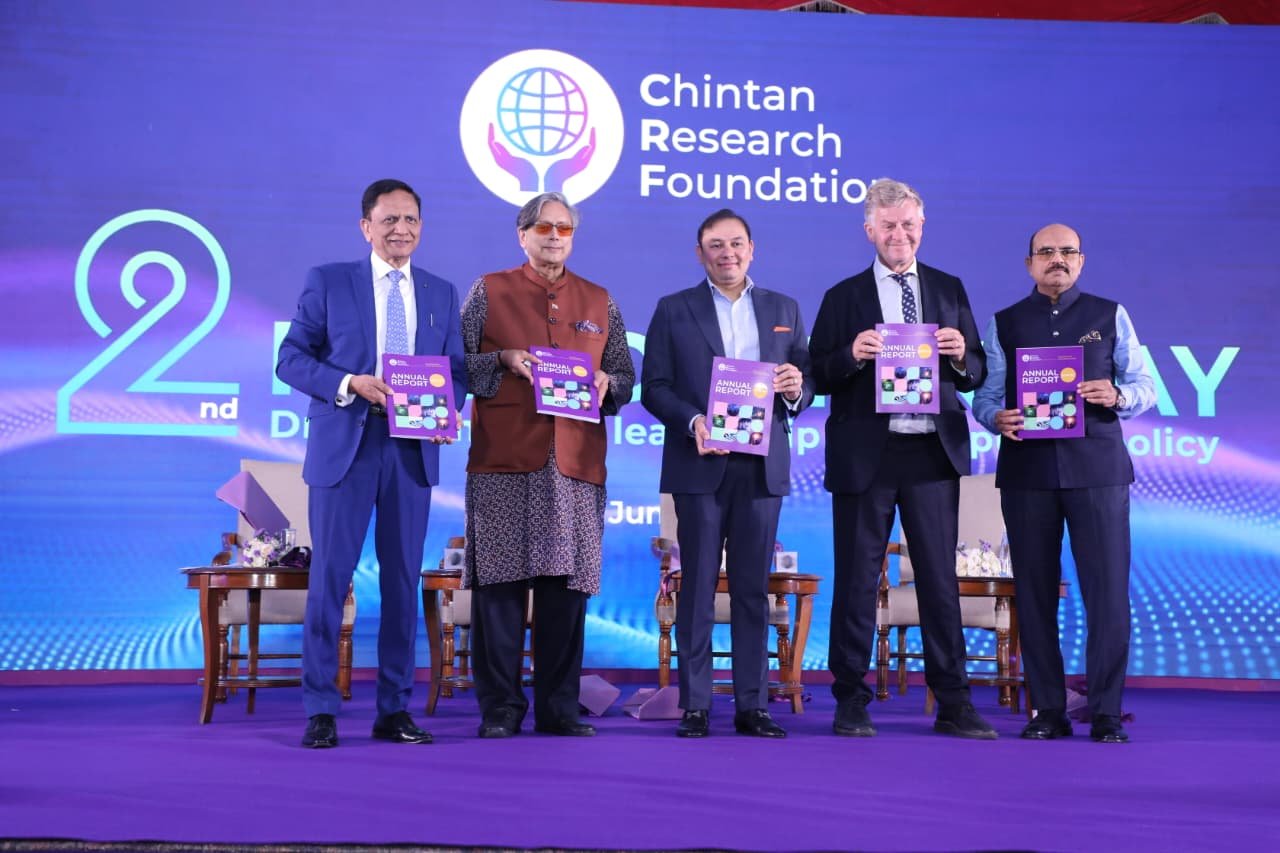
As India advances towards its Vision 2047 aspiration of becoming a developed nation, policymakers must invest not only in physical infrastructure but also in what may be called “intellectual infrastructure”: institutions that generate ideas, challenge assumptions, anticipate future risks and support evidence-based decision-making. This was the central message that emerged from the Foundation Day celebrations of the Chintan Research Foundation (CRF) held in New Delhi.
The event brought together policymakers, diplomats, industry leaders, academics, researchers, and members of the media to discuss the growing importance of ideas, institutions and long-term thinking in an era marked by rapid technological change, geopolitical uncertainty, climate challenges, and economic transformation.
Addressing the gathering, Shri Pranav Adani, Director, Adani Enterprises, said that as nations become more influential, the challenges before them also become more complex. Energy security, climate transition, artificial intelligence, demographic change, urbanisation, water stress, and geopolitical competition are increasingly interconnected, requiring policymakers to adopt a more integrated and long-term approach to decision-making.
Shri Adani emphasised that countries must invest in “intellectual infrastructure” as seriously as they invest in physical infrastructure. He noted that institutions capable of looking beyond immediate headlines, challenging conventional assumptions, identifying emerging risks, and connecting developments across sectors would play a critical role in helping societies navigate uncertainty and sustain long-term growth.
Earlier, welcoming the guests, Shri Shishir Priyadarshi, President of the Chintan Research Foundation, reflected on the profound transformations reshaping the global landscape. He observed that geopolitical competition is intensifying, technological disruption is altering the nature of work and governance, climate change is increasingly affecting economies and societies, and international institutions are facing growing pressures in a rapidly changing world.
Shri Priyadarshi noted that periods of global transition place a premium on ideas, institutions, and informed debate. “As India assumes a larger role in shaping the global order, the country needs institutions that can combine intellectual honesty with strategic clarity and practical solutions. Ideas matter most when the world becomes uncertain,” he said. He added that think tanks have a critical role to play in helping policymakers, businesses and citizens better understand the complex choices that will shape the country’s future.
Delivering the keynote address, Mr Erik Solheim, former Minister of Climate and Environment of Norway and internationally recognised sustainability leader, highlighted the importance of combining economic growth with environmental stewardship. He stressed that countries that successfully align development objectives with sustainability goals would be best positioned to thrive in the decades ahead and underlined the importance of innovative policy thinking and international cooperation in addressing shared global challenges.
The event featured discussions on the intersections between economic growth, technology, sustainability, geopolitics, and social development, and on the need for institutions capable of generating practical and forward-looking policy solutions.
Dr Shashi Tharoor, Member of Parliament and a special invitee at the event, said that CRF has arrived at the exact moment when India needs institutions capable of thinking clearly about a world that is changing with dizzying speed, certainly faster than our traditional categories for understanding this change. By integrating practical industry insights into advocacy and governance, India should ensure that policy is neither formulated in an ideological vacuum nor left to the whims of short-term transnationalism.
The event reinforced a growing recognition that in the twenty-first century, nations will compete not only through capital, technology, and infrastructure, but also through the strength of their ideas, the quality of their institutions and the resilience of their intellectual ecosystems.


Leave a Reply