

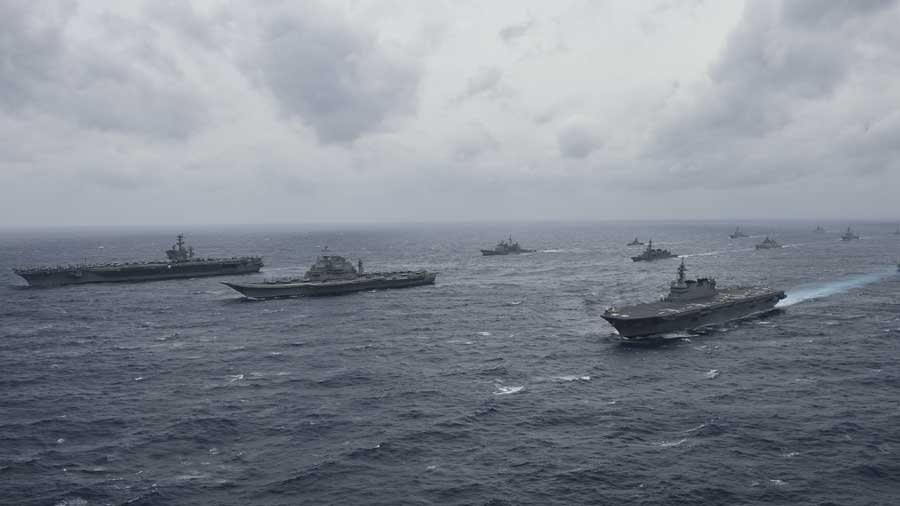
Maritime security is a cornerstone of the India–Japan partnership, bound up with territorial integrity and the stability of critical sea lines of communication.[1] The relationship has moved from rudimentary intelligence exchange towards joint capability development, driven by the imperative of a regional balance of power as China advances its maritime presence across the East and South China Seas. That movement is an evolving objective rather than an accomplished outcome. The distinction is analytically important: information sharing is evidenced by formal agreements, liaison arrangements, participation in information-fusion networks and a shared operational picture, whereas joint capability development requires co-design, joint research and development, co-production or fielded interoperable systems. On these indicators, the record shows progression in ambition and institutional coordination rather than completed, jointly developed naval technologies or fully harmonised doctrines.[2]
Strategic Context
Both governments read the Indo-Pacific as a space of territorial disputes, assertive revisionism and vulnerable supply chains, and both see the need for a coordinated response to China’s ambition to control vital waterways. Their alignment joins India’s Act East policy to Japan’s Free and Open Indo-Pacific vision, resting on the Special Strategic and Global Partnership and, institutionally, on the 2013 Joint Working Group and the 2015 Agreement on the Transfer of Defence Equipment and Technology.[3] It is nonetheless a selective, issue-based alignment, underpinned by the 2008 security declaration, the 2015 agreement, the GSOMIA and recurring exercises, rather than a mutual-defence obligation.[4]
Grey-zone coercion, including growing incursions by foreign coast guard vessels into disputed waters, demands persistent presence and stronger joint capacity to secure the sea lanes. Japan’s reliance on Pacific and Indian Ocean maritime lifelines parallels India’s concern for its offshore assets and the integrity of its Exclusive Economic Zone, and both economies would suffer severe socio-economic disruption if the Indian Ocean were destabilised.[5]
Information Sharing
Information sharing is the older and more mature strand, though it too remains partly aspirational. The Quad’s 2024 Maritime Initiative for Training in the Indo-Pacific (MAITRI) links access to shared maritime information with training and operational capacity. Its creation is cooperative institutional activity rather than a completed capability: India was scheduled to host the first workshop in 2025.[6]
On the Indian side, the Information Fusion Centre–Indian Ocean Region, run jointly by the Indian Navy and the Coast Guard, integrates maritime information in support of regional domain awareness. Maritime domain awareness (MDA) fuses vessel-tracking data, patrols and human-source intelligence into trend analyses that help identify piracy, trafficking and illegal, unreported and unregulated fishing before escalation.[7] Machine learning and predictive analytics may refine such work, but they still require liaison networks and recurring personnel exchanges to validate automated insight. Effective information sharing therefore depends on manual validation and established working relationships as much as on technical compatibility. A shared picture of the sea is not the same as an ability to act on it jointly.[8]
Joint Capability Development
The partnership is shifting from procurement towards collaborative research and development, but this should be treated cautiously. Credibility depends on overcoming the pricing, technology-transfer, industrial-participation and bureaucratic obstacles that delayed the US-2 amphibious aircraft; the US-2 and Soryu-class submarine programmes remained under negotiation, without official transfer, as of 2024. Research links between India’s DRDO and Japan’s JAXA and ATLA give the relationship an institutional base, but cooperation is best characterised as institutionalised research and ongoing negotiation rather than delivered co-development. Progress is more visible at component level. The transfer of Japan’s UNICORN naval communication antenna was the first bilateral defence-equipment sale and technology transfer under the 2015 agreement, a more concrete baseline than earlier, largely aspirational negotiations, though it should not be conflated with completed co-development or large-scale co-production. Underwater cooperation, unlike platform-level transfers, is more likely to advance through phased joint research, modular dual-use technologies, private-sector participation and defined intellectual-property arrangements.[9]
Reconciling India’s ‘Make in India’ mandates with Japan’s cautious transfer posture remains the main hurdle to joint production lines. A dedicated bilateral defence-industrial platform, standardising regulatory frameworks and aligning quality standards and certification, would help integrate Indian manufacturers into Japanese supply chains.
Naval exercises build the trust on which more ambitious initiatives depend. JIMEX, PASSEX and counter-piracy engagements allow officers to compare command structures, rehearse complex scenarios and form personal relationships and familiarity with each other’s procedures.[10] Interoperability should therefore be assessed not only through demanding tactical scenarios but through the continuity of liaison relationships. This ‘soft interoperability’ may matter as much as technical standardisation.
Implementation Challenges
The agenda is constrained by disparities in naval modernisation and by the tension between New Delhi’s operational autonomy and Tokyo’s integration into alliance-based deterrence. Japan’s restrictive export regime and India’s demand for substantial technology transfer expose a recurring gap between political aspiration and operational delivery. This autonomy–alignment dilemma is characteristic of middle-power cooperation, and it explains why the Quad and Malabar, which offer flexible, issue-specific coordination without binding alliance commitments, suit both partners.[11]
Operationally, the bilateral record documents regular PASSEX, JIMEX and counter-piracy exercises, but it does not establish that differences in rules of engagement have specifically prevented joint tasking. The better-documented constraint is the incomplete integration of the GSOMIA and the 2020 ACSA into a standing mechanism for classified, time-sensitive data exchange, set against India’s strategic autonomy.[12]
Deepening cooperation will also draw differentiated regional responses. China may read closer coordination as a deterrence signal, although both partners avoid framing the relationship as a formal anti-China alliance. ASEAN states may welcome public security goods, such as maritime awareness and disaster relief, yet remain wary that intensified minilateral activity could weaken ASEAN centrality or draw them into sharper competition. Framing cooperation around freedom of navigation, international law and capacity-building, and linking it to ASEAN-led forums and the Indo-Pacific Oceans Initiative, moderates such concerns. Two strands should be distinguished: humanitarian assistance, coastguard training and information sharing are reassuring public goods, whereas undersea systems and defence-technology transfers carry deterrent intent.[13]
Conclusion
The transition from information sharing to joint capability development marks a strategic maturation of the partnership. Early consolidation of maritime domain awareness and non-traditional security collaboration has given way to moves towards advanced naval integration and defence-industrial cooperation, exemplified by the antenna transfer under the 2015 agreement.[14] Future progress will depend on deepening synergies in dual-use technologies such as underwater autonomous systems and persistent satellite surveillance, and on codifying logistics arrangements so that technological synergy becomes operational readiness. Synchronising naval modernisation would allow both states to hedge against asymmetric threats within a stable order rooted in shared adherence to international maritime law.
Two cautions follow. First, ambition should not be mistaken for delivery: agreements, dialogues and exercises are necessary conditions for joint capability development, not evidence that it has been achieved. Second, the more sensitive the technology, the more the partnership will depend on political trust and on the patient work of liaison and standard-setting, rather than on any single platform or headline transfer.
[1]G. S. Khurana, ‘Security of Sea Lines: Prospects for India–Japan Cooperation’, Strategic Analysis 31(1), 2007, pp. 139–153.
[2]M. Chakraborty, ‘Navigating the Contours of Maritime Defence Cooperation between India and Japan: Impulses, Challenges and Opportunities’, Maritime Affairs: Journal of the National Maritime Foundation of India 16(2), 2020, pp. 106–118.
[3]C. W. Hughes, ‘Japan’s Emerging Arms Transfer Strategy: Diversifying to Re-centre on the US–Japan Alliance’, The Pacific Review 31(4), 2017, pp. 424–440; Y. P. Thi, ‘India–Japan Defense Partnership in the Indo-Pacific: Geopolitical Prospects and Challenges Under Trump’, Journal of Liberty and International Affairs 11(3), 2025, pp. 16–42.
[4]E. Atanassova-Cornelis, ‘Alignment Cooperation and Regional Security Architecture in the Indo-Pacific’, The International Spectator 55(1), 2020, pp. 18–33.
[5]Khurana (2007), as in note 1.
[6]R. Mizo and J. S. Hauger, ‘Climate Change and Maritime Security: Challenges and Prospects for Cooperation for the Quad’, Japan Focus 23, 2025.
[7]M. Kumar, ‘Addressing Maritime Security Challenges through Maritime Domain Awareness: A Study of the Role of the Information Fusion Centre–Indian Ocean Region’, Australian Journal of Maritime & Ocean Affairs 18(1), 2024, pp. 21–36.
[8]J. P. Morrissey, The Development of U.S.-Led Maritime Interoperability in Southeast Asia: SEACAT Exercise, 2002 to 2024 (Naval Postgraduate School, 2025).
[9]Hughes (2017) and Thi (2025), as in note 3.
[10]C. W. Hughes, A. Patalano and R. Ward, ‘Japan’s Grand Strategy: The Abe Era and Its Aftermath’, Survival 63(1), 2021, pp. 125–160; on soft interoperability, Morrissey (2025), as in note 8.
[11]R. Mukherjee, ‘Japan’s Strategic Outreach to India and the Prospects of a Japan–India Alliance’, International Affairs 94(4), 2018, pp. 835–859; on export controls and technology transfer, see also Chakraborty (2020), note 2, and, on the Quad and Malabar, Thi (2025), note 3.
[12]Thi (2025), as in note 3.
[13]Thi (2025), as in note 3.
[14]J. V. John, ‘India, Japan and the Indo-Pacific: Evolution, Consolidation and Limitations of the Strategic Partnership’, Journal of Asian Security and International Affairs 11(4), 2024, pp. 515–535; on the antenna transfer, Thi (2025), as in note 3.



Leave a Reply