

As Asia races to decarbonise, two complementary realities are reshaping the region’s energy geopolitics: India needs roughly US$42 billion (₹3.49 trillion) in battery storage by 2032 to keep its power grid stable, while Japan is looking to loosen China’s stranglehold over clean-energy supply chains. India’s clean energy transition is facing challenges on many front and with a heavy reliance on Chinese-monopolised markets, fluctuating battery prices, and a weakening rupee, the clean energy sector faces supply chain risks for critical minerals like lithium, cobalt, and nickel, essential for solar panels and electric vehicles. Additionally, power infrastructure, including grids and smart meters are unable to cope with unprecedented peak power demand, as ‘evening demand’ has been spiking when solar power starts to drop.
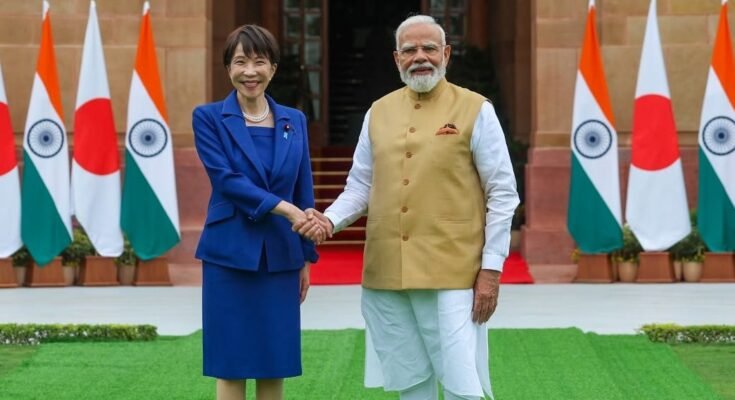
Against this backdrop, POWERR Asia, an emerging regional initiative introduced by Japan, may offer a timely avenue to overcome India’s specific supply chain, grid, and storage hurdles. Japan’s US$10 billion POWERR Asia initiative offers India a vital clean-energy force multiplier. At its core, the platform is designed to bridge the gap between cushioning immediate fuel shocks and financing long-term structural grid transitions across the region. Crucially, by launching the initiative through an expanded Asia Zero Emission Community (AZEC) framework, Tokyo has created a multilateral mechanism to bring non-AZEC partners into its regional energy architecture. This means non partners like India can now gain access to a $10 billion funding pool backed by the Japan Bank for International Cooperation (JBIC) and the Japan International Cooperation Agency (JICA), both of which offer long-term, low-interest loans.
For Japan, which lacks domestic land for large-scale renewables and seeks to de-risk its supply chains away from China, backing a regional energy initiative like POWERR Asia helps secure future clean fuel imports, industrial export markets, and verified carbon offsets. Through this push, Japan is signalling its global ambition to lead Asia’s clean energy transition by championing diversified fuels like green hydrogen, ammonia, and compressed biofuels, creating a natural opening for India to position itself as a central partner.
India already possesses the renewable resources, market scale, and ambition to lead the region’s clean energy transition. Yet partnering closely with Japan through POWERR Asia can act as an unexpected force multiplier, helping India achieve two critical goals at once: resolving its domestic infrastructure bottlenecks while accelerating its rise as a regional clean-energy powerhouse.
Engaging with such international platforms has also become essential because India’s domestic policy incentives, such as storage subsidies and mandated net-metering have fallen short of resolving deeper structural issues. A core problem is high-paying corporate clients switching to private solar, which starves state distribution companies (DISCOMs) of their primary revenue and leaves them unable to fund costly grid upgrades. Furthermore, the physical grid lacks capacity for two-way power flows, while major smart-meter initiatives like the Revamped Distribution Sector Scheme (RDSS) remain stalled in rural areas due to rigid funding structures. Together, these create an ineffective cycle where financially strained DISCOMs stall new green energy projects, leaving rural microgrids un-upgraded and slowing down the rapid clean-energy expansion India is already driving across the region.
To make POWERR Asia work on the ground, India needs to focus on two clear priorities. Firstly, keep investment-ready projects and speed up approvals so Japanese funding reaches both national power lines and state or local storage facilities. This model already works at the national level. For instance, POWERR Asia’s first project in India, the JBIC-backed Khavda–Nagpur corridor (built for US $492 million)) carries 6,000 MW of wind and solar power from Gujarat into the national grid. Handled by Power Grid Corporation of India Limited, a strong central utility, the project can easily tap Japanese loans while tying grid upgrades to Japanese equipment and supply chains rather than low-cost Chinese imports. The real opportunity now lies in extending that same model downward, ensuring Japanese funding also reaches battery storage (BESS) and state-level grid upgrades.
Secondly, on the clean-fuel front, New Delhi must use POWERR Asia to lock in export markets for its National Green Hydrogen Mission. To achieve this, India and Japan need to establish mutual recognition of green certification standards—easing cross-border logistics and clearing the way for long-term contracts in green hydrogen, ammonia, and biofuels. Early commercial deals between the two countries, such as ACME Group’s agreements to supply green ammonia and methanol from Odisha to Japanese buyers like IHI Corporation and Mitsubishi Gas Chemical, show that demand is already taking shape. Directing POWERR Asia’s policy coordination and financial backing toward shared certification rules and port upgrades is essential if India wants to scale these early deals into a reliable regional supply chain.
Beyond major transmission projects and increasing clean fuels exports, POWERR Asia can also help India localize clean-tech manufacturing and unlock grassroots financing. Rather than relying on imported components, Japanese firms can transfer advanced manufacturing processes to Indian factories to mass-produce grid equipment and non-lithium batteries locally. This co-development is commercially viable for both nations because Japan gains a cost-competitive manufacturing hub outside China, while India builds domestic industrial capacity backed by guaranteed domestic demand.
India can also deploy POWERR Asia’s credit mechanisms to shield commercial banks and unlock private financing for decentralized rooftop solar and smart-grid upgrades. While Reserve Bank of India (RBI) rules strictly cap commercial First-Loss Default Guarantees (FLDG) at 5% for standard lending partners, sovereign and bilateral institutions like JBIC and JICA are exempt from this ceiling. Channelling Japanese credit guarantees through established state lenders like the Power Finance Corporation (PFC) can protect commercial banks against early defaults in grid storage and green hydrogen projects. This same sovereign backing can also ease the collateral and underwriting bottlenecks slowing down PM-KUSUM and PM-Surya Ghar, India’s flagship solar subsidy schemes. By partnering with apex institutions like SIDBI and IREDA to pair low-cost Japanese credit lines with domestic credit-guarantee trusts, New Delhi can shield commercial lenders against early defaults by small solar developers and accelerate decentralized adoption. Lower borrowing costs may offer an alternative to developers to install the bidirectional power lines and smart meters that cash-strapped DISCOMs cannot afford.
Pairing these credit guarantees with Japanese smart-grid automation and monetising emissions reductions through the bilateral Joint Crediting Mechanism (JCM) can also generate steady revenue to keep rural microgrids well-maintained. Aligning grid guarantees and green certification can turn bilateral pledges into seamless clean-energy trade.
Even with strong political momentum, turning POWERR Asia’s promise into large-scale execution will face real institutional and physical hurdles. While central utilities like POWERGRID can easily absorb Japanese loans, financially strained DISCOMs lack the creditworthiness and project-preparation capacity to tap this financing—meaning funds could remain concentrated in big interstate lines rather than reaching local grids. Similarly, POWERR Asia’s clean-fuel ambitions risk stalling if port-side storage and export infrastructure fail to keep pace with production. Compounding these physical bottlenecks, India and Japan have yet to establish mutual recognition for their green hydrogen and ammonia certification schemes, which could create compliance friction and slow down cross-border trade.
Ultimately, POWERR Asia offers India and Japan a rare chance to build a resilient, non-Chinese clean-energy architecture across the Indo-Pacific. Pairing Japan’s low-cost capital and engineering muscle with India’s vast renewable scale can ease critical supply-chain risks and stabilise India’s evening power crunch—provided both capitals back diplomatic ambition with practical regulatory follow-through.


Leave a Reply