

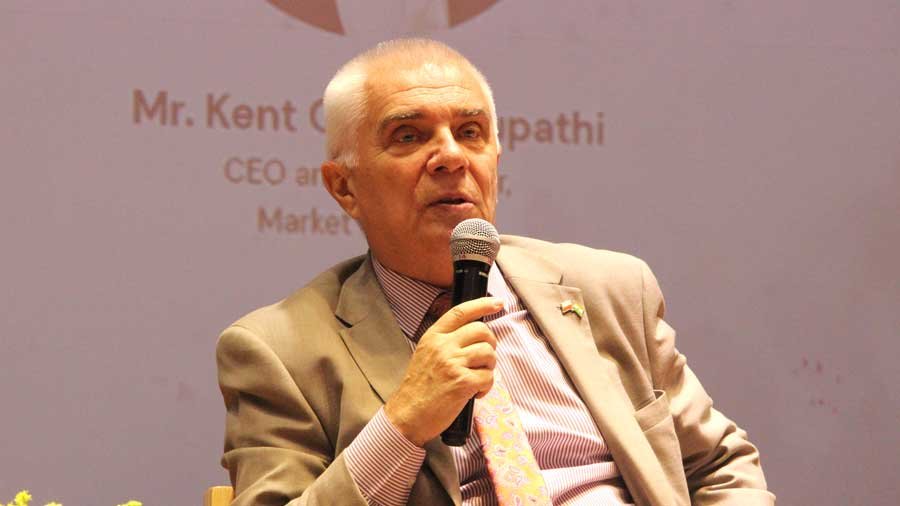
At the India–EU Diplomatic Dialogue, Poland’s chargé d’affaires a.i. Dr Piotr Antoni Świtalski called for a broader partnership with India, emphasising connectivity, advanced technology, green innovation and cooperation on global governance.
The India–European Union free trade agreement represents more than a commercial arrangement. It is an opportunity to establish a more ambitious relationship between two major economic partners at a time of global uncertainty. H.E. Dr Piotr Antoni Świtalski, chargé d’affaires a.i. of the Republic of Poland in India, spoke at the India–EU Diplomatic Dialogue organised by Diplomatist Magazine at Symbiosis International (Deemed University), Noida, on 15 October 2026.
Describing the agreement as the beginning of a new journey, Dr. Świtalski emphasised its wider significance in providing stability and predictability amid international turbulence. He encouraged Indian audiences, particularly students, to view Europe not merely as a destination for travel, but as a long-term partner for economic, technological and political cooperation.
Poland’s experience of European integration
Drawing on Poland’s experience as an EU member since 2004, Dr. Świtalski described European integration as a source of economic opportunity and institutional security. He highlighted Poland’s economic progress and the role of EU membership in strengthening the country’s confidence and position within the European economic framework.
For him, the significance of integration lies not simply in financial transfers or market access, but in the broader network of cooperation and stability it creates.
He urged India and the EU to approach their free trade agreement with a similarly expansive outlook. As he put it, the agreement should be a “floor, not the ceiling” of their relationship. Trade liberalisation, he argued, should provide the foundation for cooperation in technology, investment, security and global governance.
The agreement’s potential, he suggested, would be realised when businesses and investors on both sides identified opportunities to work together and when economic ties were reinforced by wider strategic engagement.
India–Poland ties: expanding the agenda
Dr. Świtalski highlighted the strategic partnership established between India and Poland in 2024, describing the bilateral relationship as mutually reinforcing the broader India–EU framework.
He expressed the hope that bilateral trade, which he placed at approximately US$6 billion, could double before 2030. He identified defence, space, artificial intelligence, high technology and the green economy as areas offering considerable scope for cooperation.
Polish companies, he explained, were interested not only in selling products in India but also in developing partnerships with Indian counterparts. He referred to opportunities in hydrogen and green ammonia technologies, battery recycling and other green-economy solutions.
Space cooperation was another promising area. Dr. Świtalski referred to the participation of Indian and Polish astronauts in an Axiom Space mission as a symbolic illustration of the potential for closer engagement. He also highlighted prospects for cooperation between national space agencies and for joint work in satellite monitoring.
Medical technology offered another example of existing collaboration. He cited Polish companies working with Indian partners in AI-enabled diagnostics, suggesting that such ventures could provide a foundation for further technological exchange.
Connectivity as an economic priority
Beyond technology and trade, Dr. Świtalski stressed the importance of physical connectivity. Disruptions to transport routes, particularly amid instability in West Asia, demonstrated how logistics could affect the competitiveness of international trade.
He called for greater attention to the India–Middle East–Europe Economic Corridor (IMEC) and its potential extensions towards the Baltic and Nordic regions, as well as Moldova. He also highlighted the importance of direct air links in supporting business exchanges and strengthening people-to-people contacts.
Connectivity, he argued, must be treated as a strategic priority if the benefits of trade liberalisation are to translate into reliable commercial relationships.
A wider global partnership
Dr. Świtalski ultimately placed the India–EU relationship within the wider debate on global governance. He called for closer cooperation in reforming international institutions and acknowledged India’s growing role in shaping the global order.
For Poland, he suggested, India is not simply an expanding market but a long-term partner across political, economic, cultural, educational and tourism-related fields.


Leave a Reply