

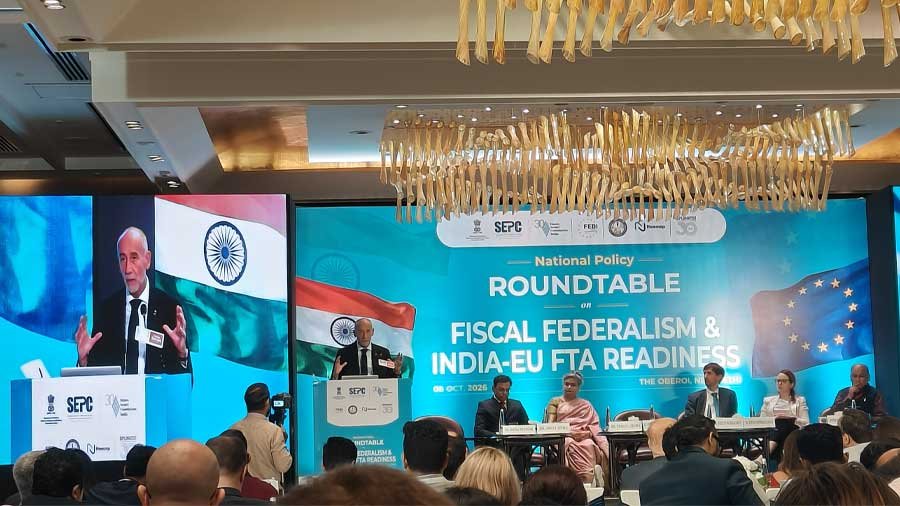
At the National Policy Roundtable on Fiscal Federalism and India–EU FTA Readiness in New Delhi, H.E. Jean-Eric Paquet, Ambassador of the European Union to India and Ambassador-designate to Bhutan, emphasised that the conclusion of the landmark trade agreement is only the beginning. Its success, he said, will depend on effective implementation across governments, states, businesses and institutions.
The conclusion of the India–European Union Free Trade Agreement (FTA) negotiations represents a major political and economic milestone in the relationship between India and Europe. But according to H.E. Jean-Eric Paquet, Ambassador of the European Union to India and Ambassador-designate to Bhutan, the real challenge now lies in turning the agreement into tangible opportunities for businesses, investors, workers and consumers.
Speaking at the National Policy Roundtable on Fiscal Federalism and India–EU FTA Readiness, held in New Delhi on 6 October, Ambassador Paquet underlined the importance of preparing for the implementation of the agreement across India’s complex federal structure and throughout the European Union.
The roundtable, organised by the Services Export Promotion Council (SEPC), in association with the Hanns Seidel Foundation India, Federation of European Business in India, KMC, NEECOP and The Diplomatist, brought together policymakers and stakeholders to examine India’s readiness for the next phase of India–EU economic relations.
Ambassador Paquet began by acknowledging the significance of the agreement and the extensive effort that went into reaching it. India and the EU announced the conclusion of negotiations in January 2026 following years of negotiations and the formal relaunch of talks in 2022. The Government of India described the agreement as a major milestone in one of India’s most strategic economic partnerships.
“It has been, I think, a major political achievement between the relationship of India and Europe.”
He noted that the political momentum behind the agreement had developed considerably over the preceding two years, with high-level engagement helping both sides demonstrate their willingness to negotiate meaningfully.
For Ambassador Paquet, however, the scale of the agreement means that implementation cannot be treated as a purely central-government exercise.
He stressed that governments, administrations, fiscal authorities, businesses and other stakeholders across Indian states and Union territories would all have a role to play. Equally, implementation would require engagement with the EU’s Member States and their respective economic ecosystems.
This federal and multi-level dimension, he argued, makes forums such as the roundtable particularly important. Indian businesses need to understand what the agreement means for individual markets, while European companies need to understand the opportunities and regulatory realities across India’s states.
From Negotiation to Execution
The India–EU FTA offers extensive market access. According to the Government of India’s official factsheet, the EU’s commitments cover almost 97 percent of tariff lines and more than 99 percent of India’s export value, with immediate duty elimination covering 90.7 percent of India’s export value and additional products receiving phased liberalisation.
For Ambassador Paquet, these figures matter, but they are only meaningful if businesses are prepared to use the opportunities they create. “The key process is ensuring that all actors in all sectors, in goods as well as services, are fully aware of the agreement and how it is set out, so that they can anticipate the opportunities.”
The agreement is expected to create opportunities across a wide range of sectors. Indian exporters stand to benefit from improved access for labour-intensive sectors such as textiles, leather, footwear, marine products, tea, coffee, spices, gems and jewellery, among others. The agreement also contains significant commitments relating to services and professional mobility.
At the same time, European businesses will gain greater access to the Indian market, including in sectors where European expertise and investment can contribute to India’s economic transformation.
Amb Paquet emphasised that the FTA should therefore be viewed not simply as a tariff agreement, but as a framework capable of supporting deeper economic integration.
Building a Common Economic Space
The Ambassador also placed the agreement in a wider geopolitical context. At a time when global trade is becoming increasingly fragmented and supply chains are being reassessed, he argued that India and Europe have an opportunity to build a more reliable and predictable economic relationship. “This is much more than just trade.”
The FTA, he suggested, can contribute to the creation of a broader economic space linking Indian and European markets, supply chains, logistics, investment and technology.
Trade and investment, in his view, cannot be considered separately. Greater market access will require efficient logistics and supply chains, while stronger supply chains will themselves depend on investment in infrastructure, technology and production capacity.
The relationship already has a substantial economic foundation. Government data puts India–EU merchandise trade at USD 136.54 billion in 2024–25, with Indian exports to the EU at USD 75.85 billion. India–EU services trade stood at USD 83.10 billion in 2024.
The States Will Matter
A significant part of Amb Paquet’s remarks focused on the role of India’s states. While the FTA is negotiated at the national level, its economic impact will be experienced across India’s states and Union territories. Businesses operate through state-level ecosystems, infrastructure, taxation, logistics, skills and regulatory environments.
This makes fiscal federalism particularly relevant to the implementation of the FTA.
Amb Paquet pointed to the importance of ensuring that domestic taxation and regulatory frameworks support, rather than undermine, the opportunities created through greater international market access. He also highlighted the need for continued dialogue between administrations and businesses to identify practical implementation challenges early.
The EU, he indicated, is prepared to work with Indian institutions and stakeholders as the agreement moves towards implementation.
A Call to Businesses: Prepare Now
Perhaps the strongest message from Ambassador Paquet was directed towards businesses.
The FTA may still require further procedural steps before it enters into force, but companies should not wait until that moment to begin preparing. The conclusion of negotiations in January 2026 was followed by legal review and other formal processes before the agreement can become operational.
“Now is the time. You don’t wait for it. You are supposed to look at your suppliers, to look at your future markets, to find your partners, because investors.”
Businesses, he argued, should already be examining their supply chains, identifying prospective European partners, studying market opportunities and understanding the requirements that will determine whether they can take advantage of preferential access once the agreement comes into force.
For policymakers, the task is equally clear: build the institutional, administrative and digital infrastructure necessary to make the agreement work efficiently.


Leave a Reply