

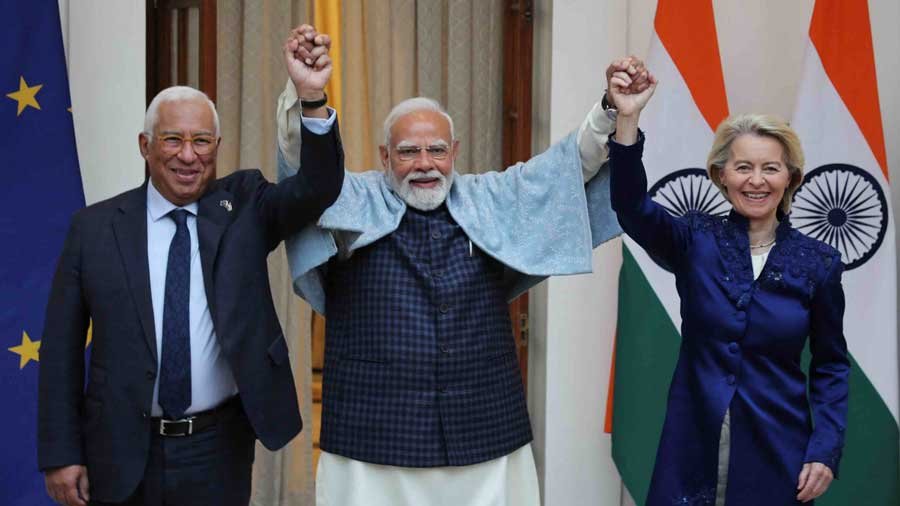
In January 2026, President António Costa and President Ursula von der Leyen attended Republic Day celebrations in India as the European Union’s first-ever Chief Guests (Ministry of External Affairs, Government of India, 2026). The visit coincided with discussions that concluded a Free Trade Agreement (FTA) with the EU, proposed in 2007, and two signed documents during the 16th India–EU Summit in New Delhi on 27 January: a Joint Declaration establishing the first India–EU Security and Defence Partnership, “Towards 2030: A New India–EU Joint Comprehensive Strategic Agenda,” and a Joint Statement on the future of India–EU security and defence cooperation (Ministry of External Affairs, Government of India, 2026).
The agreement’s end and the signing of the security declaration are expected to reinvigorate a relationship that, for nearly 20 years, was defined largely by episodic dialogue without a binding agreement. What follows is an account of how these two economic and strategic pillars work together, and the implications of the summit’s results for India as it transitions from negotiations to implementation of the partnership. This article takes a closer look at how that breakthrough works on the ground: India’s services trade and mobility, industrial and research cooperation on critical minerals and innovation, newly formalised security and defence cooperation, and regulatory cooperation on carbon and labour standards. Together, these threads suggest what India’s journey from signature to implementation could entail in the coming years.
Economic and Trade Cooperation
The agreement applies to 96.6 per cent of the tariff lines on India’s territory and 99.3 per cent in Europe; it complements a trade agreement which already accounts for over €180 billion each year and an estimated 800,000 jobs in Europe (European Commission, 2026). EU exports to India currently amount to €15 billion; EU companies are expected to save up to €4 billion in import duties annually, and exports to India could increase by up to €58 billion in the future, according to European Commission projections (European Commission, 2026). Twenty chapters cover digital trade, IP, financial services, telecommunications & mobility of professionals, and a 5-year review mechanism (Department of Commerce, Ministry of Commerce and Industry, Government of India, 2026).
The significance of the agreement for India is more about market access and mobility (which pulled negotiations to a stall in 2013) than a duty reduction, given that rates for duty advantages and access to markets in India were already relatively liberal (Department of Commerce, Ministry of Commerce and Industry, Government of India, 2026). Access to information technology and business process services, along with easier movement for skilled professionals, addresses two of India’s long-held negotiating priorities and provides Indian service exporters with a much stronger footing in the EU market, which they had hitherto lacked (European Commission, 2026).
Industrial and Supply Chain Collaboration
Beyond tariffs, the agreement also enables closer industrial cooperation. India’s manufacturing capabilities have thus looked for partners in machine tools, industrial automation, processes, and power electronics, where European companies already have the requisite experience. The trade agreement carries an industrial flavour, given the embedded joint capacity-building effort by the two countries, namely the National Critical Mineral Mission in India and the ₹500 crore allocated in the state budget to build processing capacity in 2026–27 (Ministry of Mines, Government of India, 2026). The extent to which this means joint ventures, technology transfers, or co-located manufacturing will depend on choices companies and ministries on both sides still need to make. The agreement provides a structure for that cooperation to take shape, where previously it had none.
Technology and Innovation Cooperation
In Brussels, on 15 July 2026, the third ministerial meeting of the India-EU Trade and Technology Council (TTC) agreed to two milestones for the integration of Indian institutions into the new Horizon Europe research and innovation programme that are expected to be achieved by the end of 2026, thus progressing cooperation in relation to research and technological standards (European Commission, 2026). The two sides also inaugurated the first India-EU Innovation Hub on EV charging technology, coordinated in India by the Ministry of External Affairs, the Ministry of Commerce and Industry, and the Ministry of Electronics and Information Technology. The cooperation continues on telecommunications standards, with India’s Bharat 6G Alliance connecting with the EU-based 6G Smart Alliance (Department of Telecommunications, Government of India, 2026).
Among these are the ones with the most long-lasting consequences for India: the association with Horizon Europe would make Indian research institutions part of the European research network on an ongoing basis, as opposed to a one-off collaboration that had just been built because of a political initiative that might fade into a myth through the course of time (European Commission, 2026).
Security and Defence Cooperation
The Security and Defence Partnership signed by High Representative Kaja Kallas and External Affairs Minister S. Jaishankar provides for an annual debate and cooperation on securing maritime space, securing networks, fighting terrorism, and conducting space operations and non-proliferation (European External Action Service, 2026). The deal helps India diversify its defence purchases and codifies a security partnership that had already been maturing into a mode that harmonises with the economic partnership (European External Action Service, 2026). Whether European industry progresses toward technology transfer and co-development or licensed assembly will affect its long-term significance as cooperation deepens.
Regulatory Considerations
Tariff reduction is one facet of the relationship, but another lies in regulatory alignment, where closer alliances could benefit both parties. The agreement does not waive India’s obligation to comply with the EU’s Carbon Border Adjustment Mechanism. Still, it establishes a mechanism for discussion and sets out an agreed provisional path to parity, giving India a formal voice in shaping how the mechanism is applied. The EU deforestation regulation and due diligence directive require coordination with exporters such as India, especially for labour-intensive and metals-related products, which could lead to compliance systems suitable for Indian products as well (European Commission, 2026). India has caught up, updating its Foreign Trade Policy (FTP) in June 2026 to include imports associated with ‘forced labour’ in its prohibition list, as part of the convergence of standards rather than a unilateral decision (Ministry of Commerce and Industry, Government of India, 2026).
Future Outcomes and Way Forward
In September 2026, the European Commission presented its proposals to the Council of the European Union. The deal now goes through a formal procedure: Council adoption, Parliament consent in the EU, Indian ratification, and is expected to enter into force before 2027 (European Commission, 2026). Together, the summit’s outcomes give both India and the EU gains on several fronts. The agreement eases the movement of skilled workers and gives service exporters access to EU and Indian markets (Department of Commerce, Ministry of Commerce and Industry, Government of India, 2026). Manufacturers and mineral processors gain a framework for industrial cooperation beyond tariffs (Ministry of Mines, Government of India, 2026). Research institutions connect to a broader network of innovation across India and Europe (European Commission, 2026).
For the first time, India and the EU have a formal security relationship covering maritime security, cyber security, counter-terrorism, and space (European External Action Service, 2026). India’s proactive stance on closer coordination of regulations on carbon, deforestation, and labour standards also signals its desire to help shape these rules (European Commission, 2026; Ministry of Commerce and Industry, Government of India, 2026). The summit’s significance was that both sides agreed to economic and security cooperation as a partnership of equals, not merely a one-off trade agreement. The success will depend on continued work on technology, industry, and security over the coming years, leading up to ratification.
References



Leave a Reply