

There was a time when India and China had learnt to agree to disagree without derailing their entire relationship. The 1993 Agreement on Peace and Tranquillity, followed by the 1996 military confidence-building agreement, and several other agreements and mechanisms had ensured ‘peace and tranquillity’ on the Line of Actual Control while postponing the impossible question of border settlement. Both had agreed to move forward with bilateral trade, diplomacy and multilateral cooperation even as the resolution of their boundary dispute awaited.
That equilibrium built since the 1980s stood shattered in June 2020. The ‘peace and tranquillity’ format ceased to be merely one compartment of bilateral relations. India’s new formulation became more assertive: relations could not be normal as long as the border was not normal. Then, the October 2024 Modi-Xi meeting at Kazan reversed that rupture. The understanding on in Depsang and Demchok — the last two of the post-2020 friction points — started their military disengagement. But disengagement has not moved to de-escalation, and certainly not to the old confidence-building architecture.
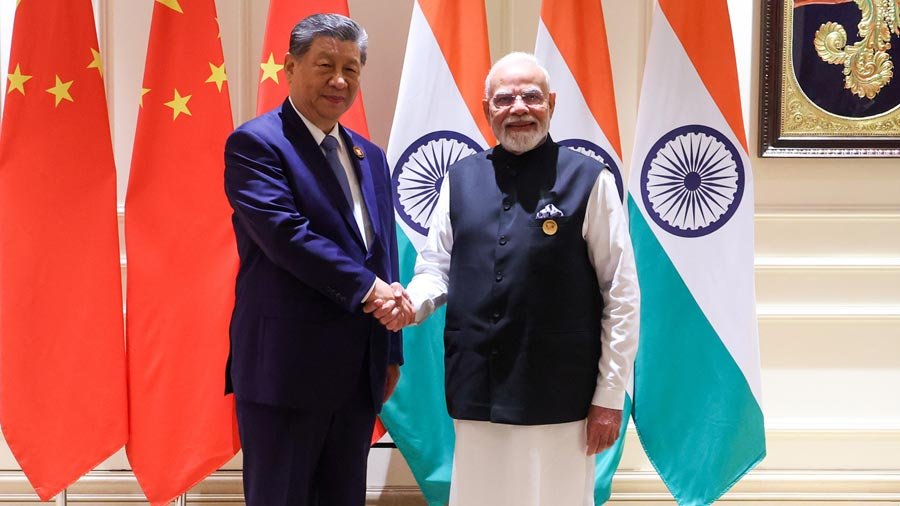
This is where the Modi-Xi meeting of September 12, 2026 and President Xi reiterating his vocabulary of ‘strategic and long-term’ and stressing that India-China are ‘developmental partners, not rivals’ becomes important. PM Modi, though, underlined that peace and tranquillity on the border remains a prerequisite for normalisation. Yet, both repeated their commitment to ‘mutual respect, mutual sensitivity and mutual interest ’, that ‘differences should not become disputes’ while hoping for a ‘fair, reasonable and mutually acceptable’ boundary settlement.
Trade Tells the Truth
Other than border questions, the most revealing evidence of their managed competition lies not in their optics and photographs but in their bilateral trade. India-China goods trade reached $151.1 billion in 2025-26, making China India’s largest trading partner. India’s imports from China were $131.63 billion against exports of only $19.47 billion, producing a $112.16 billion deficit. Indian exports did rise by about 37 percent but from such a low base that the deficit nevertheless widened.
This asymmetric interdependence has strategic implications. Chinese machinery, electronics, components, chemicals and other industrial inputs are deeply embedded in Indian manufacturing. India’s problem is not simply how to buy less from China. It is how to build faster and bigger without discovering that the very industrialisation intended to reduce dependence on China requires more of the Chinese inputs.
This is not ‘technology competition’ as China is far ahead of India across much of the technological and manufacturing spectrum. Thus India’s challenge lies in managing this asymmetric interdependence — from electronics and machinery to pharmaceuticals, solar equipment and other critical manufacturing inputs. Consequently, China’s language of ensuring ‘meaningful and predictable market access’ for India seems promising.
Competition Without Confrontation
India-China interests overlap, intersect and sometimes collide without necessarily producing a zero-sum contest. China does not see India as a rival, but India remains concerned about China’s expanding economic and military presence across the Indo-Pacific region. Beijing’s ports, connectivity projects, commercial footprint and maritime activities inevitably impact India’s security calculus. This is precisely why ‘managed competition’ remains a better description of their equations than either ‘strategic rivalry’ or ‘strategic partnership’.
There is another paradox. India’s China post-2020 policy seeks to restore deterrence. But India’s economic transformation requires access to the Chinese industrial ecosystem. This contains an uncomfortable contradiction: India wants less dependence on China without being able to reduce the economic importance of China. Decoupling therefore is not the answer. It is more likely to be in selective diversification, resilience and carefully calibrated economic engagement.
Tibet remains another sticking point. The Tibetan issue is not merely historical baggage: it touches India’s border geography. Yet, in spite of sensitivities over sovereignty, pilgrimage and trans-border exchanges, reopening of the Kailash-Mansarovar pilgrimage and border-trade points demonstrates new symbolism. The same logic applies to trans-border rivers and people-to-people contacts. These will be no grand breakthroughs; only small stitches through which a torn relationship can gradually be repaired.
From Thaw to Tactical Reset
The strongest evidence that more than a temporary pause may be developing had come even before Xi’s Delhi visit. At the 25th round of Special Representatives’ talks in Beijing in August 2026, both sides agreed to strengthen border-management mechanisms, add military meeting points and hotlines, improve communication along the LAC, and work for a new formulation of ‘early and substantial harvest’ in boundary delimitation.
But it is not yet a return to the confidence-building environment of the 1990s. Strategic circumstances have changed dramatically. Both countries now possess much better infrastructure, faster mobilisation and greater military capabilities along their frontier. The improvements that make the border more defensible also make incursions much more frequent.
The task is no longer merely to prevent armies from stumbling into confrontation. It is to construct mechanisms capable of managing a far more militarised and rapidly mobilisable frontier. That makes the Modi-Xi meeting important, though not transformational. The positive tone during Xi’s visit and reaffirmation of strategic dialogue indicate momentum. China’s own readout highlighted the resumption of institutional exchanges and cooperation. Yet the word ‘reset’ needs qualification.
Multilateralism as Shock Absorber
The most promising element of their relationship is also the least dramatic: India-China encounters at multilateral fora have increased over time. BRICS, the SCO, and the G20 allow them to pursue their overlapping interests without first resolving every bilateral disagreement. This September meeting itself showed their shared outlook on regional and global issues as Modi appreciated China’s support for India’s chairship during the 2026 BRICS summit.
This multilateral cooperation can create positive spillovers for bilateral relations. For instance, in spite of seven years gap between President Xi’s 2019 and 2026 visits, the two leaders have met half a dozen times in various multilateral fora, with their interactions spanning from courtesy pleasantries to delegation-level talks.
This Modi-Xi meeting, therefore, should neither be romanticised as a thaw nor dismissed as a tactical pause. The thaw is real but limited and vulnerable. The pause is tactical but consequential. What is emerging is a negotiated modus vivendi on working together, keeping in mind the costs of confrontation. The real test is whether they can move from military disengagement to genuine de-escalation; from border-management to sustained confidence-building; from asymmetric to balanced interdependence; and from tactical accommodation to a durable trust on how they can compete without destabilising each other.


Leave a Reply