

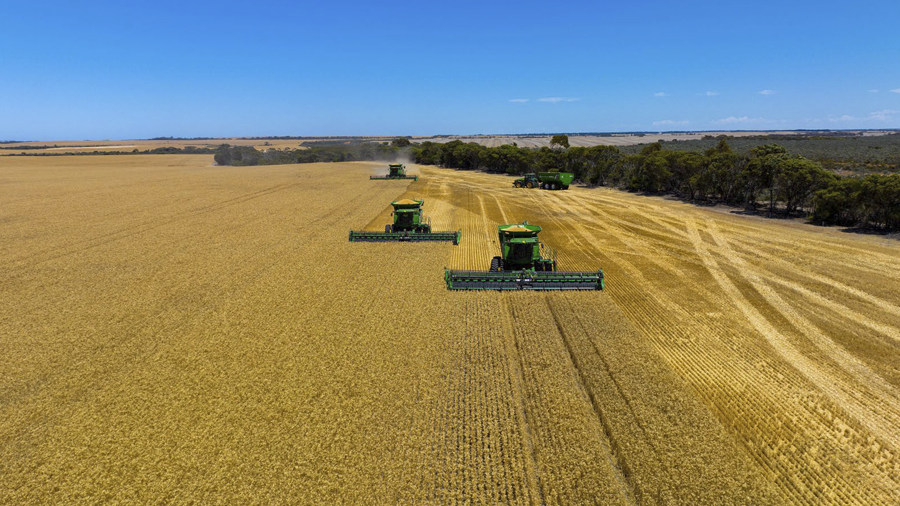
Strategic debates in the contemporary world order have largely centred on critical technologies, maritime security, and supply chains, especially as Australia and India successfully implemented the Australia-India Economic Cooperation and Trade Agreement (AIECTA) and strengthened ties through the QUAD. However, there exists an equally consequential arena—located in semi-arid lands—that supports millions of livelihoods, far removed from naval corridors.
Collaboration in dryland farming and climate-resilient crop research is emerging as a form of “climate statecraft,” which can be understood as the strategic use of agricultural science to ensure long-term stability in an era of accelerating climate volatility. Millions of smallholders in India are increasingly exposed to heat stress and erratic monsoons, particularly as nearly 60% of the country’s net sown area is rainfed. Recent studies suggest that wheat yields in India could decline by approximately 4–6% for every 1% rise in temperature, especially during the grain-filling stage. This vulnerability is further exacerbated by groundwater depletion, with many assessed blocks now classified as overexploited.
Australia, on the other hand, faces similar pressures at a different scale. A significant portion of its wheat belt lies in semi-arid regions that are highly vulnerable to prolonged drought cycles. Climate projections indicate increasing rainfall variability in southern Australia, threatening grain productivity and export reliability. Although agriculture contributes a smaller share to Australia’s GDP compared to India, it remains vital for export revenues and the rural political economy.
Shared ecological stress masks distinct agrarian structures. In India, dryland agriculture primarily functions as a livelihood system shaped by input subsidies, small landholdings, and procurement regulations. A large share of nutritionally significant crops—such as coarse cereals, pulses, and oilseeds—is produced in rainfed regions. However, government incentives, particularly the Minimum Support Price (MSP), have historically favoured water-intensive crops like rice and wheat in irrigated areas, thereby exacerbating groundwater stress and distorting cropping patterns. As a result, climate-resilient diversification into millets and pulses remains uneven and politically contested.
In contrast, Australia’s agrarian political economy is export-oriented and heavily research-driven. The rapid adoption of minimum tillage, climate-informed crop modelling, and precision nutrient management has been facilitated by strong farmer-research linkages, large landholdings, and advanced mechanisation. In this context, climate resilience is not merely an ecological necessity but a competitive strategy embedded within global grain markets.
At this juncture, cooperation between the two countries acquires strategic significance by combining India’s smallholder context with Australia’s technological capabilities.
Collaboration between India and Australia is supported by a robust institutional framework. The Indian Council of Agricultural Research (ICAR) anchors national agricultural science, particularly in climate adaptation and crop breeding. Additionally, the International Crops Research Institute for the Semi-Arid Tropics (ICRISAT), headquartered in Hyderabad, specialises in semi-arid crops such as chickpeas, sorghum, and millets.
In Australia, advanced capabilities in soil science, carbon management, and digital agriculture are driven by the Commonwealth Scientific and Industrial Research Organisation (CSIRO), while collaborative dryland research is supported by the Australian Centre for International Agricultural Research (ACIAR).
This synergy is exemplified by initiatives such as Australia–India chickpea research collaborations, which link ICRISAT, Australian universities, and ICAR institutions. These initiatives aim to enhance drought tolerance in crops critical to both Australia’s export economy and India’s protein security. Similarly, ACIAR-funded programmes have adapted Australian expertise in low tillage and crop rotation to Indian dryland conditions to improve soil moisture conservation.
AIECTA, operational since 2022, has further strengthened this scientific partnership with economic momentum. In 2023–24, bilateral trade between the two countries exceeded USD 24 billion, with increased agricultural exchanges in key commodities. While trade flows facilitate regulatory dialogue and technology diffusion, commercial growth alone cannot guarantee structural transformation.
Despite its promise, scientific cooperation between India and Australia is constrained by structural and political-economic factors.
First, technology transfer is inherently context-specific. Innovations developed in Australia are often designed for mechanised systems with large landholdings, whereas the average farm size in India is less than two hectares. The effective adoption of AI-driven advisory systems and precision agriculture requires reliable connectivity, efficient extension services, and affordable access. Without deliberate inclusion, such innovations risk excluding the most vulnerable farmers.
Second, regulatory frameworks and seed systems remain politically sensitive. India already hosts a strong private seed industry alongside public research institutions. Issues such as data governance, gene-editing regulations, and intellectual property rights must be carefully balanced. In an era where biotechnology carries geopolitical significance, cooperation must reconcile strategic autonomy with openness.
Finally, technological improvements alone cannot ensure climate resilience. In India, crop diversification is constrained by policy incentives such as MSP, which continues to favour water-intensive crops. Reforms in water governance, rationalisation of input subsidies, and expansion of crop insurance remain essential. While Australia operates within a different institutional framework, its experience with soil carbon accounting offers valuable lessons. However, policy transfer without contextual adaptation would be misguided.
Analysing dryland cooperation from a strategic perspective extends beyond bilateral engagement. In a warming Indo-Pacific, food systems are emerging as critical strategic infrastructure. As QUAD partners, India and Australia are increasingly framing resilience as a regional public good. Extending this logic to climate, resilient agriculture underscores the linkage between political stability, food security, and protein availability.
Drylands, once considered peripheral, are now central to geopolitical stability, food security, and rural livelihoods in the context of climate change. The true test of India–Australia cooperation lies not merely in the number of joint initiatives, but in whether scientific collaboration translates into inclusive scaling and meaningful domestic reforms.
Climate statecraft will remain rhetorical unless accompanied by strengthened water governance, enhanced smallholder participation, and the correction of distorted policy incentives.
In conclusion, the semi-arid frontier presents a unique opportunity for India and Australia to demonstrate how strategic partnerships can operate across both maritime and terrestrial domains. Realising this potential, however, requires aligning strategic ambition with sustained structural commitment.




Leave a Reply