

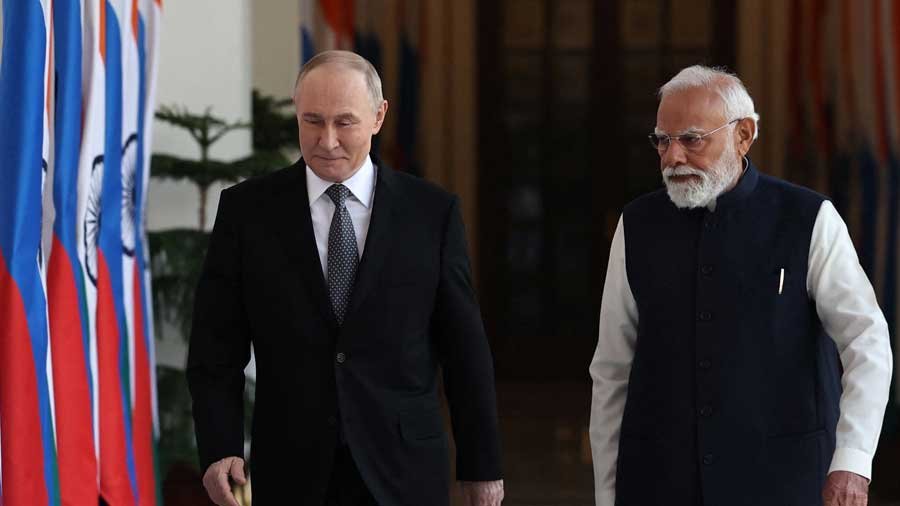
When Prime Minister Narendra Modi and President Vladimir Putin met in New Delhi on September 11, a day before the BRICS summit that India hosted as chair, the agenda before them[1] covered defence, energy and the goal of $100 billion in bilateral trade by 2030. For three years, discounted Russian oil gave the relationship a commercial weight it never enjoyed during the Cold War, but the discount has narrowed and Russian crude has settled into an ordinary place in India’s energy basket.
This transition opens new doors in the India-Russia relationship, with both New Delhi and Moscow having already laid the groundwork for broader partnership in nuclear energy, fertilisers, defence co-production, movement of skilled people and a foothold for India on the Northern Sea Route. The aim is to stabilise the relationship and build a broader partnership that does not depend on a single commodity.
From Discount to Diversification
Before February 2022, Russian crude accounted for less than 0.2 per cent[2] of India’s oil imports; within three years Russia was India’s largest supplier, and the arrangement survived a 25 per cent US penalty tariff[3] in August 2025 and sanctions on Rosneft and Lukoil[4] that October. When the Strait of Hormuz closed in 2026, Russian crude reached a record 56 per cent[5] of India’s imports in July, which proved Russia a dependable supplier in a genuine crisis. Trade rose with oil to a record $68.7 billion in 2024-25[6] before easing to nearly $60 billion in 2025-26[7], and External Affairs Minister Dr. S. Jaishankar has named the imbalance in Russia’s favour as the priority for both sides. That imbalance is the opening for Indian exporters, whom a goods agreement with the Eurasian Economic Union would serve well. Russia has meanwhile become India’s largest fertiliser supplier[8], with 6.5 million tonnes shipped in 2025.
Defence and Nuclear Energy
Defence and civil nuclear energy remain the two anchors that predate the oil years. The Stockholm International Peace Research Institute (SIPRI) reported in March 2026[9] that Russia supplied 40 per cent of India’s arms imports in 2021-25, which still makes it India’s largest single supplier. The Joint Statement of the 23rd Annual Summit[10] in December 2025 committed both sides to manufacture spares and components for Russian-origin equipment in India through transfer of technology and joint ventures, which would turn an old dependence into an Indian industrial asset. At Kudankulam in Tamil Nadu, two Russian-designed VVER-1000 reactors are operating and four more are under construction, and India has undertaken to allot a second site for Russian units. The SHANTI Act[11] of December 2025 opened the nuclear sector to private and foreign participation, and Rosatom has a long head start in the race for India’s 100 GW target.
Labour Mobility
Labour mobility is the fastest-growing new pillar, and it meets a need on both sides. Russia’s Labour Ministry expects a shortfall of 2.4 to 3.1 million workers by 2030[12], and Russian employers have turned to India as the flow of Central Asian workers has thinned. Russia issued 56,500 work permits to Indians in 2025[13], up from 36,200 the year before, for jobs in construction, fish processing, warehousing and heavy industry. On December 5, 2025, the two governments signed an agreement on temporary labour activity[14] together with an agreement on combating irregular migration, and India is opening consulates in Yekaterinburg and Kazan to serve the industrial regions.
The treaty channel matters because the informal one failed badly. Foreign Secretary Vikram Misri disclosed on September 1 that 227 Indians had been recruited[15] into the Russian army, of whom 51 died, and 139 have been discharged[16], many of them lured by agents the Central Bureau of Investigation later arrested[17]. Contracts vetted by both labour ministries are the surest way to close that route.
Medical Education
Medical education is the oldest and densest people-to-people link, and it has grown sharply since 2022. The Ministry of Education told the Lok Sabha in March 2025 that Indian enrolment in Russia rose from 19,784 in 2022 to 31,444 in 2024, and the Indian Embassy in Moscow[18] places about 23,500 of them in medical institutions, many displaced from Ukraine or priced out of private Indian colleges.
Quality remains the tough part, with a pass rate of 29.54 per cent among the 11,276 Russia-trained graduates who sat India’s Foreign Medical Graduate Examination in 2024, which is above the foreign-graduate average but well short of Indian expectations. The National Medical Commission’s 2021 regulations, which require a 54-month course, a 12-month internship at the same institution and English-medium teaching, give Russian universities a clear standard, and the Embassy’s advisory[19] urges students to verify compliance before enrolling. The December 2025 agreement on healthcare, medical education and science, along with Russian government scholarships[20] routed through the University Grants Commission, offers a framework to raise it.
The Arctic and the Eastern Sea Route
The cooperation over the Arctic has the longest horizon, despite being in its very initial stages. India has been an Arctic Council observer since 2013 and counts connectivity among the six pillars of its 2022 Arctic Policy. Russia, for its part, wants partners on the Northern Sea Route (NSR) other than China, whose vessels account for most of the route’s growing transit traffic[21]. A bilateral working group on the NSR first met in New Delhi in October 2024[22] to discuss cargo transit, polar navigation and joint shipbuilding, and in December 2025 the two shipping ministries signed a memorandum on training Indian seafarers for polar waters.
At the Arkhangelsk forum in August 2026, where India was a partner country, Indian officials spoke of a first pilot cargo voyage on the NSR in 2027[23]. The Chennai-Vladivostok corridor, which Shipping Minister Sarbananda Sonowal declared operational in November 2024[24], cuts the voyage to the Russian Far East to about 24 days. Indian investment on the ground is still modest,[25] but trained crews and working institutions buy India a cheap option on a route that will matter more each decade.
External Constraints
These pillars face real constraints, and each of them is manageable. Russia’s closeness to China is the first, and India’s answer lies in giving Moscow alternatives, since a Russia with Indian partners in Arctic shipping, nuclear manufacturing and skilled labour has less reason to rely on Beijing alone.
Washington is the second. The February 2026 executive order that lifted the penalty tariff cited an Indian commitment[26] on Russian oil that New Delhi never publicly confirmed, and India has since protected its energy choices while deepening ties with the United States. Payments and insurance remain the practical bottleneck, which the December 2025 Joint Statement addressed through commitments to national-currency settlements and interoperable payment systems. The human channels carry a separate obligation. Labour and education flows will hold only if both governments publish data, audit recruiters and universities, and act quickly whenever Indian workers or students come to harm.
Conclusion
The oil years gave India cheap energy and Russia a dependable market, and they showed that the relationship could withstand heavy external pressure. The next phase will be carried by people as much as by commodities, with each of these already having an agreement or a working group behind it, which is more than the relationship could claim in 2022. The 24th Annual Summit in Russia is the right occasion to attach annual targets to them.
[1] The Week, report on Modi-Putin talks ahead of the BRICS summit, 11 September 2026. https://www.theweek.in/news/india/2026/09/11/modi-putin-talks-begin-ahead-of-brics-summit-defence-energy-and-dollar100-billion-trade-target-on-agenda.html
[2] The Tribune (India), report on India’s Russian oil purchases in August. https://www.tribuneindia.com/news/business/business-as-usual-india-buys-2-million-bpd-russian-oil-in-august
[3] Al Jazeera, report on the 25 per cent additional US tariff over Russian oil purchases, 30 July 2025. https://www.aljazeera.com/news/2025/7/30/trump-hits-india-with-25-tariff-extra-penalty-for-russian-oil-purchases
[4] The Moscow Times, analysis of US sanctions on Rosneft and Lukoil, 28 October 2025. https://www.themoscowtimes.com/2025/10/28/what-new-us-sanctions-on-rosneft-and-lukoil-mean-for-russias-oil-trade-a90957
[5] Business Standard, report on India’s crude supplies and the Russian share, 31 August 2026. https://www.business-standard.com/amp/economy/news/india-faces-crude-squeeze-as-russian-west-asian-supplies-tighten-126083100469_1.html
[6] Embassy of India, Moscow, India-Russia bilateral relations overview. https://indianembassy-moscow.gov.in/overview.php
[7] DD News, report on India-Russia trade crossing $60 billion and the trade imbalance, with remarks by EAM S. Jaishankar. https://ddnews.gov.in/en/india-russia-trade-crosses-60-billion-but-widening-trade-imbalance-remains-key-concern-eam-jaishankar/
[8] Interfax, report on Russia as India’s largest fertiliser supplier. https://interfax.com/newsroom/top-stories/116728/
[9] Stockholm International Peace Research Institute, press release on global arms flows, March 2026. https://www.sipri.org/media/press-release/2026/global-arms-flows-jump-nearly-10-cent-european-demand-soars
[10] Press Information Bureau, Government of India, Joint Statement of the 23rd Annual India-Russia Summit, December 2025. https://www.pib.gov.in/PressReleasePage.aspx?PRID=2199494®=3&lang=1
[11] Down To Earth, article on the SHANTI Act and India’s nuclear sector. https://www.downtoearth.org.in/energy/atomic-juncture
[12] Newsweek, report on Russia’s demographic decline and labour shortfall. https://www.newsweek.com/russia-birthrate-demographic-putin-2099642
[13] The Moscow Times, report on work permits for Indian and Bangladeshi workers in 2025, 22 January 2026. https://www.themoscowtimes.com/2026/01/22/russia-boosts-work-permits-for-indian-and-bangladeshi-workers-in-2025-a91751
[14] Ministry of External Affairs, Government of India, Lok Sabha answer (LS2076) on the agreement on temporary labour activity. https://www.mea.gov.in/Images/CPV/LS2076_En.pdf
[15] Free Press Journal, report on Indians recruited into the Russian army. https://www.freepressjournal.in/india/227-indians-recruited-into-russian-army-51-killed-india-seeks-release-and-repatriation-of-remaining-nationals-video
[16] ANI, report on the MEA’s statement on Indian nationals discharged from the Russian army, 1 September 2026. https://aninews.in/news/world/asia/in-constant-discussions-with-russian-side-mea-says-239-indian-nationals-discharged-from-russian-army20260901001913/
[17] ThePrint, report on CBI arrests of recruiters trafficking Indians to the Russian army. https://theprint.in/india/cbi-arrest-2-primary-recruiters-trafficking-indians-to-russian-army-deployment-in-ukraine-war-zone/2075010/
[18] Embassy of India, Moscow, information regarding foreign medical graduation. https://indianembassy-moscow.gov.in/information-regarding-foreign-medical-graduation.php
[19] Embassy of India, Moscow, advisory for Indian students intending to pursue medical education in Russia. https://indianembassy-moscow.gov.in/pdf/Advisory%20For%20Indian%20Students%20Who%20Intend%20To%20Pursue%20Medical%20Education%20In%20Russia.pdf
[20] University Grants Commission, public notice on Russian government scholarships for Indian students. https://www.ugc.gov.in/pdfnews/1286760_Public-Notice-Scholarship-Indians-study-Russia.pdf
[21] RCI (Eye on the Arctic), report on Northern Sea Route cargo traffic and Chinese shipping, 4 September 2026. https://www.rcinet.ca/eye-on-the-arctic/2026/09/04/northern-sea-route-cargo-traffic-to-rise-14-per-cent-as-chinese-shipping-expands-says-rosatom/
[22] Atommedia (Rosatom press releases), report on the India-Russia working group on the Northern Sea Route. https://atommedia.online/en/press-releases/predstaviteli-rosatoma-prinyali-uch-6/
[23] ThePrint, article on India in the Arctic, the Northern Sea Route and the 2027 voyage. https://theprint.in/yourturn/india-in-the-arctic-northern-sea-route-connectivity-strategy-and-2027-voyage/3048327/
[24] Business Standard, report on the Chennai-Vladivostok maritime corridor becoming operational, 18 November 2024. https://www.business-standard.com/industry/news/chennai-vladivostok-maritime-corridor-becomes-operational-says-sonowal-124111801090_1.html
[25] Observer Research Foundation, article on the drivers of India’s engagement in the Northern Sea Route. https://www.orfonline.org/research/theorising-the-drivers-of-india-s-engagement-in-the-northern-sea-route
[26] CNBC, report on the US tariff ruling on India and Russian oil purchases, 25 February 2026. https://www.cnbc.com/2026/02/25/us-tariff-ruling-india-russian-oil-purchases.html



Leave a Reply