

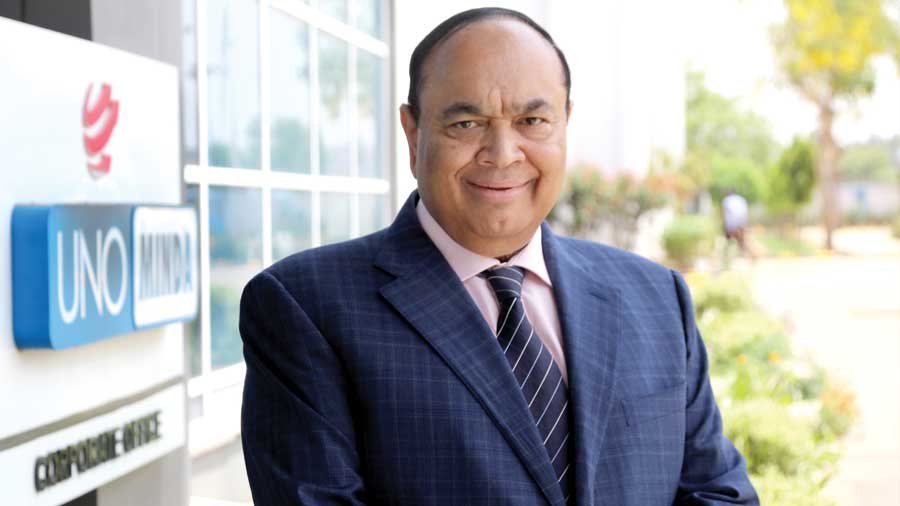
Mr. Nirmal Kumar Minda
Executive Chairman, Uno Minda Group and President, Associated Chambers of Commerce and Industry of India
As India and Africa deepen their engagement across manufacturing, mobility, and industrial transformation, the automotive sector is emerging as a powerful pillar of South–South cooperation. In this exclusive conversation with Diplomatist, Mr Nirmal Kumar Minda shares his perspective on the future of India–Africa automotive partnerships, the rise of electric mobility across emerging markets, and the growing importance of localisation, technology transfer, and industrial ecosystems.
Over the years, Uno Minda has evolved from a domestic component manufacturer into a global mobility technology player with operations and partnerships across multiple geographies. As India and Africa both seek to strengthen manufacturing ecosystems, how do you see African markets fitting into India’s long-term automotive supply-chain strategy?
ASSOCHAM was among the first industry associations to initiate focused engagement with African embassies in India. We organised a major interaction hosted by the Embassy of Ethiopia, where more than 20 African ambassadors participated alongside nearly 400 industry representatives from sectors including pharmaceuticals, agriculture, automobiles, textiles, and energy.
From the automotive industry’s perspective, when global OEMs such as Toyota or Suzuki enter new markets, they bring with them a well-established supplier ecosystem comprising Tier 1, Tier 2, and MSME partners. India has already developed a strong and globally competitive automotive supply chain, and this ecosystem can naturally integrate with Africa’s growing manufacturing ambitions.
India and Africa also share strong cultural alignment and long-standing people-to-people connections, supported by vibrant Indian communities across the continent. As urbanisation accelerates and per capita incomes rise in African economies, demand for both public and private mobility solutions will increase significantly. This creates strong potential for deeper South–South industrial integration and long-term manufacturing partnerships between India and Africa.
You have consistently championed localisation and technology partnerships as key pillars of industrial growth. Several African economies are now focusing on local assembly, EV adoption, and industrial value addition. Do you believe Indian auto-component manufacturers are prepared to move beyond exports and participate in Africa’s manufacturing transformation through joint ventures and local production ecosystems?
Absolutely. Indian auto-component manufacturers are increasingly prepared to move beyond conventional export-led models and actively participate in Africa’s industrial transformation through joint ventures, technology partnerships, and local manufacturing ecosystems.
Indian companies possess strong expertise in affordable manufacturing, frugal engineering, and cost-efficient mobility solutions, particularly in the EV segment. These capabilities align very well with the evolving needs of African markets.
Collaborative manufacturing initiatives can generate local employment, strengthen domestic value addition, improve supply-chain resilience, and support industrial capacity building across the continent. Indian companies are well-positioned to become long-term manufacturing partners rather than simply equipment suppliers.
Uno Minda has invested aggressively in electric mobility technologies, including EV powertrain systems, chargers, battery management systems, and e-drive solutions. Many African countries are simultaneously grappling with urbanisation, rising fuel costs, and sustainability pressures. Could Africa emerge as a strategic growth market for affordable electric mobility solutions developed in India?
Yes, Africa has immense potential to emerge as a strategic growth market for affordable electric mobility solutions developed in India.
Several automotive manufacturers are already accelerating EV production globally, while African economies are increasingly seeking cost-effective and scalable mobility solutions to address rapid urbanisation, rising fuel import dependence, and sustainability challenges.
India’s strengths in battery management systems, EV components, smart mobility technologies, and affordable engineering make Indian solutions highly relevant for African conditions. However, the expansion of charging infrastructure across African markets will be a critical requirement for the long-term growth of the EV ecosystem.
You have also emphasised calibrated trade frameworks that protect MSMEs while integrating India more deeply into global value chains. In the context of Africa, what specific policy mechanisms, such as preferential financing, industrial parks, technology-transfer frameworks, or local-currency settlements, are required to unlock stronger India–Africa manufacturing partnerships?
MSMEs remain the backbone of every industrial ecosystem. At ASSOCHAM, we have identified four key pillars for India’s growth trajectory: Make in India, Ease of Doing Business, MSME growth, and Digitisation with Sustainability. We believe similar frameworks can also strengthen industrial cooperation with African economies.
To unlock stronger India–Africa manufacturing partnerships, several policy mechanisms are essential. These include preferential financing through EXIM Bank credit lines, joint industrial parks to improve ease of doing business, and structured technology-transfer partnerships in sectors such as pharmaceuticals, renewable energy, and mobility.
In addition, local-currency settlement mechanisms and stronger banking connectivity can help reduce foreign exchange risks and lower transaction costs for businesses. Skill development and vocational training centres will also play a vital role in ensuring sustainable industrial growth and long-term workforce development.



Leave a Reply