

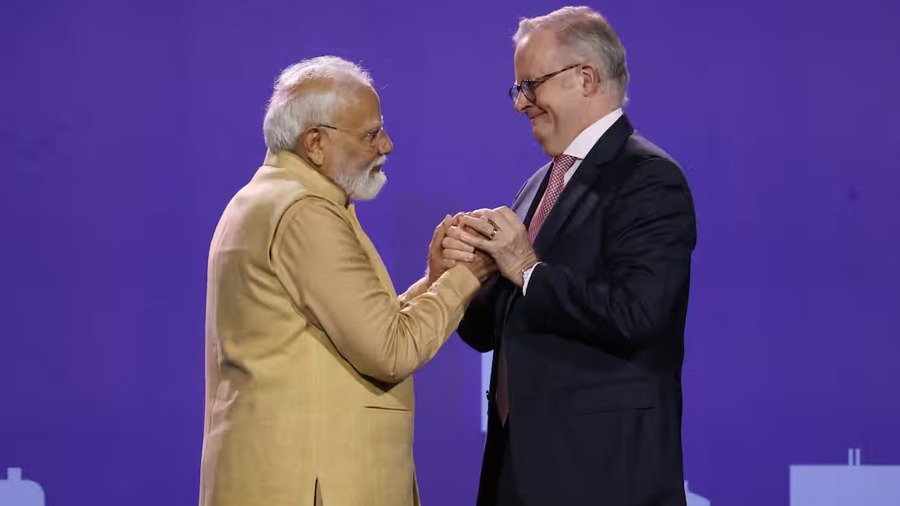
Indian Prime Minister Narendra Modi’s state visit, which is the third of his tenure, is a game-changer in the strategic cooperation between New Delhi and Canberra. Australia and India have signed an agreement to export Australian uranium to India for use in its nuclear energy sector.
India has long eyed Australia’s uranium reserves since the beginning of the 21st century. Australia possesses around 28 per cent of the world’s uranium reserves, which could help India meet its target of achieving 100 gigawatts of nuclear energy capacity by 2047. At the same time, Australia is looking to diversify its trade beyond its reliance on China, its largest trading partner. The two nations also plan to establish a “temporary space tracking terminal” on Australia’s Cocos (Keeling) Islands in the Indian Ocean, which will support India’s spaceflight projects.
Furthermore, India and Australia may strengthen their strategic alliance with the United States, including facilitating a greater US military presence in the South-West Pacific and increasing maritime strategic cooperation with Japan, France, Indonesia, and New Zealand.
Australian Defence White Papers published in 2009, 2012, and 2013 reflected a cautious approach towards greater strategic manoeuvring against Beijing’s maritime expansion. However, the emergence of the Indo-Pacific as a geo-strategic concept has helped bring about a broader strategic alignment among like-minded nations.
Strategic cooperation between India and Australia has gained even greater significance as China expands its strategic reach across the Indo-Pacific through the increasing range and operational capability of its submarine fleet. In response, Australia and India are working together on a collaborative research project aimed at enhancing undersea surveillance capabilities, marking the first science and technology partnership of its kind between the two countries.
In this context, the three-year initiative launched last year focuses on improving submarine detection and autonomous underwater vehicle tracking through advanced technologies, primarily aimed at monitoring Chinese activities in the Indo-Pacific.
The collaboration seeks to test innovative algorithms and facilitate the exchange of expertise between the two countries on undersea surveillance systems, one of the focus technologies under AUKUS Pillar II. The joint research, announced last month, will explore the use of towed-array target motion analysis to enhance the reliability and efficiency of existing surveillance systems, with potential applications in anti-submarine operations.
The proposed network is likely to be integrated with the existing US-Japan “Fish Hook” network, which was established specifically to monitor Chinese naval submarine activity in the South China Sea and across the Indian Ocean region.
Furthermore, the joint project with the University of Western Australia Defence and Security Institute (UWA DSI) aims to strengthen bilateral cooperation between Australia and India in Maritime Domain Awareness (MDA) capabilities across the Indo-Pacific, with a specific focus on Underwater Domain Awareness (UDA).
The initiative will address five key aspects of UDA: an initial scoping study of Australia-India bilateral undersea intentions and capabilities; anti-submarine warfare (ASW); uncrewed underwater vehicles (UUVs); undersea search and rescue; and deep-sea awareness. The project aims to make a significant contribution to regional stability and security while aligning with recent diplomatic developments and broader initiatives such as the Indo-Pacific Oceans Initiative (IPOI), by fostering policy collaboration among academia, industry, and government.
It is understood that Narendra Modi’s state visit to Australia reinforces the India-Australia Joint Declaration on a Shared Vision for Maritime Cooperation in the Indo-Pacific. The Comprehensive Strategic Partnership (CSP) places particular emphasis on strengthening regional Maritime Domain Awareness, especially in the Indian Ocean.
This project addresses critical aspects of maritime security that have become increasingly important due to the growing presence of underwater threats in the Eastern Indian Ocean and the Pacific Ocean, thereby enhancing strategic cooperation between India’s Eastern Fleet and Australia’s Western Fleet.
Furthermore, Narendra Modi’s state visit reinforces the significance of the Quad framework and the Malabar naval exercises conducted among the participating countries. As the Quad sharpens its focus on high-technology cooperation and maritime deterrence, initiatives such as the India-Australia undersea project are likely to become key pillars in safeguarding shared regional interests. As strategic waters become increasingly contested and adversaries rely more heavily on stealth technologies, real-time undersea intelligence may prove indispensable.
In conclusion, Narendra Modi’s state visit will further strengthen the existing strategic cooperation between India and Australia, particularly in the field of undersea cooperation.
It will also pave the way for more effective anti-submarine operations across the wider Indo-Pacific region and serve as a strategic deterrence mechanism in line with Australia’s expectations under the AUKUS framework and the broader strategic partnership between India and Australia.
Furthermore, it will strengthen uranium cooperation between India and Australia, enabling the effective use of nuclear energy by India for peaceful purposes.


Leave a Reply