

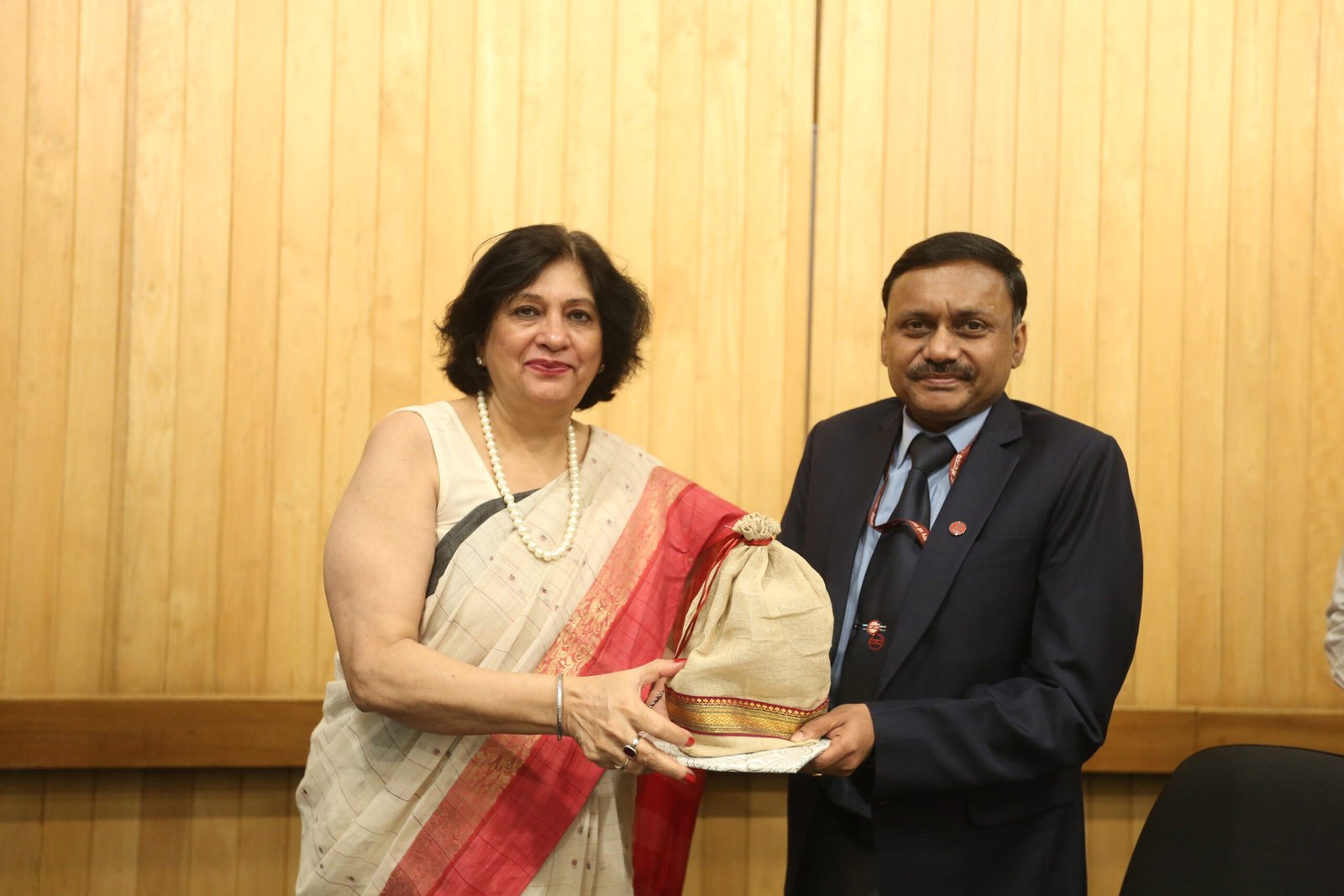
Dr Amit Kumar Jain, Director (Operations & Services), Delhi Metro Rail Corporation, argues that India’s electric mobility transition cannot be reduced to replacing internal-combustion vehicles with electric ones. The real opportunity lies in creating an integrated, energy-efficient and public-transport-led mobility ecosystem.
At a time when India is confronting the twin pressures of deteriorating urban air quality and growing energy demand, the transition to electric mobility is increasingly being viewed as both an environmental necessity and a strategic imperative. But electrification alone, Dr Amit Kumar Jain, Director (Operations & Services), Delhi Metro Rail Corporation (DMRC), cautioned, cannot provide the complete answer.
Speaking at the TERI–India Habitat Centre Lecture and Discussion Series on Sustainable Development in New Delhi on 21 September, at a session titled “Beyond Tailpipe: Electric Mobility at the Intersection of Air Quality and Energy Security”, Dr Jain argued for a broader understanding of electric mobility, one that connects vehicles, public transport, infrastructure, energy systems and the way people actually travel.
“The question is not simply whether we can replace internal-combustion vehicles with electric vehicles. The question is whether we can create an integrated mobility system that addresses air pollution, energy security and the growing demand for transportation.”
The scale of the challenge is significant. India’s transport sector is closely linked to petroleum consumption and imported crude, while road transport accounts for the overwhelming share of transport-related emissions. TERI’s background to the lecture notes that transport contributes approximately 13 percent of India’s greenhouse-gas emissions, with road transport accounting for around 90 per cent of transport emissions. The Bureau of Energy Efficiency similarly notes that transport accounts for about 18 per cent of India’s total energy consumption and that road transport is responsible for the bulk of the sector’s CO₂ emissions.
Against this backdrop, mass public transport has a critical role to play.
The power of moving millions together
Dr Jain used the Delhi Metro as an illustration of what electric mobility can achieve when it operates at scale. DMRC’s network currently extends to approximately 416 km and 303 stations, with 12 operational lines including the Airport Express, carrying around seven million passenger journeys a day.
The numbers illustrate a simple but powerful proposition: the greatest gains from electrification may come not merely from changing the propulsion technology of individual vehicles, but from moving large numbers of people efficiently.
“If each of these passengers were to make the same journey in an individual vehicle, imagine the additional pressure that would place on our roads, our energy consumption and our air quality,” he said.
For Dr Jain, this makes mass transit an important part of the electric mobility conversation. Metro systems, suburban rail and other forms of electric public transport already demonstrate that mobility can be electrified at scale while simultaneously reducing dependence on individual motorised transport.
Electric mobility is not new
The transition to electric mobility is often presented as a relatively new phenomenon. Dr Jain offered a different perspective.
Electric traction has been part of India’s railway story for a century. The country’s first electric train ran between Bombay Victoria Terminus and Kurla in 1925. Indian Railways has since moved steadily towards electrification, with approximately 99.4 per cent of its broad-gauge network electrified as of February 2026, according to the Ministry of Railways.
“The idea that electric mobility is something new is not correct,” Dr Jain observed. “Electric traction has been part of our railway system for almost a hundred years.”
The experience of railways also demonstrates why the conversation around electrification needs to extend beyond the vehicle itself. Electric traction brings benefits in terms of efficiency and local emissions, but the ultimate environmental benefit also depends on how the electricity is generated and how efficiently the overall transport system operates.
Efficiency beyond the tailpipe
One of the examples Dr Jain highlighted was regenerative braking, a technology that allows the kinetic energy generated during braking to be converted back into electrical energy rather than simply being dissipated as heat.
DMRC has long employed regenerative braking as part of its energy-efficiency measures. Its sustainability reporting has documented energy savings of around 30–40 per cent of traction energy through regenerative braking, while government technical assessments have recorded substantial regeneration levels on the Delhi Metro network.
“When brakes are applied, the mechanical energy of the moving train can be converted back into electrical energy. That energy can then be used by another accelerating train,” Dr Jain explained.
This, he suggested, demonstrates the larger principle at work: the objective should not simply be to electrify transport, but to make the entire mobility system more energy-efficient.
From park-and-ride to park-and-charge
The integration of different modes of transport is another important part of this transition.
Dr Jain pointed to DMRC’s efforts to facilitate electric mobility around metro stations, including the development of charging infrastructure and “park-and-charge” models. Such an approach allows commuters to combine private electric vehicles with mass transit, charging the vehicle while using the metro for the longer part of the journey.
The concept has already been demonstrated through DMRC-linked facilities. A charging facility at Noida City Centre, for instance, was developed as a “Park and Charge” model, allowing commuters to charge their EVs while travelling by metro.
“The idea is that you can come to the metro station, park and charge your vehicle, use the metro for your journey and collect your vehicle when you return,” Dr Jain said.
Such models can help address one of the persistent challenges of EV adoption: charging convenience. Rather than viewing charging infrastructure as a separate ecosystem, integrating it with existing mobility hubs can make electrification part of the journey itself.
The solution lies in integration
For Dr Jain, therefore, the central question is not whether India should adopt electric vehicles. It is how the country builds an ecosystem around them.
This means integrating electric cars, buses, two-wheelers and last-mile mobility with metro systems and railways. It also means ensuring that charging infrastructure keeps pace with demand, that electricity supply becomes progressively cleaner, and that transport planning encourages people to choose efficient shared mobility wherever possible.
“We should not look at electric mobility in isolation. We need an integrated approach, e-buses, e-bikes, last-mile connectivity, metro systems and railway networks all working together.”
The distinction is important. Simply replacing every conventional vehicle with an electric equivalent could reduce tailpipe emissions, but it would not automatically solve congestion, road-space constraints, energy demand or the inefficiencies associated with individual travel.
“The solution is not only moving from diesel to electric,” Dr Jain said. “It is about creating an integrated electric mobility ecosystem.”
The road ahead
India’s rapidly urbanising cities will require significantly greater mobility in the coming decades. The challenge will be to meet that demand without locking cities into higher levels of congestion, pollution and petroleum dependence.
The experience of Delhi Metro offers one possible direction: electrification combined with mass transit, energy efficiency, digital integration and first- and last-mile connectivity.
The transition, Dr Jain suggested, should therefore be understood as a systems challenge rather than simply a technology shift.
“Electric mobility is not the solution by itself. Integrated electric mobility is the solution.”
That perspective takes the debate beyond the tailpipe and beyond the vehicle. It places the focus instead on the entire journey: where the energy comes from, how efficiently it is used, how people connect to public transport, and how millions of individual journeys can collectively become cleaner and more efficient.
For a country seeking to balance rapid economic growth with cleaner air and greater energy security, that may be the more consequential question: not simply how to electrify vehicles, but how to electrify mobility itself.


Leave a Reply