

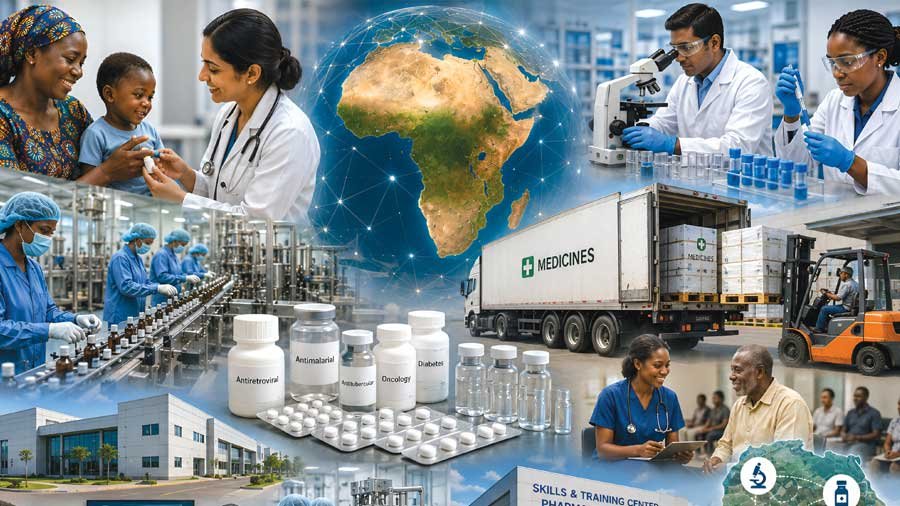
In the 21st century, diplomacy is no longer shaped only by trade agreements, military alliances, or strategic negotiations. Increasingly, healthcare has emerged as one of the most powerful instruments of global influence.
Medicines, vaccines, digital health technologies and public health partnerships are redefining international cooperation. Within this evolving landscape, India’s pharmaceutical engagement with Africa stands out as one of the most impactful examples of healthcare diplomacy transforming lives across borders.
Currently, in Africa, where nearly 70–90% of medicines are still imported, has become one of the most important beneficiaries of India’s affordable healthcare ecosystem. Today, India supplies approximately 45% of all generic medicines used across the African continent, making it a cornerstone of Africa’s public health transformation.
As the world accelerates toward 2030, however, that topography has shifted irreversibly. In an era of fragmented supply chains, donor fatigue and realigning geopolitical priorities, a distinctively horizontal model of cooperation has emerged. Leading this charge is India, leveraging its title as the “Pharmacy of the World” to architect a new era of pharmaceutical diplomacy that is quietly but profoundly transforming public health landscapes across Africa.
However, this relationship is no longer merely commercial. It has evolved into a strategic partnership rooted in South-South cooperation, healthcare equity and shared developmental priorities.
From Transaction to Transformation
This relationship began in earnest during the HIV/AIDS crisis of the late 1990s and early 2000s, when Indian pharmaceutical companies, most notably Cipla, provided antiretroviral (ARV) drugs for a fraction of the cost, nearly $10,000 per patient annually, demanded by Western firms.
Cipla’s $1-per-day triple-drug regimen shattered pricing barriers, catalysing a continent-wide treatment revolution as that breakthrough fundamentally altered the trajectory of HIV treatment in Africa.
Today, Indian-made antiretrovirals constitute 80% of Africa’s total consumption. AIDS-related deaths in Africa plummeted from two million in 2004 to 650,000 in 2021, while life expectancy across sub-Saharan Africa rose from 56.5 years in 2010 to 62.3 years in 2024.
Beyond HIV, Indian firms account for 67% of WHO-prequalified medicines for malaria and tuberculosis. From 2000 to 2015, malaria deaths in Africa fell by nearly 40%, a decline attributed in part to the widespread availability of affordable Indian generics.
India’s intervention during the HIV/AIDS crisis was not merely a commercial success; it became a defining moment in global health diplomacy.
Indian pharmaceutical companies now supply affordable medicines for malaria, tuberculosis, maternal healthcare, cardiovascular diseases, diabetes, oncology and infectious diseases across countries such as Nigeria, Kenya, South Africa, Ethiopia, Tanzania and Zambia.
Indian firms also account for a major share of WHO-prequalified medicines used for malaria and tuberculosis treatment in Africa. From paediatric medicines to affordable chronic disease therapies, Indian pharmaceutical innovation has significantly improved healthcare accessibility across the continent.
The COVID-19 pandemic further elevated India’s role as a healthcare partner to Africa. Through the “Vaccine Maitri” initiative, India supplied vaccines, medicines, diagnostics, ventilators and protective equipment to developing countries worldwide, including many African nations.
This expanding partnership reflects a broader transformation in healthcare diplomacy from emergency intervention to long-term public health collaboration, thus establishing India as a trusted healthcare partner capable of delivering affordable and scalable solutions for the Global South.
This move was not only humanitarian but also solidified India’s position as a reliable, strategic partner, reinforcing the ancient philosophical principle of Vasudhaiva Kutumbakam (the world is one family).
Building Healthcare Sovereignty in Africa
One of the most significant developments shaping the India–Africa healthcare partnership toward 2030 is Africa’s ambition to build local pharmaceutical and vaccine manufacturing capacity.
Under the leadership of the Africa Centres for Disease Control and Prevention and the Partnerships for African Vaccine Manufacturing initiative, African nations aim to locally manufacture 60% of the continent’s vaccine requirements by 2040.
This shift presents a historic opportunity for India and Africa to transition from a buyer–seller relationship into co-developers of healthcare resilience.
Indian pharmaceutical companies are increasingly establishing local manufacturing units, technology transfer partnerships, and joint ventures across Africa. A landmark example is the partnership between Akums Drugs & Pharmaceuticals and the Government of Zambia.
Under this agreement, Akums is establishing a pharmaceutical manufacturing facility expected to produce oral medicines, injectables and essential therapeutics locally by 2028, reducing Zambia’s dependence on imported medicines and transforming it into a regional supply hub for Southern Africa by 2030.
The ICMR-Africa Union Alliance
The depth of this partnership is best illustrated by the high-level institutional framework established between the Indian Council of Medical Research (ICMR) and the African Union. In a historic Memorandum of Understanding signed in early 2026, the two bodies agreed to focus specifically on the “indigenous development of safe, affordable and effective drugs, diagnostics and vaccines” tailored to regional disease burdens.
By the end of 2026, a joint programme secretariat will begin rolling out an implementation plan to train health professionals, regulators, and industry staff, ensuring that Africa does not just consume health solutions but helps design them.
This engagement complements India’s growing alliance with the Africa Centres for Disease Control and Prevention (Africa CDC). Meetings in Addis Ababa have moved beyond dialogue into concrete action plans concerning pandemic preparedness and health security, critical for a continent that carries over 20% of the global disease burden but manufactures less than 2% of the vaccines it consumes.
Economic Backdrop: Doubling Trade by 2030
This health transformation is underpinned by a massive economic push. During the 20th CII India-Africa Business Conclave in August 2025, Union Minister Piyush Goyal set a hard target: double bilateral trade to nearly $200 billion by 2030, with focus sectors including healthcare and value-added pharmaceuticals. For Africa, this means moving from raw material exports to producing finished medical goods for global markets.
Challenges on the Road to 2030 & Way Ahead
Despite strong momentum, the road to 2030 is not without challenges. Africa continues to face fragmented regulatory systems, weak healthcare infrastructure, financing gaps and heavy dependence on imported medicines and medical products, accounting for nearly 70–90% of its pharmaceutical needs.
Simultaneously, India’s pharmaceutical sector remains dependent on China for nearly 70% of its Active Pharmaceutical Ingredient (API) imports, exposing vulnerabilities in global supply chains during crises.
Yet, these shared challenges are transforming the India–Africa healthcare relationship from a buyer–seller model into a strategic partnership focused on resilience, innovation, and healthcare security for the Global South.



Leave a Reply