

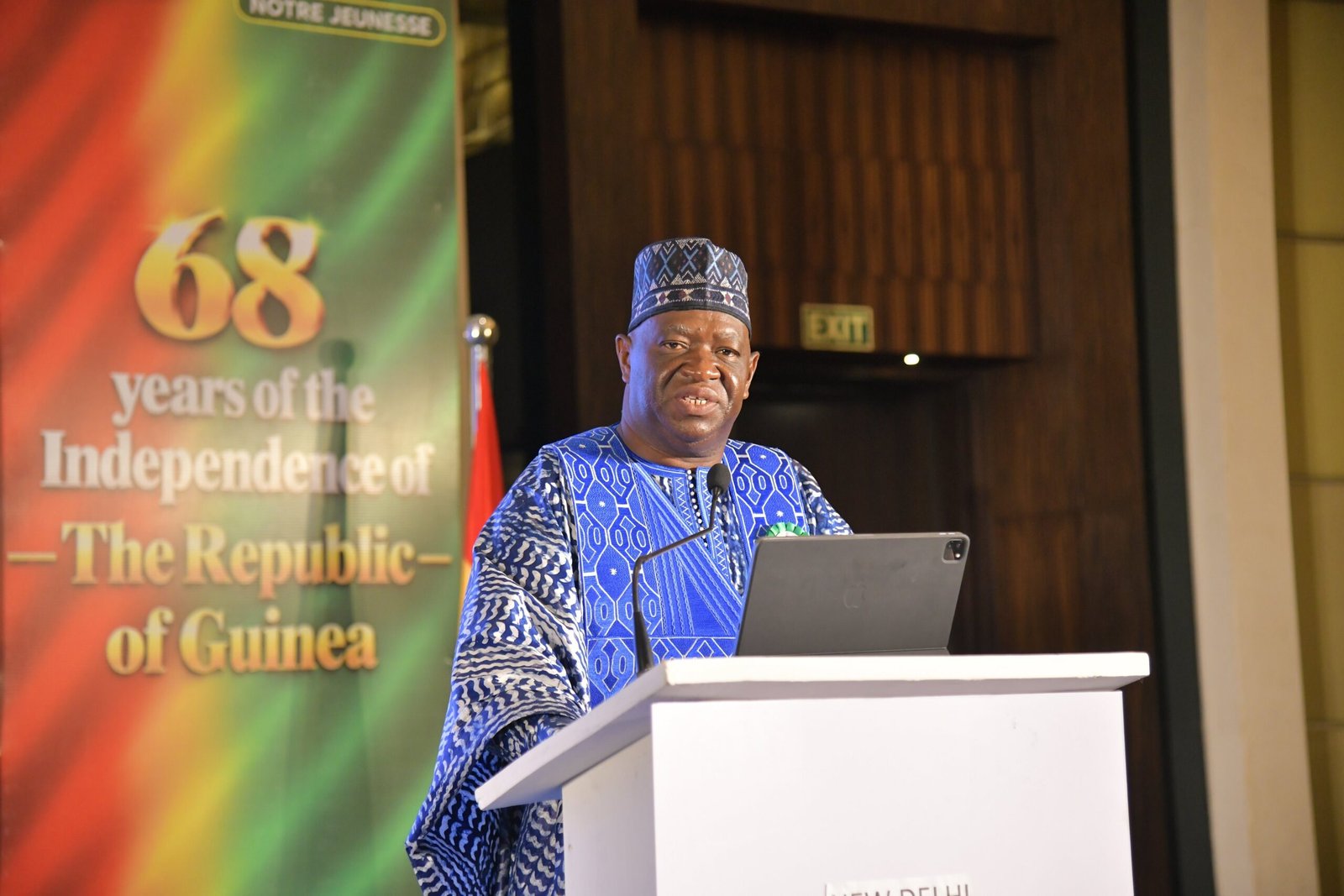
At Guinea’s 68th Independence anniversary celebration in New Delhi, Ambassador CONTE Alassane outlined a national agenda centred on youth, industrialisation, economic sovereignty and deeper partnerships with India.
The Republic of Guinea marked the 68th anniversary of its independence in New Delhi on 6 October 2026, with its Ambassador to India, H.E. Mr. CONTE Alassane, using the occasion to articulate a vision that extends well beyond the commemoration of independence. Under the theme “Drawing inspiration from the past to build the future together – Our Youth”, the celebration placed Guinea’s younger generation at the centre of its development ambitions.
For the Ambassador, the significance of independence lies not only in remembering the decision that shaped Guinea’s modern history, but in determining what sovereignty should mean for the country today. Guinea’s next chapter, he suggested, must be defined by the ability to convert its substantial natural resources, human capital and geographical advantages into productive capacity, employment and broad-based prosperity.
From Independence to Economic Sovereignty
Guinea’s independence was proclaimed on 2 October 1958, following the referendum of 28 September, when Guineans voted against integration into the French Community and opted for immediate independence. Nearly seven decades later, the country is approaching sovereignty through a different lens.
“Sixty-eight years later, a new responsibility falls upon our generation: to consolidate our economic sovereignty and transform our immense potential into jobs, infrastructure and prosperity for our people,” Ambassador CONTE said.
That ambition is reflected in the development priorities of Guinea’s current administration and in a new direction for its foreign policy. According to the Ambassador, Guinea adopted its first Foreign Policy Document on 9 September 2026, providing a strategic framework intended to orient diplomacy more strongly towards the country’s national interests and development objectives.
Diplomacy, in this vision, is not confined to political relations. It is expected to contribute directly to economic development by attracting investment and technology, opening new markets, strengthening partnerships and creating opportunities for young Guineans.
Putting Youth at the Centre
Youth emerged as one of the defining themes of the Ambassador’s address. Guinea’s young population represents both a demographic opportunity and a responsibility for policymakers.
“Youth must not only be beneficiaries of development; they must be its main actors and driving force,” he said.
This approach places education, vocational training, entrepreneurship, creativity and employment at the heart of Guinea’s development agenda. Rather than viewing young people simply as future beneficiaries of economic growth, the country wants to position them as participants in building new industries, businesses and institutions.
It is an especially important objective as Guinea seeks to transform an economy historically associated with the export of mineral resources into one capable of generating greater value domestically.
Simandou 2040 and a Broader Transformation Agenda
The clearest expression of this ambition is Simandou 2040, Guinea’s long-term socio-economic development programme. While Simandou is internationally recognised for its mineral resources, the Ambassador emphasised that the wider programme is intended to reach far beyond mining.
Simandou 2040 is expected to mobilise more than US$200 billion in investments and encompass industrialisation, infrastructure and energy, agriculture and agribusiness, education, healthcare, vocational training, digital transformation, private-sector development and job creation.
The underlying objective is to ensure that Guinea’s resources become a foundation for national transformation rather than remaining primarily an export commodity.
The Ambassador’s formulation was clear: “Our fervent wish is to make our natural resources a true lever of prosperity for the people, by building a productive, competitive, modern Guinea open to direct investment.”
This points towards a gradual shift from an extraction-led model to one centred on local processing, industrial capacity, infrastructure and domestic value chains.
A Strategic Opening for Indian Partnerships
India occupies an important place in this transformation strategy. Guinea and India have longstanding relations, but the Ambassador sees considerable room to move towards more commercially and technologically substantive cooperation.
“India possesses recognised expertise in industry, digital technology, agriculture, health, education, innovation and skills training, while Guinea has considerable resources and potential,” he said.
The opportunity, therefore, is complementary. Guinea can offer resources, agricultural potential and a strategic position in West Africa, while Indian companies and institutions can contribute technology, industrial capabilities, expertise and skills.
Under Simandou 2040, the Embassy sees potential for Indian participation across mining and agro-industry, energy, infrastructure, healthcare, education, vocational training and digital technologies. The objective is to move from broad expressions of partnership towards concrete projects with measurable economic and social outcomes.
The Ambassador also highlighted the importance of stronger links among entrepreneurs, universities, research centres and young people in both countries. The Embassy in New Delhi intends to play a more active facilitation and networking role by engaging investors, businesses and potential partners interested in Guinea.
Guinea’s Resource Advantage
Guinea’s economic proposition is underpinned by substantial natural resources. The Ambassador noted that the country holds nearly 25 percent of the world’s bauxite reserves and is now the world’s leading producer. It also has approximately four billion tonnes of iron ore, including significant high-grade resources, as well as estimated gold reserves of nearly 700 tonnes and important diamond resources.
Yet resources alone do not guarantee development. Guinea’s challenge is to build the infrastructure, energy systems, industrial capacity and skills required to translate resource wealth into domestic economic value.
The country also has an estimated 6,000 MW of hydroelectric potential, substantial agricultural potential and approximately 300 kilometres of coastline. Its borders with Guinea-Bissau, Mali, Senegal, Côte d’Ivoire, Liberia and Sierra Leone give it a strategic position within West Africa.
The development of ports, railways and energy infrastructure is consequently central to Guinea’s economic strategy. Better connectivity can strengthen mining and agricultural exports while also supporting industrialisation and regional trade.
From Extraction to Value Creation
Perhaps the most significant message from the Independence Day address was Guinea’s determination to capture more value domestically.
The Ambassador described the ambition as a transition “from extraction and export logistics to a genuine dynamic of local transformation, in order to create more value, jobs, and wealth for the benefit of our country.”
That shift has implications across the economy. It means greater emphasis on processing, manufacturing, logistics, energy and services around Guinea’s natural-resource base. It also creates opportunities for international companies willing to participate not merely as buyers of commodities, but as long-term partners in building productive capacity.
For Indian businesses, this could open space across the mining value chain, agro-processing, infrastructure, engineering, renewable energy, healthcare, education, digital services and vocational training.
A New Role for Diplomacy
The speech also offered a broader view of what Guinea expects from its diplomatic network. Embassies are increasingly being positioned as facilitators of investment, technology partnerships, market access and institutional cooperation.
For Guinea’s mission in New Delhi, this means helping connect Indian businesses and institutions with opportunities emerging from the country’s development agenda while also encouraging greater people-to-people and knowledge exchanges.
This economic orientation reflects a broader evolution in Guinea’s foreign policy — one in which diplomatic relations are expected to contribute directly to national development.
The Next Chapter
The Ambassador concluded by drawing a direct line between Guinea’s history and its future. In 1958, Guineans said “No” to domination in their pursuit of political freedom. Today, he argued, the country must say “YES to development, national unity, industrialisation, innovation, youth employment and shared prosperity.”
That formulation captures the central message of Guinea’s 68th anniversary celebration. The country is seeking to redefine sovereignty not simply as political independence, but as the capacity to determine how its resources are developed, how value is created and how opportunities reach its people.
For India, the message is equally significant. Guinea is positioning itself not only as a resource-rich country but as an emerging partner seeking technology, investment, skills, infrastructure and long-term industrial cooperation.
As Ambassador CONTE put it, “May Simandou 2040 open a new stage in the economic and social transformation of our country, driven by its youth, supported by its partners and guided by a common ambition: To make Guinea a modern, prosperous, sovereign nation fully committed to the path of development.”
For Guinea, the next phase of its independence story may therefore be measured not simply by what lies beneath its soil, but by what it can build above it: industries, infrastructure, skills, jobs and partnerships that turn potential into lasting prosperity.


Leave a Reply