

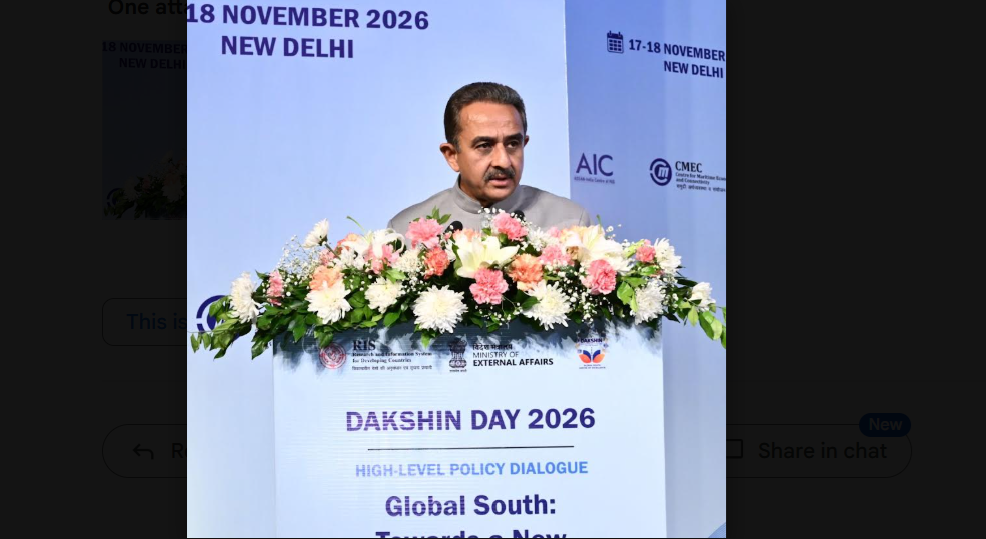
At DAKSHIN Day 2026, the Minister calls for stronger South-South cooperation, inclusive technology and a new phase of India–Africa co-development.
Union Minister of State for External Affairs, Shri Kirti Vardhan Singh, delivered the keynote address at the inaugural session of the DAKSHIN Day 2026 High-Level Policy Dialogue, held on 17 November at the India Habitat Centre, New Delhi. Organised by the Research and Information System for Developing Countries (RIS), in partnership with the Ministry of External Affairs, Government of India, the two-day dialogue was themed *Global South: Towards a New Strategic Partnership.
Addressing the gathering on the third anniversary of DAKSHIN – the Global South Centre of Excellence at RIS – the Minister highlighted its growing role in strengthening South-South cooperation. Recalling its establishment following the second Voice of the Global South Summit in November 2023, he noted that DAKSHIN had developed partnerships with 164 think tanks across 95 countries, helping advance research and development priorities across the Global South.
Emphasising the need for developing countries to play a more active role in global decision-making, he said, “The question before us is whether we will merely respond to the global change or will we be a part of actively shaping what comes next in the future?”
Referring to Prime Minister Narendra Modi’s call for moving the Global South from being a rule-taker to a rule-shaper, Singh stressed the importance of building the capacity to generate and share knowledge. He observed that DAKSHIN could provide a platform for countries of the Global South to study their own challenges, exchange experiences and develop solutions suited to their priorities.
The Minister outlined three key priorities for DAKSHIN: building common perspectives on shared concerns such as trade, debt, climate and technology; strengthening resilience through diversified partnerships and supply chains; and sharing and scaling up successful development solutions.
Highlighting India’s development cooperation, he referred to initiatives such as the Indian Technical and Economic Cooperation (ITEC) programme, digital public infrastructure, affordable healthcare, renewable energy and disaster resilience. He also underscored the importance of ensuring that artificial intelligence remains accessible and inclusive, warning against the emergence of a new technological divide.
“AI must be a multiplier, not a monopoly,” he said, calling for the Global South to have a collective voice in shaping the future of this transformative technology.
On India–Africa relations, Singh called for a shift towards co-development, stronger value chains and local industrial growth. He noted that India’s vision of Viksit Bharat 2047 and Africa’s Agenda 2063 reflect shared aspirations for inclusive growth and prosperity. Greater collaboration among young people, universities, researchers and policymakers, he added, would be essential to translating knowledge into meaningful outcomes.
The Minister invoked India’s philosophy of Vasudhaiva Kutumbakam– the world is one family – and observed that families grow stronger through sharing, learning and standing by one another. He expressed confidence that DAKSHIN would continue to strengthen partnerships and amplify the voice of the Global South in shaping a more inclusive and balanced world order.


Leave a Reply