

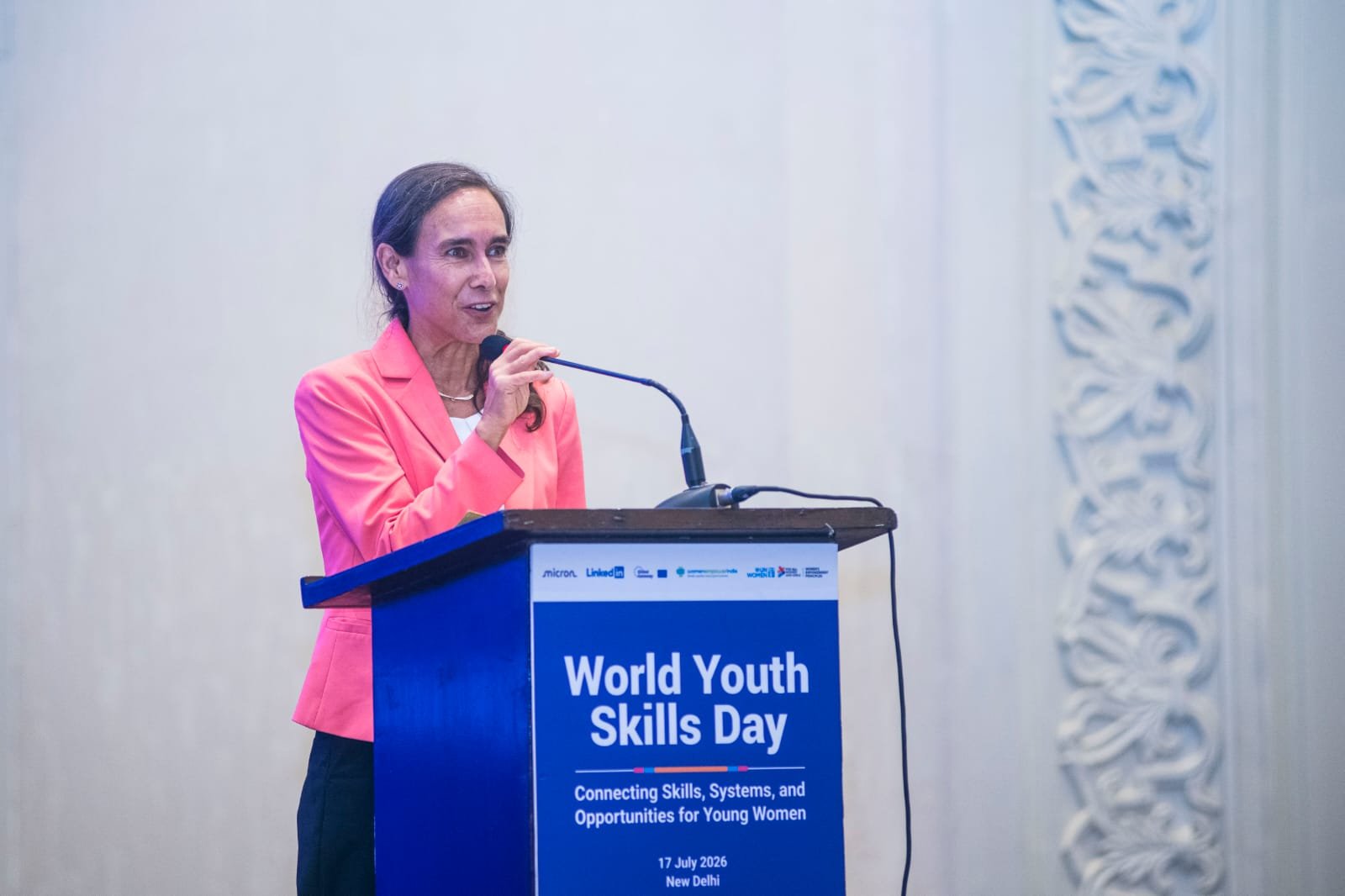
Emphasising that the transition to a green and digital economy must be inclusive, Ms. Pamela Baijal, Deputy Head of the Economic Cooperation and Development Division, Embassy of the Federal Republic of Germany in India, called for stronger systems that enable young women to access quality skills, decent jobs and leadership opportunities.
Addressing the World Youth Skills Day 2026 celebration organised by UN Women India, Ms. Baijal underlined that connecting skills, systems and opportunities is essential to ensuring that young women become active participants in India’s sustainable development journey rather than mere beneficiaries.
A Personal Journey That Shaped Her Belief in Skills
Beginning her address on a personal note, Ms. Baijal reflected on her own career journey, recalling that she was once uncertain about the professional path she should pursue.
After completing school, she enrolled in a two-year certified vocational training programme in banking and finance, which combined classroom learning with practical workplace experience.
“With the right support, young women can thrive in any profession. Strong skilling systems have the power to turn potential into opportunities we may never have imagined.”
She said the inspiring stories shared by young women during the event reaffirmed her belief in the transformative power of vocational education and skills development.
Skills Alone Are Not Enough
Referring to this year’s World Youth Skills Day theme, “Connecting Skills, Systems and Opportunities for Young Women,” Ms. Baijal said the discussion was particularly relevant to the India-Germany Green and Sustainable Development Partnership (GSDP), launched in 2022, which serves as a guiding framework for bilateral cooperation on sustainable development.
She noted that while new jobs will continue to emerge as economies become greener, more digital and more resilient, creating opportunities requires more than just technical skills.
“The question is no longer whether new jobs will emerge, they certainly will. The real question is whether these jobs will offer meaningful opportunities for young women.”
She stressed that an enabling ecosystem is equally important. “Skills are fundamental, but skills alone are not enough. Young women need supportive families, quality and affordable training institutions, safe learning environments, flexible policies, industry partnerships and inclusive workplaces.”
Green Economy Offers Enormous Opportunities
Ms. Baijal observed that India’s transition towards a greener economy presents tremendous opportunities for inclusive economic growth.
She pointed to emerging sectors such as electric mobility and solar energy as industries with significant employment potential.
“There are enormous opportunities for young women in emerging sectors like electric vehicles and solar energy. The challenge is that these sectors are not yet fully prepared to welcome women in large numbers.”
She stressed that addressing gender gaps in technical and vocational education remains essential if women are to benefit equally from the green economy.
“Gender equality is not a separate agenda. It is central to sustainable economic development and to a just transition towards a green economy.”
Women Must Be Professionals, Innovators and Leaders
Ms. Baijal emphasised that women should play leadership roles in shaping future economies.
“Women must participate not only as beneficiaries but as skilled professionals, innovators, entrepreneurs, leaders and changemakers.”
She said Germany and India share the conviction that investing in women, girls and young people is among the most effective investments any nation can make for sustainable development.
Germany’s Long Partnership with India’s Skills Ecosystem
Highlighting Germany’s longstanding cooperation with India, Ms. Baijal noted that Germany has supported vocational education and training (VET) initiatives in India for more than three decades.
She also referred to Germany’s support for green skills initiatives that aim to strengthen women’s participation in future-oriented occupations, particularly in renewable energy and sustainable technologies.
She said stronger collaboration between Indian training institutions and German companies operating in India can create new employment pathways for women.
“Young women should not only be trained for the jobs of the future, they should be empowered to thrive and grow in them.”
Building Systems That Work for Women
Calling for a systemic approach, Ms. Baijal said training institutions must work closely with industry to ensure that education matches evolving labour market demands.
She urged policymakers, businesses and educational institutions to strengthen systems that enable women to enter, remain and advance in emerging sectors.
“World Youth Skills Day is not only about celebrating young people. It is about asking ourselves whether our institutions, labour markets and partnerships are evolving quickly enough to meet the aspirations of young women.”
Germany Reaffirms Its Commitment
Concluding her address, Ms. Baijal reaffirmed Germany’s commitment to working alongside the Government of India, industry partners and development organisations to strengthen a future-ready and inclusive skills ecosystem.
“When we connect skills with systems, and systems with opportunities, we do far more than prepare young women for tomorrow’s jobs. We build the foundation for a more inclusive, competitive and sustainable economy for everyone.”


Leave a Reply