

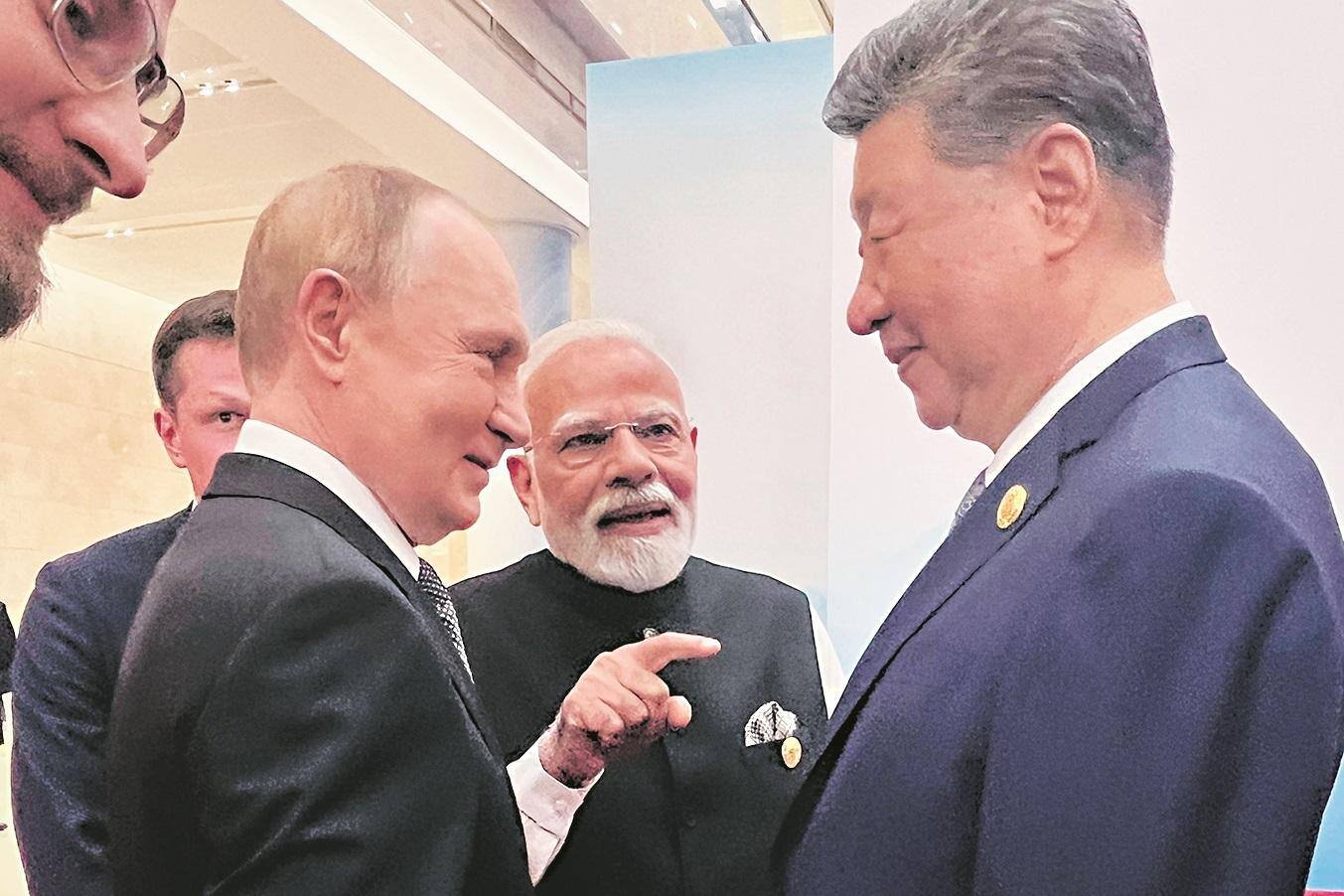
he Shenzhen trilateral signals an emerging politics of great-power accommodation, with China gaining diplomatic visibility, Russia reclaiming international legitimacy and the US testing the limits of transactional diplomacy. For India, the implications are more unsettling and call for a major recalibration of its choices in diplomatic signalling to preserve its national interests.
China clearly emerged as one of the principal diplomatic beneficiaries of the trilateral summit involving the US, Russia and China, held on the sidelines of the APEC summit in Shenzhen on 19 November 2026, much like a master chess player. Watched with considerable anxiety and introspection by other powers, the meeting was as much about optics as it was about the substance of negotiations. ‘Candid’, ‘positive’, ‘constructive’ and ‘fruitful’ were the words used by the media to describe these meetings, as China made a bid for a more accommodative arrangement that could have far-reaching consequences beyond the summit.
For Beijing, the occasion offered an opportunity to position itself as a convenor of great-power diplomacy. On the other hand, as far as the US is concerned, the APEC 2026 summit was a remarkable diplomatic gamble, if not a potential strategic miscalculation or faux pas.
Having previously opposed Russia’s assault on Ukraine, which was largely condemned by the Biden administration, Trump was in Shenzhen to ‘propose peace’ or, rather, sit at the negotiating table with Putin and Xi in a setting that conferred symbolic legitimacy upon both leaders. This major concession to the two traditional rivals, now considered ‘frenemies’ of the US, almost sounded like a death knell for the Donroe Doctrine.
Not only will this create pressure on the US to let go of some ground in Iranian waters, but it will also necessitate a deeper recalibration within US policy circles on how much the country is willing to concede in order to promote peace or accommodate a ‘peaceful transition in the global world order’. The contrast was striking, given the continued absence of a negotiated settlement to the Ukraine war.
Military intervention and financial assistance, the two most significant tools deployed as complementary instruments of US geopolitical influence, seem truncated, with almost no expectation of political and ideological alignment.
Trump’s adaptation of the Monroe Doctrine, with an emphasis on American primacy in the Western Hemisphere, rests on an assertion of regional dominance and an unwillingness to tolerate external influence in its immediate neighbourhood. Yet his willingness to engage Moscow and Beijing through personalised diplomacy suggests that the pursuit of American primacy may increasingly coexist with selective compromises elsewhere.
In fact, at the summit, all three countries had geopolitically different aims: China sought to reinforce its credentials as a responsible global power and advocate of multilateral cooperation; Russia sought recognition as an indispensable interlocutor in international security; and the US appeared willing to experiment with a more personalised and transactional approach to managing its geopolitical rivals.
While comparisons with Yalta became inevitable because of the optics and historical nostalgia evoked among global leaders, what is clear is the remaking of a new multipolar ‘cake’, in which the powers did not feel the need to carve out new spheres of influence, but only to consolidate their territorial presence along already pre-drawn lines.
The 1945 Yalta Conference was convened by wartime allies to determine the contours of the post-war settlement. At Shenzhen, however, competing powers came together without a shared strategic vision. The danger is that this arrangement could normalise multipolar bargains on spheres of influence and tacit understandings on security questions without formal agreements.
The APEC 2026 summit was an eye-opener to the ‘new reality of political compromises’ and the ‘death of global hegemonic claims’, characterised by a lack of political will to ‘own’ the stage on the part of any single nation. China, otherwise, is happy to believe that it has owned, arrived on and conquered this stage.
India, unfortunately, still lags far behind in the mental calculus of these great powers, diminishing its ability to engage as a major stakeholder in the new great game unfolding on the ashes of Ukraine and Iran.
The APEC declaration itself is a tiny masterpiece of diplomatic brinkmanship, with the Chinese emphasising that “at a time when military-political risks are on the rise, what is desperately needed is unity rather than division and dialogues rather than ultimatums.”
Under the theme ‘Building an Asia-Pacific Community to Prosper Together’, China sought to foreground openness, innovation and cooperation, with particular emphasis on the digital economy and artificial intelligence (AI) as engines of innovation-driven growth. Xi Jinping’s remarks on digital infrastructure, cross-border trade flows and an open innovation ecosystem reflected Beijing’s ambition to shape the economic and technological architecture of the Asia-Pacific region.
China’s claims in the South China Sea were the only exception that rekindled the flames of regional hegemonism, but these claims were also largely irredentist. Meanwhile, it reassured other countries of its commitment to opening the Chinese market, seeking to assuage US concerns and mitigate the risks arising from tariffs.
China also reiterated its commitment to financing infrastructure projects across Southeast Asia, Africa and Europe, which will help it build and retain its geopolitical clout.
It was obviously the first-ever trilateral meeting among the leaders of these three countries after a hiatus of many years, specifically in the context of the failure of various peace proposals to coerce Putin into ceasing his war on Ukraine.
Trump came well-equipped with the threat of a ‘nuclear button’, and his objective was to push for a new nuclear arms control framework that would include China, following the expiration of the New START treaty between Washington and Moscow in February.
While the signalling and optics astutely brought out China’s ability to mediate and lay down a negotiating table for the G3, Putin was more outspoken about how the ‘nuclear football’ was not really a deterrent when it came to deterring his actions in Ukraine.
The summit closed with the usual affirmations that ‘a nuclear war cannot be won and must never be fought’, alongside deliberations on reducing nuclear risks and preventing the proliferation of nuclear weapons. However, there was no commitment to reduce or restrict the development of nuclear weapons.
The three countries reaffirmed the importance of stable energy flows and of devising plans to increase the production and supply of refined petroleum products for the benefit of all nations.
But the major elephant in the room was unmistakably India. India risks falling behind in the strategic calculations of these powers, and its absence from significant negotiating tables like this one could deter its ability to influence the emerging architecture of great-power negotiations.
Notwithstanding the polemical debate over ‘Asia-Pacific’ and the ‘Indo-Pacific’, India is cognisant of the economic opportunities and geopolitical stakes that will define the future of this part of the globe. Its efforts have largely been concentrated on strengthening its position through platforms like the QUAD and the East Asia Forum.
Modest Reciprocity: The Politics of Selective Accommodation
China and Russia both blithely brushed aside US criticism of debt-trap diplomacy and the leveraging of financial influence through the weaponisation of critical supply chains. The Shenzhen meeting did little to resolve these underlying disagreements.
Putin, for his part, blatantly claimed that Western sanctions imposed on Russia had failed: “They were not capable of fully stopping growth or destroying the economies of the competition.”
However, a modicum of reciprocity could be seen in the way these countries remained silent on each other’s core national interests and acknowledged that the international leadership power matrix had become too complicated for any one power to impose a ‘winner takes it all’ settlement.
The summit demonstrated how competing powers can temporarily bracket their differences when broader strategic interests demand diplomatic accommodation.
Thus, for Putin, the meeting was particularly valuable. At a time when Russia continues to face Western sanctions and diplomatic isolation over Ukraine, sharing a negotiating table with the American and Chinese presidents offered an opportunity to reaffirm Moscow’s status as a major international power.
The optics alone were consequential: Russia could demonstrate that its exclusion from Western diplomatic forums had not translated into exclusion from great-power diplomacy.
For Xi Jinping, the summit offered a different dividend. By hosting both leaders, China acquired diplomatic visibility as a convenor of strategic negotiations. Its ability to bring Washington and Moscow together reinforced Beijing’s claim that it can play a consequential role in managing international tensions.
Yet this diplomatic achievement should not be mistaken for evidence that China has become an impartial mediator. Its close strategic partnership with Russia and its own rivalry with the United States inevitably shape its negotiating preferences.
Trump, meanwhile, appeared to derive political value from the spectacle of personal diplomacy. His engagement with Xi and Putin was consistent with his preference for leader-to-leader negotiations, often privileging immediate political outcomes over established diplomatic processes.
The risk, however, is that such personalised diplomacy can generate expectations of strategic accommodation without necessarily producing durable agreements.
But the essential fault lines remain deep-seated. The United States remains concerned about China’s technological and economic ascendancy; China continues to resist American strategic containment; and Russia’s relationship with Washington remains heavily conditioned by the Ukraine war.
What emerged in Shenzhen is thus a politics of modest reciprocity: a willingness to recognise one another’s strategic interests without necessarily accepting one another’s geopolitical claims.
The US President had a meeting with Philippine President Ferdinand Marcos Jr. just before attending the APEC summit. During the meeting, defence cooperation was extended through a proposal for a major civilian nuclear energy project, and the two countries reached a mutually beneficial trade deal.
The Chinese and Russians seemed relaxed and unbothered by this muscle-flexing in the near seas, welcoming the US as a reassured duo that knew how to play its cards well.
Xi Jinping’s attempts to receive the US President with the same pomp and honour that had been accorded to him on US soil a few months earlier can be read as little more than reciprocity in diplomatic conduct. It does not suggest any diminishing of Putin’s significance in terms of strategic relationships.
On the other hand, the traditional discomfort of the Japanese came to the surface in the way Sanae Takaichi was received by a person of much lower rank, demonstrating that Japan’s position had been lowered in the Chinese hierarchy of relationships.
A Tilted Negotiating Table and India’s Optimism as It Bites the Bitter Pill
The historic trilateral meeting was an eye-opener for another reason: it exposed the growing tendency of major powers to privilege direct negotiations among themselves, potentially relegating the interests of other stakeholders to the margins of international decision-making.
India is not a member of APEC and was therefore not a participant in the APEC Leaders’ Meeting. Nevertheless, the optics of three major powers discussing nuclear stability, energy security and international governance without India’s participation raise questions about its position in the wider architecture of great-power diplomacy. They also create political anxiety about the possibility of India being relegated to the role of a ‘non-flag bearer’ in the larger geopolitical contestation.
India is neither a peripheral power nor a passive observer of the changing international order. It is a major economy, a nuclear-armed state, an influential voice of the Global South and an increasingly consequential actor in the Indo-Pacific.
Its strategic partnerships with the United States, its longstanding defence and diplomatic relationship with Russia, and its complex economic and security competition with China give it a distinctive position in the international system.
Yet these attributes do not automatically translate into a seat at every consequential negotiating table. India, despite its growing capabilities, does not yet possess leverage comparable to that of the ‘G3’.
More importantly, its strategic autonomy, while a source of diplomatic flexibility, can also complicate its ability to build enduring coalitions around specific geopolitical objectives.
For India, the larger challenge is to ensure that emerging arrangements do not create strategic asymmetries that undermine its interests. It must also find a respectable voice for itself across different hedging platforms and developmental forums, safeguarding its national interests.


Leave a Reply