

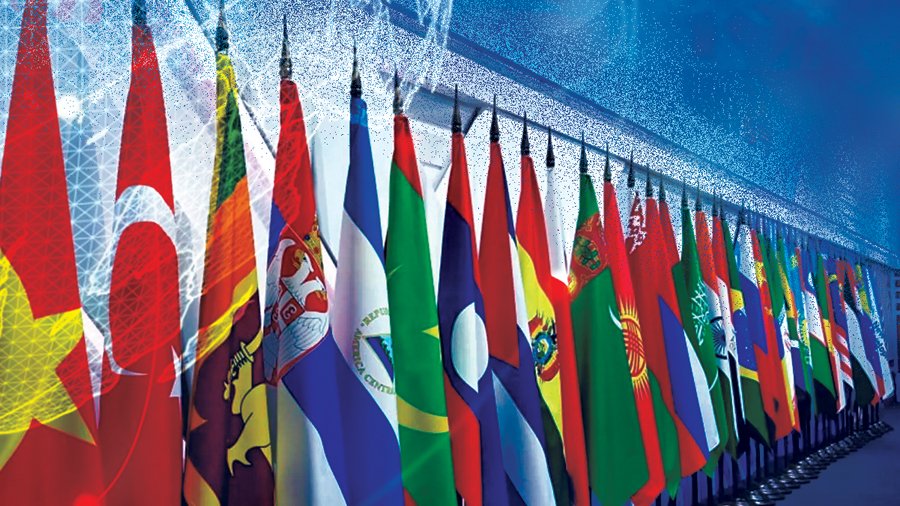
Amid ongoing geopolitical uncertainty in India’s periphery, the country has intensified its engagements in multilateral institutions, given the anarchic structure of the international system. It is crucial to focus on development and diplomacy to foster a peaceful and robust global order. India must navigate this environment by convergently collaborating with multiple stakeholders within a global order shaped by resource and economic interdependencies, while maintaining strategic autonomy.
In the context of multipolarity, it is essential for India to deepen its global engagement to retain autonomy through platforms such as BRICS+, the G7, and the G20. These institutions collectively account for a significant share of global GDP (PPP) and trade volume, underscoring their importance for India as it navigates an increasingly complex geopolitical landscape through engagement and collaboration.
President Trump’s assertive and nationalistic narrative, exemplified by Make America Great Again (MAGA), reflects a mercantilist intent that may not align with the needs of developing countries. These countries remain apprehensive about neocolonial tendencies and the impact of geopolitical uncertainty on their resources and markets.
At a time when Washington is exploring alternative engagements—such as its outreach to Pakistan during the recent Iran war—it appears to be adopting a zero-sum approach toward India’s interests. This includes the use of economic coercion through tariffs to pressure New Delhi to reduce its engagements with Moscow. Consequently, New Delhi has been compelled to recalibrate its global engagements based on norms, values, and principles within a rules-based order, where constructive cooperation and mutual understanding are essential to interpreting state behaviour.
Further, through its involvement in various groupings, New Delhi can leverage its multilateral engagements to hedge while engaging with major powers. At the G20 Summit of 2023, India was appreciated for its inclusive approach toward the Global South, particularly for facilitating the inclusion of the African Union as a member of the G20 under the Delhi Declaration, which[1] emphasised sustainable initiatives such as LiFE, Digital India, and a universal institutional approach under the slogan Vasudhaiva Kutumbakam—‘One World, One Family.’
The recent expansion of BRICS has been viewed as an effort to create an alternative platform for Global South countries to address developmental needs, including innovation, technological and academic growth, employment, and skill development. However, India faces a strategic dilemma: it cannot participate in overtly anti-Western blocs, but it can engage in alternative partnerships that do not seek to antagonise the West or the United States.[2]
Washington’s recent aggressive tactics, including the imposition of tariffs, have led New Delhi to sign agreements with the UK and the EU, while also recalibrating ties with Beijing through the resumption of flights, dialogue, and economic exchanges.
Recently, BRICS has undergone expansion, beginning with the Kazan Summit, with the inclusion of Iran, Egypt, Indonesia, Saudi Arabia, Ethiopia, and the United Arab Emirates.[3] China’s increased involvement in India’s periphery has prompted New Delhi to diversify its focus toward other groupings and partnerships through a flexible approach.
With the inclusion of more countries, BRICS now accounts for approximately 40 per cent of global oil supply and a combined GDP of USD 32 trillion, as noted in an IDSA report.[4] For India, the BRICS 2026 presidency may serve as an opportunity to foster sustainability, particularly under the theme “Building Resilience and Innovation for Cooperation and Sustainability.”[5]
BRICS can be seen as an alternative platform for the Global South, offering opportunities for growth in sectors such as ICT, agriculture,[6] and minerals, alongside fostering innovation, empowerment, and people-to-people exchanges. Additional benefits may include the development and protection of indigenous communities and support for small and medium enterprises (SMEs).
Global frameworks have proven to be vital platforms for India to reiterate its call for development and growth. In this context, the G20, BRICS, and G7 serve as key institutions for collaboration, cooperation, and inclusive global development. The combined GDP of the G7 amounts to USD 78 trillion, making it a powerful forum for middle powers to engage and participate.
At the recent Kananaskis G7 Summit, Prime Minister Modi[7] emphasised the importance of development for the Global South, particularly in areas such as artificial intelligence, the green economy, quantum technology, information technology, critical minerals, automobiles, and pharmaceuticals.
Other areas for collaboration include addressing non-traditional security threats such as climate change, drug trafficking, illegal migration, and radical extremism, as well as ensuring that institutions adhere to principles of non-bias and impartiality toward weaker societies and communities.
Building on India’s past successes and global outreach during its G20 presidency, the country continues to pursue a strategy of multi-alignment to advance its global ambitions. At the recent Johannesburg Summit,[8] Prime Minister Modi highlighted the importance of collaboration on critical minerals essential for electric vehicle (EV) batteries and clean energy. He also proposed initiatives involving the use of satellites for disaster management, agricultural and fisheries development, and addressing concerns related to nutrition and food security.
These sustainable initiatives can help shape a positive narrative for India’s global outreach and incentivise Global South countries to view its rise favourably.
In light of uncertainties with partners such as the United States, it has become imperative for India to pursue a foreign policy grounded in national security, national will, and national interest. Aid diplomacy, particularly in supporting the rehabilitation of conflict-affected countries, can serve as a means to build goodwill and strengthen partnerships.
An independent foreign policy must remain assertive and persuasive, even in the face of economic coercion. This can be mitigated through increased multilateral engagement, ensuring that the global order does not shift toward unipolarity.
Trump’s dual-track foreign policy has been viewed with scepticism by allies. Despite being part of the QUAD, New Delhi faces constraints in voicing concerns due to its engagements with Washington through initiatives such as iCET and defence cooperation.
Moreover, Washington views the Indo-Pacific as a critical geopolitical theatre that it seeks to protect and re-establish. In this context, it should recognise India as a viable counterbalance to China’s economic influence, particularly through partnerships with middle and smaller powers. India can project itself as a reliable partner by offering a strong market and skilled labour in initiatives under the G20, BRICS, and G7 frameworks.
Currently, Washington’s isolationist tendencies, reflected in its scepticism and perceived regional coercion of allies,[9] have not been well received. As a result, many countries are increasingly looking toward India or China, making platforms such as BRICS+, G7, and G20 even more significant in safeguarding India’s position as a comprehensive regional power.
Thus, a cautious “wait and watch” approach will be necessary to assess evolving geopolitical trends, enabling India to hedge, balance, and engage with countries on converging interests.
Therefore, engagement with multilateral frameworks provides India with the impetus to promote sustainable development initiatives for Global South countries. Through these platforms, India can act as a bridge between the Global North and South, ensuring that core principles such as respect for recognised borders and maritime security[10] are upheld in an uncertain and anarchic global order, where survival depends on cooperation and engagement on shared global challenges.
[1] G20 Leaders Declaration, G20 India , September 9-11th 2023, https://www.g20.in/content/dam/gtwenty/gtwenty_new/document/G20-New-Delhi-Leaders-Declaration.pdf
[2] Yashraj Sharma, BRICS wargames: Why they matter, why India opted out, Al Jazeera , January 11th 2026, https://www.aljazeera.com/news/2026/1/11/brics-wargames-why-they-matter-why-india-opted-out
[3] Yashraj Sharma, BRICS wargames: Why they matter, why India opted out, Al Jazeera , January 11th 2026, https://www.aljazeera.com/news/2026/1/11/brics-wargames-why-they-matter-why-india-opted-out
[4] Ashok Sajjanhar, India’s BRICS Presidency: Challenges and Opportunities, Manohar Parrikar IDSA, February 16th 2026, https://idsa.in/publisher/issuebrief/indias-brics-presidency-challenges-and-opportunities#:~:text=The%20total%20GDP%20of%20the,more%20than%2040%20per%20cent.
[5] English translation of Prime Minister’s statement during the BRICS session on Environment, COP-30, and Global Health, Ministry of External Affairs, July 7 2025 , https://www.mea.gov.in/Speeches-Statements.htm?dtl/39775
[6] Rio de Janeiro Declaration- Strengthening Global South Cooperation for a More Inclusive and Sustainable Governance, Ministry of External Affairs, July 7th 2025, https://www.mea.gov.in/bilateral-documents.htm?dtl%2F39770%2FRio_de_Janeiro_Declaration_Strengthening_Global_South_Cooperation_for_a_More_Inclusive_and_Sustainable_Governance
[7] Prime Minister addresses the G7 Outreach Session, Ministry of External Affairs, July 17th 2025, https://www.mea.gov.in/press-releases.htm?dtl/39690/Prime_Minister_addresses_the_G7_Outreach_Session_June_17_2025
[8] PM Modi proposes six new initiatives at G20 Leaders’ Summit in Johannesburg, News on Air, November 23rd 2025, https://www.newsonair.gov.in/pm-modi-unveils-six-global-development-initiatives-at-g20-summit-opening-in-johannesburg/
[9] Hugo Dixon, Geopolitical jujitsu can turn the tables on Trump, Reuters, January 26th 2026, https://www.reuters.com/commentary/breakingviews/geopolitical-jujitsu-can-turn-tables-trump-2026-01-26/
[10] Richard M Rossow India’s Future Strategic Choices: Complications of Mass, Centre for Strategic and International Studies, December 2nd 2026, https://www.csis.org/analysis/indias-future-strategic-choices-complications-mass



Leave a Reply