

Technology is no longer simply supporting the travel experience; it is increasingly becoming part of the journey itself. From visa processing and airport navigation to personalised travel services and wellness, artificial intelligence is beginning to connect the many fragmented stages of a traveller’s journey.
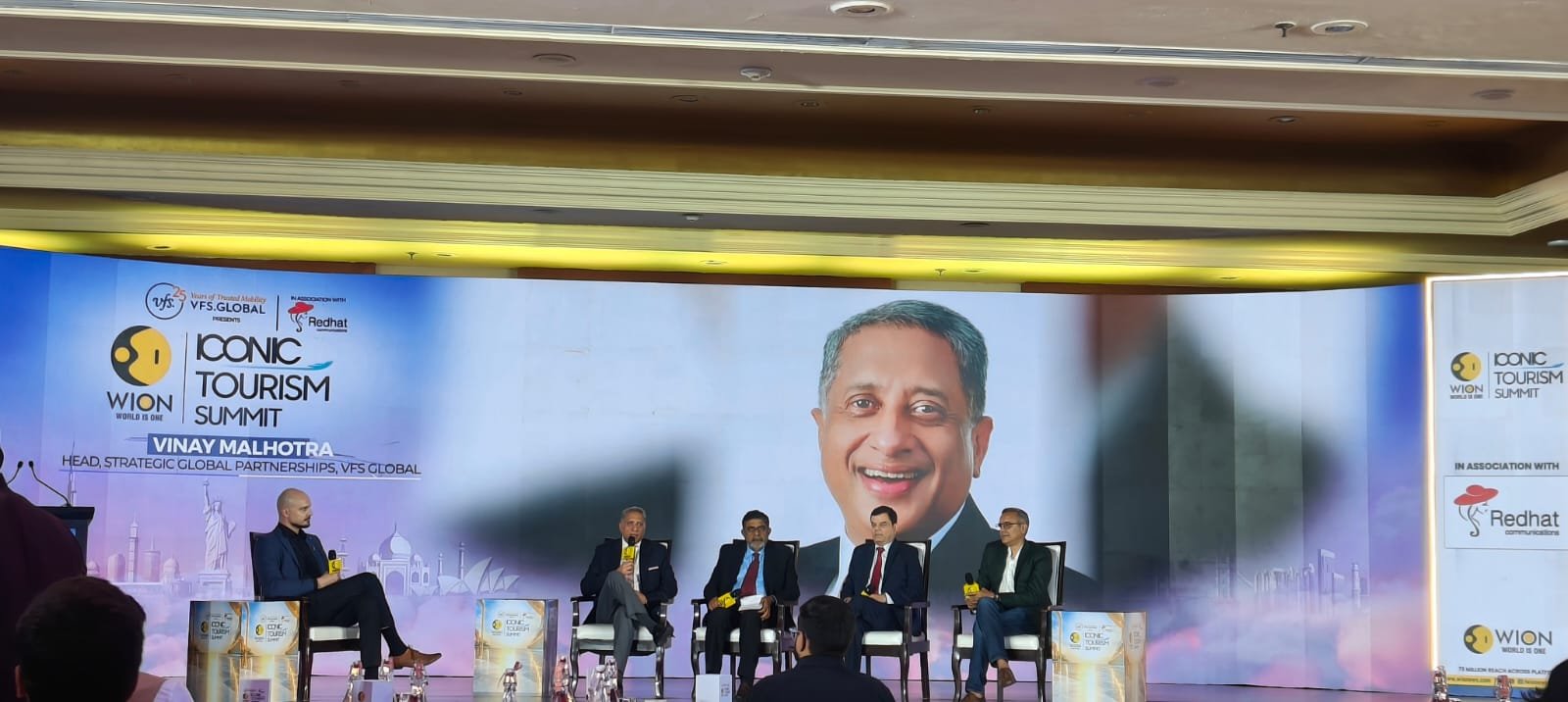
That was the central theme of the panel ‘Tech Frontiers: Reshaping Journeys’ at the WION Iconic Tourism Summit, held on 23rd September in New Delhi, which brought together Anil Parashar, Executive Director, ITQ Technologies Pvt Ltd; Vinay Malhotra, Head – Strategic Partnerships, VFS Global; Achin Sharma, Chief Digital Officer, WAISL; and Abhilash Kalathil, Executive Director, Kairali Ayurvedic Group.
The conversation quickly moved beyond the familiar question of whether AI will transform tourism. The more pertinent question, the panellists suggested, is how technology can make travel genuinely simpler without making it less human.
For Vinay Malhotra, the scale of VFS Global’s operations makes technology indispensable. VFS Global currently serves 70 client governments and operates more than 4,000 application centres across 167 countries.
He pointed to the company’s Intelligent Document Processing (IDP) capabilities as an example of AI being used behind the scenes to support visa processing. Such systems can help identify inconsistencies in documentation and generate structured information for visa officers, while keeping the actual visa decision with the relevant government authority. VFS Global itself emphasises that its IDP solution operates with human-in-the-loop controls.
Malhotra also highlighted the challenge posed by increasingly complex documentation. Bank statements, for instance, can run into hundreds of pages, making manual scrutiny both time-consuming and difficult. AI can help identify anomalies and inconsistencies that may otherwise be missed.
But technology, he stressed, is not confined to the back office. VFS Global’s digital services also extend to customer interaction, with AI and generative AI being used to support communication across multiple languages.
One of the most practical examples he offered was Visa At Your Doorstep, a service that takes the visa application process to a traveller’s home, office or another convenient location. The mobile set-up can capture documentation, biometrics, photographs and digital signatures before transmitting the information to the relevant authorities. The service is particularly useful for corporate groups, families, medical travellers and those living far from visa centres.
For Malhotra, therefore, technology works best when it removes friction.
That thought became a recurring theme throughout the discussion.
Anil Parashar argued that the travel industry should be careful not to confuse technology adoption with progress. Technology should simplify the experience rather than create another layer of processes for travellers and travel professionals.
His larger point was that AI should not be viewed as a replacement for human judgement. Travel agents, he suggested, will continue to have a role precisely because technology cannot anticipate every human circumstance.
“The question that we need to be asked is what technology cannot do,” was the essence of Parashar’s argument. The tasks that technology cannot handle effectively will continue to require human intervention.
This becomes particularly important when technology gets something wrong.
Parashar cited examples from the airline industry where data-driven systems can produce recommendations based on historical patterns, while human decision-makers may recognise circumstances that the algorithm has not adequately captured. The lesson was clear: data can inform decisions, but it should not automatically dictate them.
Achin Sharma brought the discussion closer to the airport itself. As airports become increasingly digitised, he argued, the biggest opportunity lies not in deploying isolated technologies but in connecting the different parts of the travel ecosystem.
WAISL is already working in this direction, with solutions spanning passenger processing, airport operations, biometrics, analytics, IoT and digital-twin technology. Its current AeroWise platform, for example, brings operational data together to provide airports with a unified view of airside and landside activity.
For Sharma, the real promise of AI is its ability to reduce friction across the entire journey. A traveller should not have to repeatedly move between different systems for flights, hotels, transfers and other services. AI could eventually connect these stages and anticipate problems before they become disruptions.
A delayed flight, for example, should not simply generate an alert. An intelligent travel ecosystem could recognise that the delay threatens a connecting flight, identify alternatives and present them to the traveller.
The airport itself is also becoming more intelligent. WAISL’s work with GMR Airports includes AI-enabled operational systems, while DigiYatra and facial-recognition-based passenger processing are helping create more paperless and contactless journeys.
Sharma’s vision extended even to navigation inside airports: technology can guide passengers from one gate to another while also intelligently surfacing relevant services along the way.
Yet the panellists repeatedly returned to one warning: technology for technology’s sake can be counterproductive.
A digital check-in that requires a traveller to enter the same information repeatedly is not seamless. A chatbot that cannot resolve a problem but prevents access to a human agent is not necessarily improving customer service. And an automated process that depends on unreliable connectivity can become another source of frustration.
“Automate the predictable and humanise the exceptions,” Sharma said, capturing perhaps the most important principle to emerge from the discussion.
For Abhilash Kalathil, technology is equally relevant to one of tourism’s fastest-growing segments: wellness travel.
Kairali Ayurvedic Group has been experimenting with AI not to replace Ayurveda practitioners, but to support them and create more personalised engagement with guests. The group introduced KAAI and its AI assistant, Aarika, designed to support practitioners with information, case management and personalised recommendations.
Kalathil described a future in which technology can maintain a relationship with a guest even after the physical wellness experience has ended. Rather than sending generic promotional messages, an AI-enabled system could remember preferences, interests and previous experiences and help create a more personalised relationship with the traveller.
For a wellness business built around long-term relationships, that distinction matters.
At the same time, Kalathil acknowledged that there are moments when technology must step aside. If a guest needs to discuss a medical issue, medication or a question that requires professional judgement, the interaction must be escalated to the appropriate human expert.
The discussion ultimately revealed that the future of travel may not be about choosing between humans and machines. It is about deciding where each is most useful.
AI can process vast quantities of information, identify patterns, predict disruptions, personalise recommendations and automate repetitive tasks. Humans bring empathy, context, judgement and the ability to respond to circumstances that do not fit neatly into a dataset.
As Parashar put it, the real opportunity lies in making technology work for people rather than making people work around technology.
The next frontier of tourism, therefore, may not simply be smarter airports, faster visas or more sophisticated AI assistants. It may be a travel ecosystem in which these technologies finally begin to speak to one another, quietly removing the friction from the journey while leaving the most human parts of travel firmly in human hands.


Leave a Reply