

Some poems are read. Others are performed. And then there are those rare moments when poetry escapes the printed page altogether, finding its rhythm in voice, music and the imagination of everyone present.
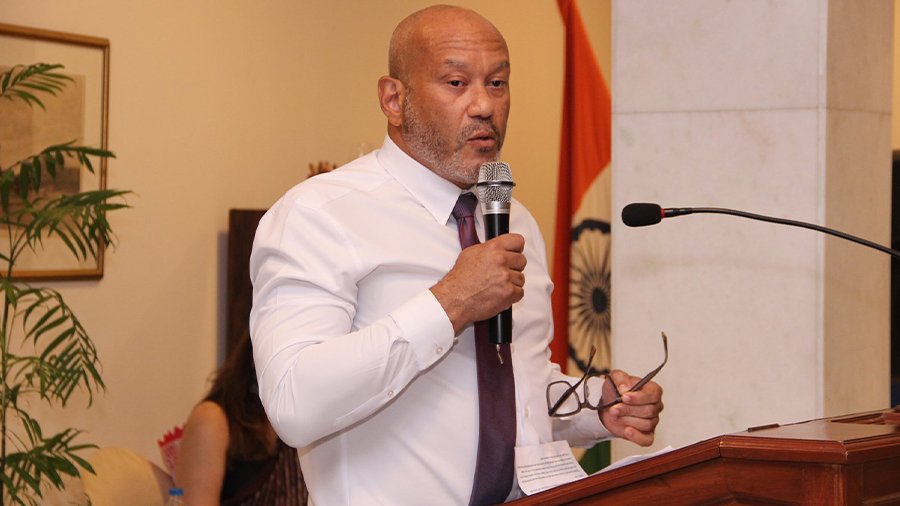
That was precisely the experience created by H.E. Mr. Jason Keats Hall, High Commissioner of Jamaica to India, during the Literary Evening jointly hosted by the Austrian Embassy in New Delhi and Diplomatist Magazine at the Residence of the Austrian Ambassador on 25 June 2026.
The evening had already celebrated literature from across continents. But when it was Jamaica’s turn, something changed.
Rather than simply reading from the text, High Commissioner Hall brought to life “The Song of the Banana Man” by celebrated Jamaican poet Evan Jones to the accompaniment of music. Dub poetry is a form of performance poetry that originated in Kingston, Jamaica, in the 1970s. It involves spoken word delivered over reggae rhythms or dub music. Pioneers of the genre often use it as a powerful medium for social commentary and political protest. As the opening chords from the music played, the atmosphere in the room took on an entirely different character.
The words acquired rhythm. The rhythm became movement.
And before long, the audience was no longer merely listening to a poem; they were experiencing it.
Laughter, smiles, and spontaneous applause filled the room as High Commissioner Hall recited the poem with remarkable energy, warmth and theatrical flair.
Originally written as a celebration of the everyday Jamaican farmer, The Song of the Banana Man is far more than a simple poem. It is an affirmation of self-reliance, dignity and Caribbean identity. Emerging from the historical realities of slavery, colonialism and hardship, Evan Jones’s work challenges prejudice while celebrating hard work, resilience, gratitude and national pride.
Those themes resonated well beyond Jamaica.
Following his spirited reading H.E. Mr. Jason Keats Hall, High Commissioner of Jamaica to India, joined Ajay Jain, Founder of Kunzum Bookstore, for a brief but engaging conversation that offered the audience a deeper understanding of both the poem and Jamaica itself.
Opening the discussion, Ajay Jain asked the High Commissioner what had inspired him to select The Song of the Banana Man for the Literary Evening.
The High Commissioner smiled and admitted that it had not been an easy decision. He had considered several literary works before finally choosing the poem, describing it as his “first choice” for a deeply personal reason.
Recalling a childhood memory, he shared that it was customary for generations of Jamaican schoolchildren to recite poetry during annual school performances. When it was his turn as a young student in primary school, he froze before the audience and was unable to do it.
“I was extremely shy in school and never able to perform this poem publicly” he said with a laugh. “So, this evening is a first’. “It is probably also the first time that this poem has been performed to dub music”
The conversation then moved beyond the poem itself to Jamaica’s remarkable cultural identity.
The High Commissioner observed that although Jamaica is a nation of just under three million people, its influence on the world has been far greater than its size would suggest. He pointed to reggae music as one of the country’s greatest cultural exports, describing it as a powerful ambassador that has connected Jamaica with people across the globe.
“Travelling the world as a Jamaican has been phenomenal for me,” he remarked, explaining that music has often opened doors and created connections long before formal diplomacy begins. Culture, he noted, has always played a diplomatic role.
Ajay Jain then invited him to reflect on another area in which Jamaica has earned global recognition: sport.
The High Commissioner spoke proudly of Jamaica’s extraordinary achievements in athletics, particularly in sprint events. He noted that Jamaican athletes have won more than a third of all Sprint medals (100m, 200m, 110m high hurdles, 100m hurdles, 400m, 4 x 100m, and 4 x 400m relays) in international competitions (Olympics and IAAF World Championships), with only the United States surpassing them, a remarkable accomplishment considering the vast difference in population size.
Comparing a country of approximately 2.8 million people with one of over 300 million, he remarked with characteristic humour, “Something special is happening in Jamaica.”
For him, however, Jamaica’s success cannot be measured by medals or music alone. It is rooted in the country’s history.
He reflected that the resilience, determination and confidence displayed by Jamaicans today have emerged from triumph over generations of struggle, oppression and adversity. Those experiences have shaped a people whose creativity, perseverance and sense of identity continue to inspire the world.
Ajay Jain also noted that the High Commissioner’s middle name is Keats, prompting him to ask whether there was a connection with the celebrated English Romantic poet, John Keats. Smiling, High Commissioner Hall shared the touching story behind his name.
His grandfather, John McGowan Hall, though not formally educated, was an avid reader and he named each of his children after renowned British writers. “I have an Uncle Wells, an Uncle Cadman, an Uncle Marshall, an Aunt Myrth and my father was Keats,” he recalled. He was extremely eloquent and passed down this gift to his children, each formidable wordsmiths in their own right.
The literary legacy continued into the next generation, as he inherited his father’s name and, perhaps, his love for language. Reflecting on a peripatetic childhood spent living in countries as diverse as Brazil, Mozambique, Eswatini, Sierra Leone, and latterly, the USA and the UK for university, he remembered a time when friendships were sustained through handwritten letters, postcards and aerograms. Those experiences, he said, helped to nurture a lifelong habit of writing. It also helps that everyone in my family is a writer, my mother Hyacinth Hall with a PhD in Child Education and Psychology is a poet, my middle sister, Kathryn Hall, also a PhD, in Micro Biology and Molecular Genetics from Harvard is a published author (see The Placebo Effect), and my eldest sister Christine Bergsrud with multiple Post graduate degrees is a fine writer of fiction as well.
Even today, he continues to write with great care, joking that he still punctuates his Whatsapp text messages. During the COVID-19 lockdown in India, writing became both a creative outlet and a source of comfort, inspiring him to compose poetry and begin work on a book. “I enjoy writing,” he said, describing English as a wonderfully rich language whose vast vocabulary and remarkable evolution continue to fascinate him.
In just a few minutes, High Commissioner Hall demonstrated that diplomacy is not only conducted through policy and negotiation. Sometimes, it is carried in a poem learned as a child, a melody recognised across continents, or the quiet pride with which one speaks of home.
And on that memorable evening in New Delhi, Jamaica told its story with poetry, music and unmistakable joy.


Leave a Reply