

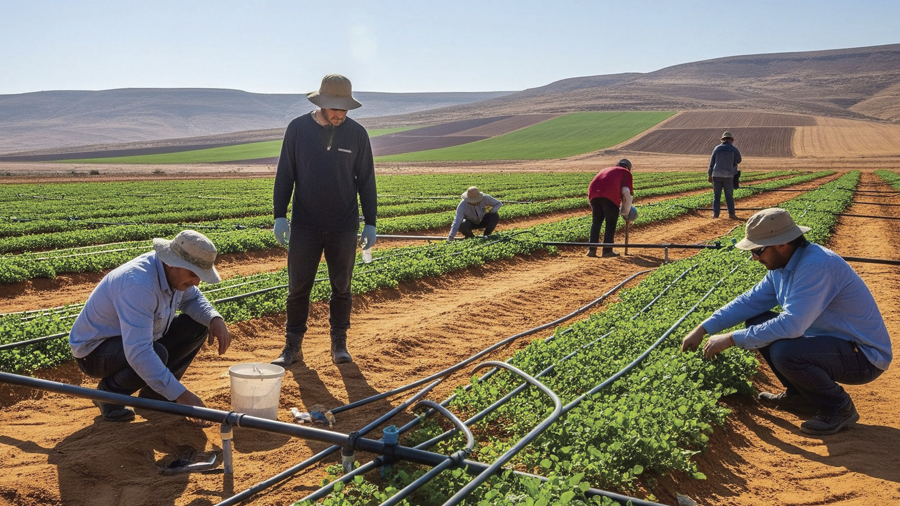
India-Israel relations hold far deeper promise beyond this oft-hyped bonhomie of their national leaders that was once again on display during Prime Minister Modi’s two-day visit to Israel during the last week of February 2026. In a carefully choreographed state visit — capped by an address to the Knesset and a joint declaration elevating bilateral ties to a Special Strategic Partnership for Peace, Innovation & Prosperity — agriculture stood out as one of the most concrete areas of continued shared progress and promise to make their partnerships a future-security enterprise.
Especially their new phase in their agricultural cooperation that began from this visit isn’t about aspirational symbolisms alone. It reflects their over two decades of incremental piece-building under the Indo-Israeli Agriculture Project (IIAP) that was launched in 2006 with Israeli technical assistance through MASHAV —Israel’s international development agency, with a focus on skill building and technical cooperation in agricultural and food security, and its Indian counterparts, such as the National Horticulture Mission. In 2026, this cooperationbegan to pick up momentum in scale, spectrum, and size, promising to make India’s agriculture sector sustainable and competitive.
Technology Transfer for Rural Transformation
At the heart of the Indo-Israeli partnership have been Centres of Excellence (CoEs) — high-tech agricultural hubs co-designed by Israeli experts and Indian agricultural institutions. While 32 of these are already operational, 18 more have been under development. During this visit to Israel, PM Modi announced their decision to take this number to 100 to ensure enhanced productivity and income for Indian farmers.
These CoEs have adapted Israeli innovations and best practices in drip irrigation, fertigation, protected cultivation, pest management, nursery technology, and water-efficient horticulture to local Indian conditions. These have trained thousands of Indian farmers — from Punjab to Karnataka — in novel methods that have improved the quality and quantity of their yields. While comprehensive statewide income data is still emerging, early field surveys show that farmers participating in CoE and allied programmes have reported higher monthly net incomes thanks to better crop quality and reduced input waste.
It is in this backdrop that Prime Minister Modi, along with his counterpart, Prime Minister Benjamin Netanyahu, announced a new grassroots-centric initiative known as ‘Villages of Excellence’. This shift — from isolated demonstration plots to community-level transformation — seeks to embed Israeli technologies directly into Indian village ecosystems. It means farmers won’t merely visit a CoE site; they can experience tailored irrigation systems, satellite-based soil monitoring and real-time decision support right in their home districts.
What Indian and Israeli Farmers Gain
What has sustained their enduring partnership is the fact that it has ensured mutual benefit for both sides. For Indian farmers, the value of this cooperation has been palpable across several parameters, including the following:
Likewise, Israeli farmers and agritech sectors have also benefited from their sustained cooperation with India. This can be seen from:
In essence, Indian demand provides Israeli technology firms — especially those specialising in Artificial Intelligence-driven crop analytics, sensors, and automated irrigation systems — with a vast field of laboratories and a commercial pathway which makes their partnership mutually beneficial.
Complementarity of the Two Agri-Systems
One question often asked is how a small, arid, water-starved nation of 10 million people like Israel aligns so well with a giant agrarian economy like India’s 1.4 billion masses ordained with monsoon and extensive rain-fed and Himalayan river systems? The answer to this lies in appreciating their complementarity, not similarity.
Israel’s agriculture sector is world-renowned for doing more with less. With less than 5 per cent arable land and chronic water scarcity, Israeli agriculture has become synonymous with innovation and efficiency. From precision drip irrigation to advanced greenhouse cultivation, technologies, platforms, and practises developed in cases like the Negev and Judean deserts have inspired global applications wherever agriculture faces water and arable land scarcity.
In contrast, India’s agriculture supports nearly 60 per cent of its population and accounts for more than 15 per cent of its GDP. It features enormous diversity — from rice paddies in the East to pulses and oilseeds across the central plains, and horticulture spread across multiple agro-climatic zones. This provides scale and context, while Israeli science supplies precision and optimisation. This is how theircontrasts have actually created their enduring synergistic complementarities, where,
It is in this backdrop that various agreements signed during PM Modi’s Israel visit last month signal a strategic shift from project-based CoEs to Village-level systemic integration, making their relationship resilient and adaptable to future challenges by institutionalisingcooperationeven more deeply by,
Navigating Climate Challenges to Food Security
With climate change exerting pressures on food systems worldwide, the Indo-Israeli partnership has come to be perhaps a prerequisite for food security. Both countries face heat stress, water scarcity, and the need for resilient crops. Israeli expertise in greenhouse technology, water recycling, and climate-adaptive farming is directly relevant to India’s long-term food security strategy. Technological collaboration — from satellite data analytics to AI-supported crop forecasting — holds promise for smarter national decision-making and risk mitigation.
This growth trajectory of Indo-Israeli agricultural cooperation is now being shaped by both breadth and depth across the whole spectrum of their novel initiatives:
Based on their track record, the coming decade can see Indo-Israeli collaborations transform millions of smallholder farms with high-efficiency practices. This can bolster rural incomes through improved market linkages and value addition. This should also help position India as a regional agritech leader, amplifying exports and food security. Indeed, this model of bilateralcooperationcan become an inspiration for global south partnerships — pragmatic, scalable, and rooted in real-world challenges and opportunities.


Leave a Reply