

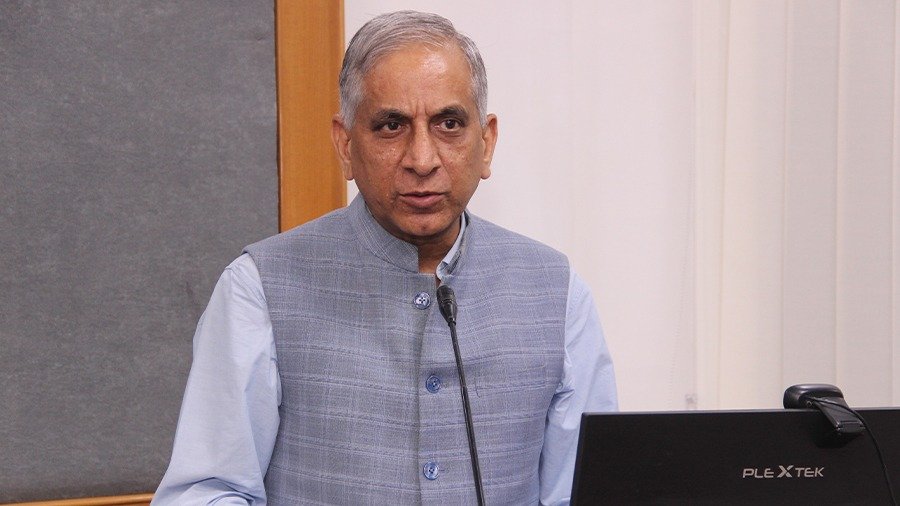
At a time of profound geopolitical flux and economic uncertainty, India’s leadership of BRICS presents both a formidable challenge and a defining opportunity. Speaking at “The Global South Speaks: India’s Leadership in BRICS and Beyond” held on April 28 at the Indian Institute of Foreign Trade (IIFT), Shri Amit Yadav, former Secretary to the Government of India, framed the central question facing policymakers today: how can BRICS navigate an increasingly fragmented world order without a rigid, rule-based framework?
As he observed at the outset, “In these uncertain times, without a rule-based framework, how do we navigate BRICS? That is both the challenge and the opportunity as India assumes the presidency.” This duality of risk and possibility runs through India’s evolving engagement with BRICS and its broader positioning within the Global South.
Shri Yadav emphasised that the Global South is no longer a passive entity in global discourse. “For decades, the Global South was spoken about. Today, it speaks for itself, with confidence, cohesion and clarity. At the centre of this transformation stands India.” This shift reflects a deeper structural transition in global governance, where emerging economies are asserting agency and demanding a more equitable international order.
Tracing the evolution of BRICS, from its origins as BRIC to its current expanded formation, he highlighted its transformation into a significant geopolitical and economic bloc. With its expanded membership now encompassing major emerging economies across continents, BRICS represents a substantial share of the global population, trade, and energy production. According to Shri Yadav, “BRICS today accounts for nearly half the world’s population, a significant share of global trade, and a major portion of energy production, making it not just an economic grouping, but a formidable political bloc in a multipolar world.”
Yet, this expansion brings complexity. The diversity of interests, economic asymmetries, and geopolitical divergences within BRICS pose real challenges to cohesion. At the same time, external pressures and competing global alignments further complicate cooperation. Shri Yadav acknowledged these tensions candidly, noting that BRICS must carefully balance expansion with internal consolidation: “The question before us is whether to continue expanding or to deepen cohesion within the existing framework.”
A key theme of his address was the role of BRICS as a bridge, linking the Global South with advanced economies and multilateral institutions. Rather than positioning itself in opposition to existing global structures, BRICS, he argued, should function as a connector. “We must see BRICS as a bridge, connecting emerging economies with the Western blocs and integrating these engagements into platforms like the G20.”
In this context, India’s diplomatic approach assumes particular significance. Shri Yadav underscored India’s strategy of “multi-alignment” and strategic autonomy, which allows it to maintain strong ties with both the Global South and the West. “India’s path is not about rigid alliances or military blocs. It is a conscious strategy of autonomy, balance and engagement across multiple alignments.” This positioning enables India to act as a stabilising force and consensus-builder in an otherwise polarised international system.
Reflecting on India’s recent global engagements, he pointed to the country’s successful leadership during the G20 Summit in 2023, where India managed to secure a consensus despite deep divisions among member states. This, he suggested, demonstrates India’s ability to bridge differences and deliver outcomes in complex multilateral settings. Similarly, India’s role in shaping conversations around emerging technologies, particularly through initiatives like global AI dialogues, illustrates its commitment to ensuring that innovation remains human-centric and development-oriented.
Shri Yadav also highlighted key priority areas for India’s BRICS presidency. These include strengthening digital public infrastructure, enhancing energy and food security, addressing climate change, advancing AI governance, and building resilient supply chains. Trade and investment facilitation, particularly through mechanisms that reduce logistical barriers and promote local currency transactions, were identified as critical levers for deepening intra-BRICS cooperation.
He drew attention to ongoing initiatives such as the BRICS Cross-Border Payments System and discussions around digital currencies, noting their potential to reduce transaction costs while preserving monetary sovereignty. Similarly, institutions like the New Development Bank (NDB) and the Contingent Reserve Arrangement were cited as important alternatives to traditional global financial structures, offering more flexible and less conditional financing to developing countries.
However, Shri Yadav cautioned that BRICS must guard against becoming merely a rhetorical platform. “We must ensure that BRICS does not become a forum for anti-Western rhetoric, but rather a platform for constructive and pragmatic cooperation.” For BRICS to remain relevant, its initiatives must translate into tangible outcomes, whether in infrastructure development, trade facilitation, or global governance reform.
On the trade front, he stressed the importance of addressing non-tariff barriers, improving customs procedures, and leveraging digital technologies to streamline cross-border commerce. Food security and supply chain resilience were identified as pressing concerns, particularly in light of recent global disruptions. “Agricultural export restrictions and supply chain disruptions have direct implications for food security. These are areas where BRICS cooperation can make a real difference.”
In addressing global governance, Shri Yadav pointed to the urgent need for reform within institutions like the World Trade Organisation (WTO), particularly in areas such as dispute resolution and rule-making. While acknowledging divergences among BRICS members on specific issues, he suggested that issue-based cooperation could still yield progress.
In his concluding remarks, Shri Yadav articulated a vision for BRICS as a transformative force in global affairs. “The future of BRICS lies in its ability to balance diversity with unity, and ambition with pragmatism.” He expressed confidence that, under India’s leadership, BRICS can contribute to shaping a more inclusive, representative, and balanced world order.
Perhaps most strikingly, he framed India not merely as a participant in this transformation, but as a driver of it: “India is not just part of this journey, it is helping light it.”
In an era marked by fragmentation and uncertainty, this vision positions India and BRICS as central actors in the ongoing reconfiguration of global power and governance.


Leave a Reply