

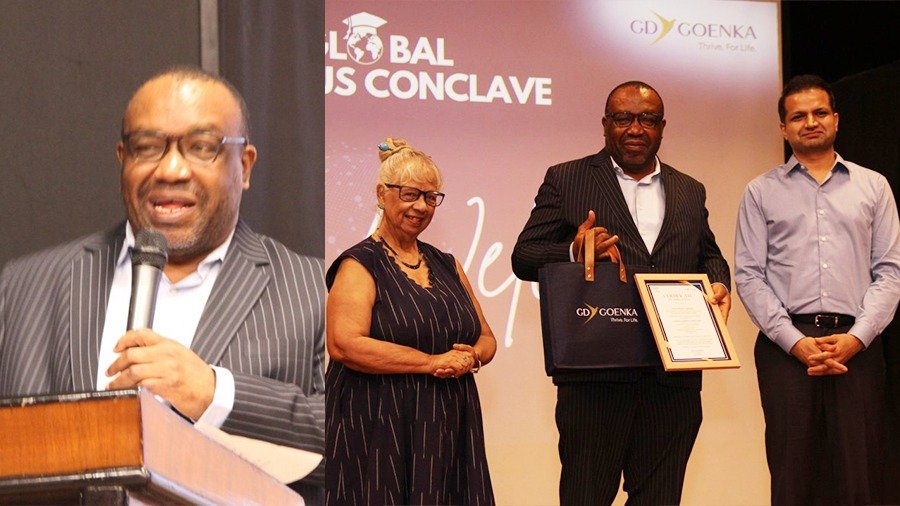
At the Global Campus Conclave 2026, Dr Obijiofor Aginam, Director of UNESCO MGIEP, called for an education system that goes beyond degrees and employability, to cultivate empathy, critical inquiry, global citizenship and the capacity to build peaceful, resilient societies.
Education has always been about preparing young people for the world they are about to inherit. But what happens when the world itself becomes increasingly difficult to predict?
That was the question at the heart of the inaugural expert address delivered by Dr Obijiofor Aginam, Director, UNESCO Mahatma Gandhi Institute of Education for Peace and Sustainable Development (UNESCO MGIEP), at the Global Campus Conclave, organised jointly by Diplomatist@30 and GD Goenka Group on 18 August at GD Goenka The Flagship School, New Delhi.
Addressing educators, diplomats, students and international education stakeholders, Dr Aginam argued that education can no longer be viewed simply through the familiar lenses of literacy, qualifications, skills and employability. In an increasingly fractured world, education has a much larger responsibility: to prepare human beings capable of living together.
He began by situating UNESCO MGIEP within the larger mandate of UNESCO.
“The mandate of UNESCO, simply put, is to promote peace through education, culture and science,” he said, describing these as three interconnected pillars of the organisation’s work.
Established with the support of the Government of India, UNESCO MGIEP was launched in 2012 as a UNESCO Category 1 Institute—the first and only such research institute in the Asia-Pacific region. Its mandate is closely aligned with SDG 4.7 and the promotion of education for peaceful and sustainable societies.
From a new world order to a new world disorder
One of the most striking ideas in Dr Aginam’s address came from a book he encountered shortly after taking up his position at UNESCO MGIEP.
He recalled meeting the eminent Indian educationist and scholar Professor J. S. Rajput, who gave him a book titled Education for a New World Order. The book prompted him to reconsider what education ought to mean in a world undergoing profound transformation.
Dr Aginam offered his own provocative reformulation: “Perhaps we can now explore education for a new world disorder.”
The phrase captures the central challenge facing education today.
The world is experiencing what is increasingly described as a polycrisis, multiple crises occurring simultaneously and interacting with one another. Armed conflicts, climate change, pandemics, food and energy insecurity, displacement and migration, widening inequalities, the digital divide and the rapid emergence of artificial intelligence are all reshaping the environment in which young people are learning and preparing for their futures.
“These pose serious challenges to peace, livelihoods, human flourishing, diplomacy and international cooperation,” Dr Aginam observed.
For education systems, this means that preparing students merely to succeed in examinations or enter the labour market is no longer sufficient.
The deeper question is: How do we prepare young people to navigate uncertainty without losing their humanity?
The pandemic exposed the fault lines
Dr Aginam pointed to COVID-19 as a powerful illustration of the fragility of contemporary systems.
The pandemic disrupted education on a massive scale, intensified inequalities and exposed the fault lines between and within societies. It also demonstrated that education cannot be isolated from questions of public health, poverty, technology, social cohesion and global cooperation.
This is where, he argued, international educational cooperation becomes particularly important.
The world cannot address interconnected challenges through isolated educational systems operating within national boundaries. At the same time, the notion of a shared global society built around common values has been weakened by growing geopolitical fragmentation.
The challenge, therefore, is not simply to expand international education, but to rethink what international education is meant to achieve.
The missing dimension: the human being
Dr Aginam’s answer begins with a shift from education as the transmission of knowledge towards education as the cultivation of human flourishing.
UNESCO MGIEP’s work places particular emphasis on social and emotional learning (SEL), which the Institute sees as central to building peaceful and sustainable societies. Its framework focuses on four core competencies: mindfulness, empathy, compassion and critical inquiry.
Dr Aginam explained the four in simple but powerful terms.
Empathy allows learners to understand another person’s perspective.
Mindfulness helps develop the inner awareness and calm necessary to navigate uncertainty.
Compassion turns concern for others into constructive action.
And critical inquiry enables young people to question assumptions, imagine alternatives and participate in creating more just futures.
Together, these competencies create something that traditional measures of educational achievement often struggle to capture: the ability to understand oneself, understand others and respond thoughtfully to complex situations.
“Education must move from merely transmitting knowledge to cultivating being—what we now call human flourishing,” Dr Aginam said.
This is not an argument against academic achievement. Rather, it is an argument for a broader definition of achievement.
A student may be academically brilliant and still struggle to listen, empathise, collaborate or navigate disagreement. In a world defined by complexity and interdependence, these are not peripheral qualities. They are essential capabilities.
Education for global citizenship
The second pathway identified by Dr Aginam was global citizenship education.
A global citizen, in this context, is not simply someone who has studied abroad, speaks several languages or has an international career. Global citizenship is about developing the knowledge, values and skills required to engage responsibly with an interconnected world.
Climate change does not respect borders. Neither do pandemics, technological disruption, misinformation, migration or economic shocks.
The problems are global. The response, therefore, requires people who can think beyond narrow boundaries while remaining grounded in their own communities.
UNESCO’s work on global citizenship education similarly emphasises the development of knowledge, values and competencies that enable learners to contribute to more peaceful, inclusive and sustainable societies. UNESCO MGIEP’s own Global Citizenship programme integrates this with its social and emotional learning framework.
For Dr Aginam, the implications are profound.
Education must help young people become not only employable, but responsible participants in society.
Beyond examinations and degrees
Perhaps the most provocative part of the address was Dr Aginam’s challenge to the traditional hierarchy of educational success.
He invoked the thinking of Jiddu Krishnamurti, whose Education and the Significance of Life argues against treating examinations and degrees as the ultimate measure of intelligence. Krishnamurti wrote that education should create integrated human beings and warned against reducing intelligence to information or qualifications.
Dr Aginam used this argument to make a larger point: degrees are important, but they cannot be the destination of education.
The real measure of an education system should also include whether it develops curiosity, empathy, resilience, civic responsibility, critical thinking and the ability to live constructively with difference.
This has implications for policymakers, schools and universities.
It means embedding social and emotional learning and peace education within curricula rather than treating them as optional additions. It means strengthening global citizenship education. It means paying attention to teacher well-being. And it means asking whether educational assessment measures only what students can reproduce, or also what they can understand, question, create and contribute.
A policy shift is needed
Dr Aginam called for what he described as an urgent policy shift.
If education is to respond to the realities of the 21st century, then policymakers must look beyond conventional indicators of success.
“When policymakers invest in social and emotional learning, they build an invisible scaffold that allows societies to remain peaceful, hopeful and resilient,” he said.
This invisible scaffold may not appear on a report card. It cannot always be captured through examination scores. Yet it influences how young people deal with disagreement, uncertainty, diversity and conflict.
And those capabilities increasingly determine the quality of the societies they will inherit, and eventually lead.
Local roots, global connections
Importantly, Dr Aginam did not argue for an education system that simply imports a universal model.
Instead, he emphasised the importance of education for peace and global citizenship being locally grounded and globally connected.
This is particularly relevant to international education.
A genuinely global campus should not mean that every institution looks the same or that students abandon their cultural identities in favour of a generic global identity.
Rather, internationalisation should create opportunities for students to encounter difference, question assumptions, exchange perspectives and discover common ground.
That is where the idea of the Global Campus becomes particularly meaningful.
The global campus is not simply a physical campus populated by international students.
It is a mindset.
It is the ability to see the world as interconnected while understanding the particularities of one’s own community.
What kind of education can change the world?
Dr Aginam concluded by returning to one of the most frequently cited statements about education, Nelson Mandela’s observation that education is “the most powerful weapon which you can use to change the world.” The quotation is well documented, including in accounts of Mandela’s 1990 address in Boston.
But Dr Aginam added an important question: If education is indeed such a powerful force, what kind of education are we talking about?
That may be the more important question for our time.
An education that produces technically skilled graduates but leaves them unable to understand one another may contribute to efficiency without creating peace.
An education that produces highly employable individuals but not compassionate citizens may strengthen economies without necessarily strengthening societies.
And an education that teaches young people to compete without teaching them how to collaborate may prepare them for a marketplace while leaving them unprepared for a world of shared challenges.
The alternative is an education that brings together the cognitive and the social-emotional; knowledge and wisdom; skills and values; individual achievement and collective responsibility.
That is the education that Dr Aginam believes can help humanity navigate its present disorder.
And perhaps that is the real challenge before the global campus: not simply to produce students who are ready for the world, but to produce human beings who are ready to help shape a better one.


Leave a Reply