

There are evenings when authors talk about their books. And then there are evenings when the books seem to talk back.
On September 3, Le Méridien, New Delhi became a meeting point for four very different literary worlds, ghosts and the supernatural, sisters and mental health, spirituality and love, and a woman forced to live seven lives to survive.
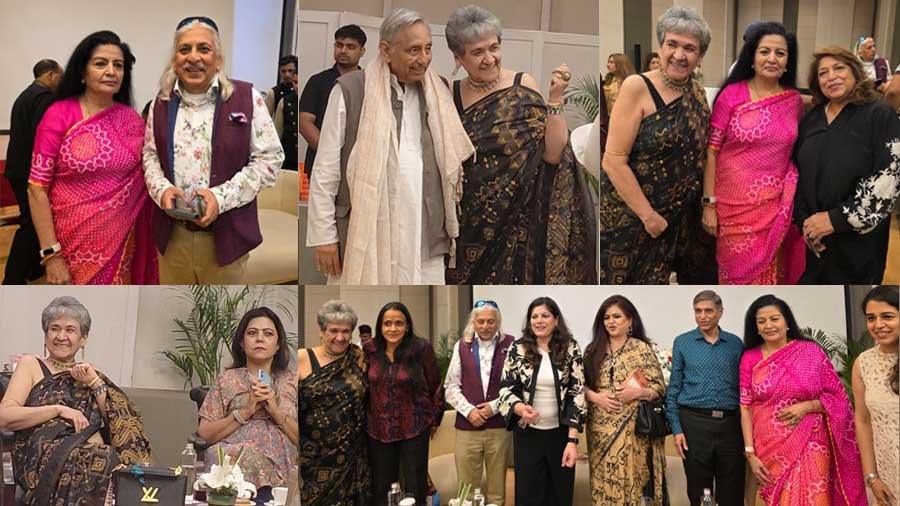
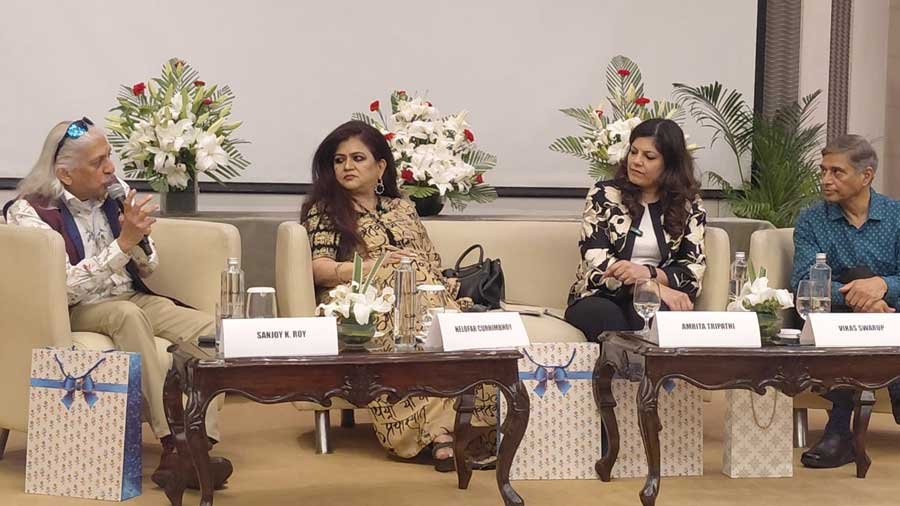
Titled “Ghosts, Sisters, Healer & Seven Lives: An Indian Quadriptych – Four Voices,” the evening brought together four writers: Sanjoy K. Roy, Vikas Swarup, Nelofar Currimbhoy and Amita Tripathi, in a conversation moderated by Roy himself. Presented by Ratan, Shahana and Mona, with Diplomatist as the knowledge partner, the evening was less a formal panel and more an unfolding literary conversation.
Roy moved from one writer to another, drawing out the stories behind their stories: Where does a book begin? In experience? In memory? In headlines? In spirituality? In trauma? And what happens when a writer takes those fragments and turns them into another life?
“Is the Govinda you are writing about the one you are seeing?”
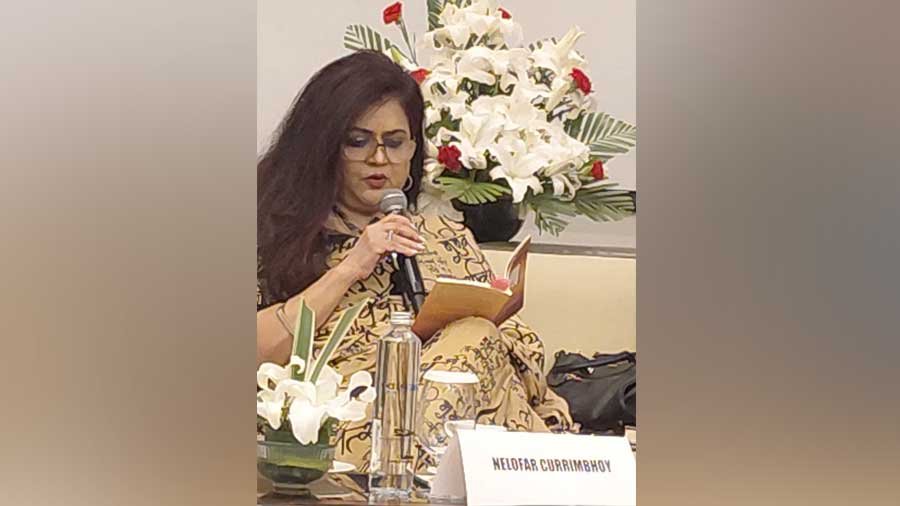
The first literary journey belonged to Nelofar Currimbhoy, whose Eyes of the Healer is a work of verse centred on Govinda, a young seeker searching for divinity and a deeper meaning to life, alongside Maya, whose world revolves around him. The book explores love, temptation, human fragility and spirituality.
Roy began not with a conventional question about plot, but with poetry.
He drew attention to Nelofar’s lesser-known identity as a poet and asked how she had managed to express an intensely Indian spiritual sensibility in English, a language that, he suggested, does not always possess the same cultural vocabulary or cadence as India’s many indigenous languages.
Roy asked, how does one write about devotion, love and an almost other-worldly spirituality in English?
Nelofar’s answer began with a simple declaration: “I truly believe that love is the most beautiful aspect of life.”
For her, Eyes of the Healer was never a carefully engineered literary project. It arrived almost accidentally. Her brother’s wedding, an episode of bronchitis and her inability to attend the pre-wedding celebrations became the unlikely circumstances in which Govinda first appeared. What began as a small poem continued to grow until, as she described it, “Govinda got a life of his own.”
That, perhaps, became one of the evening’s recurring ideas: the writer may begin the story, but sometimes the character takes over.
Nelofar spoke about Govinda as a young man who meditates with his eyes closed for years before opening them to a world in which he encounters love. But beneath the narrative lies her own spiritual journey, her engagement with Buddhism, her proximity to the Tibetan community and her belief that spirituality need not be confined to a single religious framework.
“I definitely feel I received it.”
She was speaking about the book itself, the sense that Eyes of the Healer was not something she had meticulously planned, but something that came to her.
And perhaps that explains why the book, originally written in verse, feels less like a conventional novel and more like an unfolding spiritual landscape. Bloomsbury describes it as a “saga in verse” that explores human fragility, love, temptation and spiritual journeys.
Roy then pushed the conversation towards an intriguing contradiction.
Nelofar, after all, lives in two worlds: the world of writing and the world of the beauty business she inherited and helped build.
Roy asked, is there a dissonance between the two? Her answer was an emphatic no.
For Currimbhoy, creativity flows across both worlds. Poetry may be one form of expression; product creation another. She described the two not as competing identities but as complementary ones.
“I think creativity helps you in business.” And suddenly, the conversation about a poet became a conversation about the creative instinct itself.
Then came seven lives.
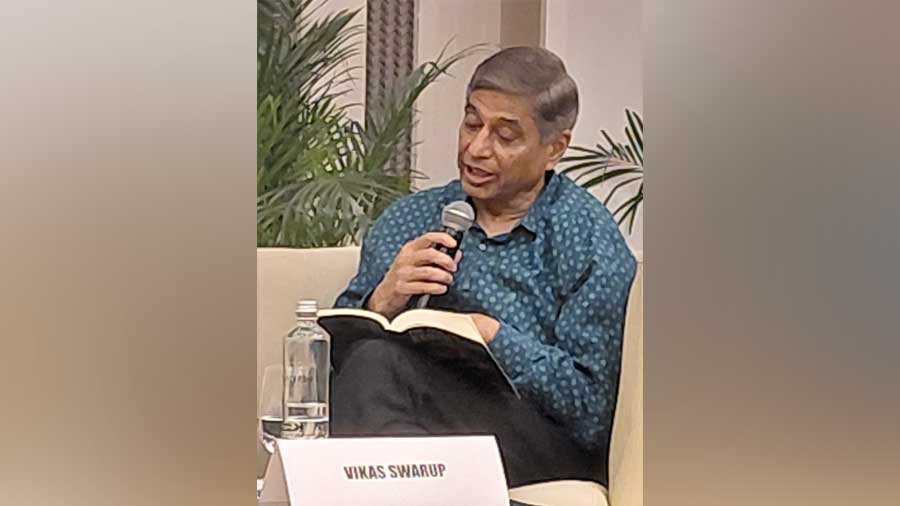
If Nelofar’s world was spiritual and lyrical, Vikas Swarup’s was decidedly more dangerous.
Roy turned to the former diplomat and internationally bestselling author, whose latest novel, The Girl with Seven Lives, places a young woman named Devi at the centre of a high-stakes story of survival. The book opens with Devi being held captive, with her fate tied to the telling of her seven extraordinary lives.
Roy had already been drawn into the mystery of the book. He admitted that he had struggled to finish it and had at one point asked for a synopsis, only to be met with questions about whether he really wanted the ending revealed.
But his question to Swarup went beyond the kidnapping and the seven identities.
Where does all this come from? Does a writer borrow from newspapers? From political events? From real-life incidents? From personal experience?
Swarup’s answer was revealing: “For me, the inspiration really comes from everyday life in India.”
The contemporary India that appears in the novel, he explained, is assembled from things that exist around us: institutions, headlines, corruption, class, poverty, power and the countless contradictions that make up everyday life.
Devi’s journey takes her through radically different circumstances and identities. The official description of the novel calls her a survivor who, over the course of one night, reveals the secrets of her seven lives to her captor.
But Swarup was interested in something deeper than the thriller mechanism.
He wanted to create a character with “many shades of grey”—a protagonist who may have committed crimes and yet remains compelling enough for the reader to root for her.
And that led to another important question. Why seven lives? Roy wondered whether Devi’s name and transformations deliberately drew on Indian ideas of the divine feminine and Indian cosmology.
Swarup dismissed the connection as intentional symbolism. The seven lives, he explained, were not seven superficial identities. Each time Devi changes her name, she reinvents herself completely.
At one point, Roy observed that the book might have been called The Girl with Seven Names. Swarup’s response was characteristically playful: “This is not a LinkedIn profile.”
The line drew out the real distinction. These are not seven professional identities. They are seven attempts at survival.
And this is where The Girl with Seven Lives becomes more than a thriller. It becomes an exploration of how far a person can reinvent herself when circumstances leave her with no other choice.
From headlines to the human mind
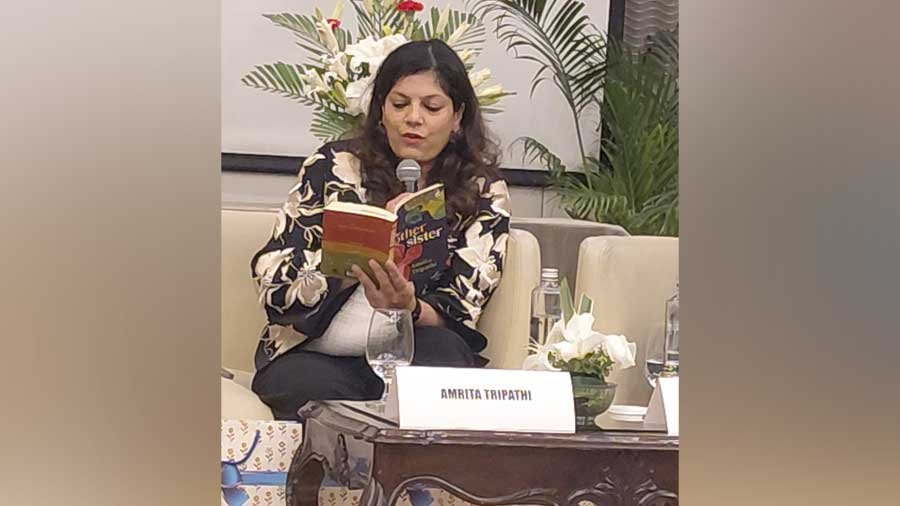
The conversation then moved to Amita Tripathi, whose writing has repeatedly engaged with mental health, grief, suicide and the fractures within families and individuals.
Roy noted the progression in her work, from journalism and media to fiction and, increasingly, the terrain of mental health. But Tripathi corrected one assumption.
Her interest in mental health, she explained, did not simply emerge because she was a journalist. She had actually begun covering mental health as a journalist, at a time when the subject remained substantially underreported.
That experience stayed with her.The conversation soon became much larger than literature.
Roy asked: Why is mental health such an important issue in India—and why does it continue to be so difficult to talk about? Tripathi’s response was clear: because mental health does not belong to one class, one community or one kind of family.
“We all have mental health. We are all on a spectrum somewhere.”
Some people may have a diagnosis. Others may not. But everyone experiences distress, grief, anxiety, loss or emotional upheaval at different points in life.
Her work has also taken her into the difficult territory of suicide. Tripathi explained that her nonfiction work on India’s suicide crisis was co-authored with psychiatrists, allowing her to approach the subject both as a journalist and as a storyteller.
And the central lesson from that work was that suicide is rarely about one thing.
It is multifactorial and deeply complex.
She spoke particularly about young people, the danger of dismissing suicidal thoughts, and the need to listen rather than immediately minimise someone’s distress.
“Please know you’re not alone. Please know help is available.”
The conversation moved from books to something far more immediate: what ordinary people can actually do.
Tripathi spoke about gatekeeper training, which teaches people how to recognise warning signs and, crucially, how to listen empathetically. She pointed to the Centre for Mental Health Law & Policy in Pune as one source of suicide gatekeeper training.
But perhaps her most powerful observation was not about policy or institutions. It was about ourselves.
“Stigma starts and ends with us.”
A boss. A parent. A friend. A colleague.
The question is not simply whether society has stigma. The question is what each of us does when someone sitting beside us says, I am not okay. And this was where the literary conversation unexpectedly became a conversation about everyday life.
“Your mind is like a tea house.”
Tripathi offered an evocative image while speaking about emotions: the idea that the mind is like a tea house, and feelings are like guests.
You let them in. You don’t necessarily have to serve them tea. You allow them to arrive, and eventually, to leave.
It was perhaps the most poetic moment of a section that had otherwise dealt with statistics, suicide, policy and mental health. Her larger message was one of gentleness.
We are often far harsher towards ourselves than we are towards others. We judge our own emotions, label some as “negative” and try to push them away.
But grief is not failure. Anxiety is not weakness. Sadness is not something that needs to be hidden. Sometimes, the first step is simply to acknowledge what is there.
And then the moderator became an author
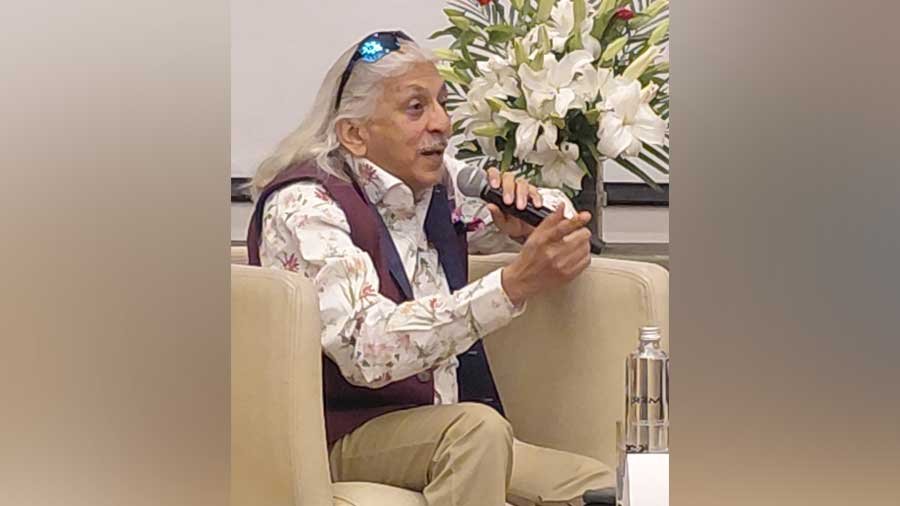
There was an inevitable moment when Roy could no longer remain only the questioner.
The conversation turned towards his own book, There’s a Ghost in My Room, his exploration of encounters with the supernatural and the unexplained. Roy’s book draws upon experiences spanning places, journeys and memories, and has been described as a work that approaches ghosts with curiosity, humour and cultural context.
In an unexpected turn, emcee Ooron Das put Roy in the spotlight, asking him a question that brought the conversation closer to home: “What is the secret of your mental health?”
Roy’s answer was unexpectedly introspective.
He explained that the book itself began almost by accident, following pressure from publishers during and after COVID to write a book. But in researching and writing the stories, something happened that he had not anticipated.
He began to recognise that some of the incidents had left a deeper imprint on him than he had realised. Writing became a form of processing. A way of revisiting experiences. A way of connecting fragments that had remained unresolved.
“In completing the book, I realised that the trauma that some of these incidents had… impacted me.”
The act of researching old experiences brought him back to places and memories from decades earlier. What had once seemed like isolated incidents began to reveal connections.
And suddenly, the book about ghosts became something else. A book about memory. About unresolved experiences.
About the stories that remain somewhere inside us long after the event itself has disappeared.


Leave a Reply