

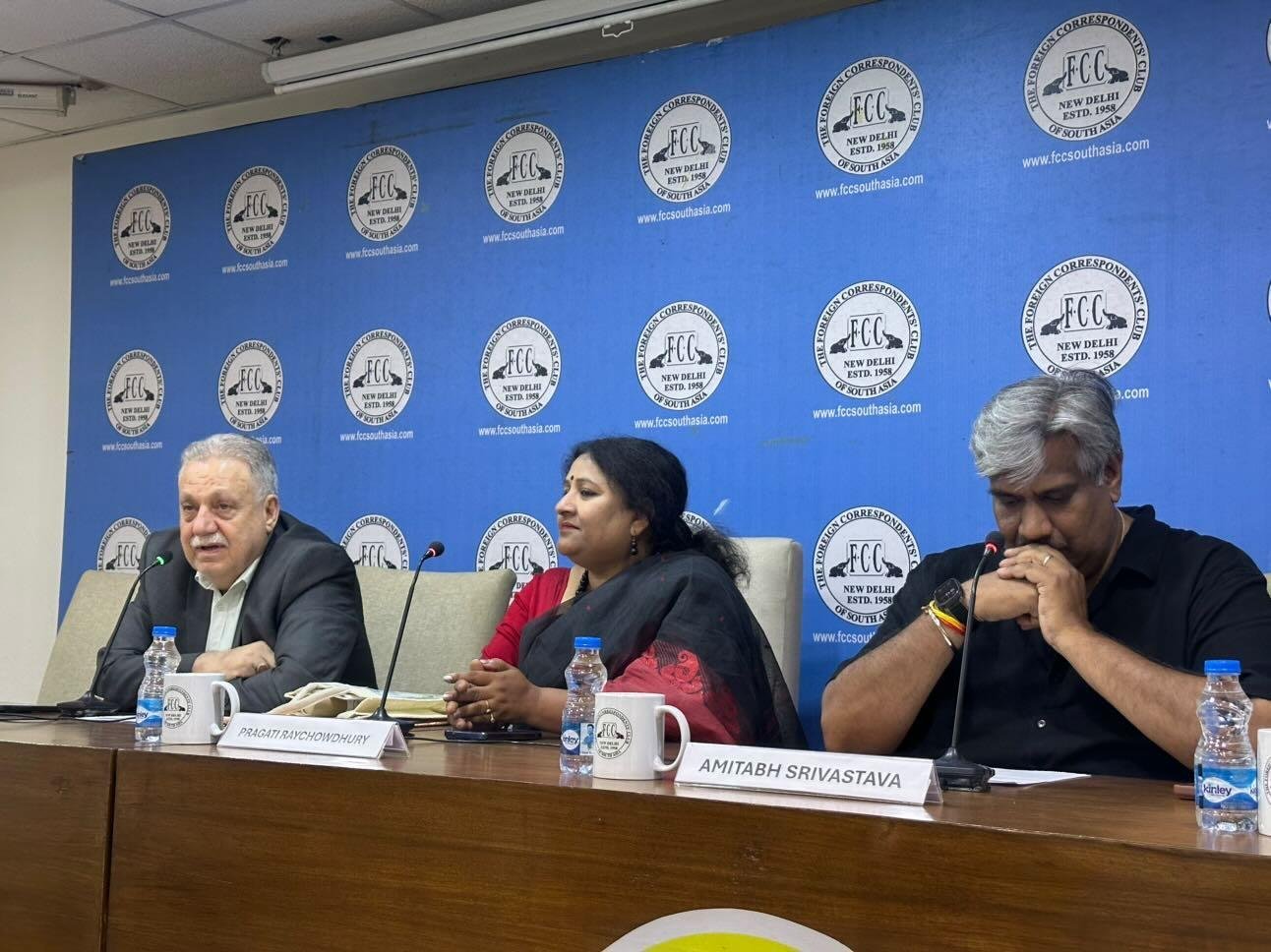
On the occasion of World Environment Day, the Foreign Correspondents’ Club (FCC), New Delhi, in partnership with Green Goddess, organised an engaging and interactive Green Living Workshop aimed at promoting sustainable living and encouraging environmentally conscious habits among participants.
The workshop brought together journalists, members of the media community, and sustainability enthusiasts for an evening of learning, reflection, and practical demonstrations on how small lifestyle changes can contribute to a greener future.
Welcoming the participants, Dr. Waiel Awwad, President of the Foreign Correspondents’ Club of South Asia, highlighted the urgent need to protect the environment for future generations.
“The changes we are witnessing in our environment make us all reflect on what kind of world we are leaving behind for our children,” he remarked. Stressing that environmental responsibility must move beyond words and translate into action, Dr. Awwad announced FCC’s decision to replace traditional gifts and mementos with plants. “Why don’t we give a plant instead? It survives with you, grows with you, and serves as a constant reminder of our responsibility towards nature,” he said.
Introducing the keynote speaker, Mr. Amitabh Srivastava, Member of the Managing Committee of FCC, spoke about his long association with Ms. Pragati Raychowdhury, Founder of Green Goddess. He highlighted her transition from a successful two-decade-long career in education to becoming a sustainability entrepreneur dedicated to promoting eco-friendly living.
Mr. Srivastava described Green Goddess as a unique initiative that goes beyond simply distributing plants. “What impressed us was the thought process behind the products, the soil, the organic manure, the sustainable packaging, and the long-term viability of the plants. These are not merely decorative items; they are tools for encouraging a greener lifestyle,” he noted.
He also shared how Green Goddess has developed innovative products such as plantable notebooks, seed-embedded pens and pencils, and sustainable gifting solutions, all designed to reduce waste and promote environmental awareness. The workshop, he explained, was conceived as a way of inspiring participants to adopt practical, environmentally responsible habits.
Taking the floor, Ms. Pragati Raychowdhury delivered an energetic and thought-provoking session that combined environmental awareness with practical solutions.
Reflecting on the significance of World Environment Day, she challenged participants to think beyond symbolic observances.
“Every year, 5 June comes and goes. But what is our contribution? Merely talking about sustainability is not enough. We need to adopt habits that create lasting change,” she said.
Drawing on her background as an educator, Ms. Raychowdhury emphasised the importance of cultivating environmental responsibility through everyday actions. She spoke about replacing conventional flower bouquets with potted plants, reducing waste through recycled products, and encouraging children and families to embrace sustainability as a way of life.
Sharing the journey behind Green Goddess, she explained how her passion for gardening evolved into a social enterprise focused on making green living accessible and affordable. Her mission, she said, was to transform gardening from a luxury into a necessity.
One of the highlights of the session was the showcase of Green Goddess’s innovative eco-friendly products. Participants were introduced to notebooks with seed-embedded covers, plantable pens and pencils made from recycled cotton and jute waste, and sustainable gifting solutions designed to minimise environmental impact.
Demonstrating how these products work, Ms. Raychowdhury explained that once a notebook or pencil has served its purpose, it can be planted directly into the soil, allowing flowers, herbs, or vegetables to grow from the embedded seeds.
The workshop also featured discussions on home composting, creating nutrient-rich soil from household waste, urban gardening, and the importance of reducing dependence on chemically intensive agriculture. Participants learned how even small spaces can be used to grow vegetables and herbs sustainably.
A particularly engaging segment focused on the creation of seed balls, small clay-coated seed capsules that can be scattered on barren land to encourage afforestation. Ms. Raychowdhury urged participants to involve children and communities in such simple yet impactful environmental initiatives.
“If out of fifty seed balls, even one tree grows, that is an achievement,” she remarked, highlighting how collective action can create meaningful environmental change.
The session concluded with interactive activities, quizzes, discussions, and the distribution of eco-friendly products, giving participants practical tools to begin their own sustainability journeys.


Leave a Reply