

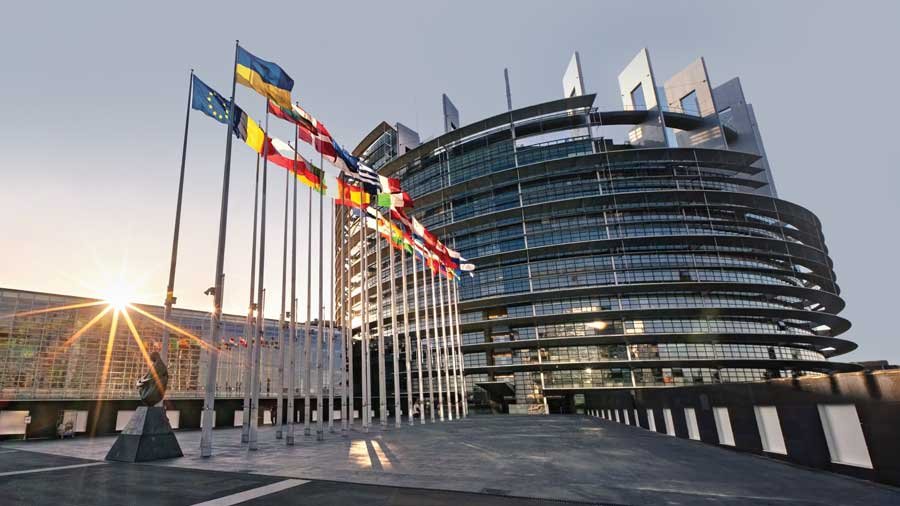
The European Union is by far the most successful example of regional integration. Established in 1957 as the European Economic Community, it has transformed organically from a customs union to a common market, from an economic community to a political union. It spans economic, social, political and security domains. Economic integration has been remarkably successful through the single market and single currency; social and political union is evident in borderless travel and Schengen. But the lag in security prevented the EU from emerging as a full geopolitical actor.
This article analyses why a coherent and robust security and defence policy remained conspicuously absent and what options exist for the EU to play an effective geopolitical role.
Two reasons stand out from my research. First, Europe, basking under the NATO umbrella, did not invest adequately in its own defence infrastructure. NATO was largely funded by the United States. That comfort has been disturbed by President Donald Trump’s second-term demand that allies spend more. Europe is now seeking its own defence wherewithal.
The numbers show a decisive turn. According to European Defence Agency data released on 16 July 2026, EU defence spending reached EUR 343 billion in 2024, up 19 percent over 2023, and EUR 418 billion in 2025, a further 20 percent jump, representing 2.2 percent of EU GDP. The EDA projects EUR 454 billion for 2026, or 2.4 percent of GDP. Twenty-three member states now meet NATO’s 2 percent benchmark, up from six in 2021. Equipment investment is at record highs, and defence R&D rose to EUR 17 billion in 2025, projected to reach EUR 20 billion in 2026. Both member states and the EU as a body are supporting Ukraine.
The financing architecture is also new. The Commission’s Readiness 2030 / ReArm Europe plan of March 2025 mobilises up to EUR 800 billion in financing capacity, not a cash pot: up to EUR 650 billion via activation of the national escape clause of the Stability and Growth Pact over four years, and EUR 150 billion in joint SAFE (Security Action for Europe) loans for joint procurement. SAFE is loans, not grants, with first disbursements in early 2026 to frontline states. This is national money being spent faster, with EU facilitation.
Second, divergence among three key countries stunted geopolitical growth: Britain, Germany and France. Having joined 16 years after its foundation, Britain insisted on widening over deepening, dispersing central authority and retaining the US security alliance. It maintained a privileged transatlantic tie outside the EU framework. Continued dependence on Washington decelerated EU security consolidation.
France always harboured ambition to create an alternative power centre to the US and Soviet Union. After the Soviet implosion, the French desire to build the EU as a third pole remained alive, but needed German backing and British isolation, which ended with Brexit in 2020.
Germany was not keen on geopolitical engagement. Having suffered in the Second World War, it focused on economic rebuilding. Unlike France and Britain, without former colonies, Germany needed a market; it found Europe handy. Without Germany committing resources to European security and showing interest in an international role, the EU did not move further. Its involvement in the violent break-up of Yugoslavia in the 1990s exposed deficits in foreign policy strategy.
Today, the EU is arming itself and seeking geopolitical space. Yet it remains caught in a fundamental dilemma of interfacing trade with security. The EU, Germany in particular, reckons China a strategic rival, but German investment and trade with China keep growing. Post-globalisation, trade could be separated from security, as China advocates and advises India. That is how India runs a deficit of over 100 billion USD with China while confronting military skirmishes on the border. How logical is it to build a rival economy that becomes a Frankenstein’s monster?
Germany illustrates both turnaround and tension. Germany became NATO’s second-largest spender in 2023, spending EUR 90.6 billion in 2024, up 20 percent, and remains the largest absolute contributor to EU rearmament. Poland and the Baltics are on track for 3.5 percent plus of GDP; per The Military Balance 2026, Denmark raised spending 114 percent, Belgium 59 percent, Spain 43 percent, and Sweden 31 percent. Yet Berlin still exports heavily to Beijing while labelling it a systemic rival. This duality is the new European reality.
What is discernible is that the EU contemplates a multipolar world built on strategic autonomy. India also advocates such an order. Both concepts need decoding. Strategic autonomy as a sovereign claim is trite; any state claims it. On deeper analysis, if it means independence from hegemonic, coercive alliances and freedom to navigate, it is understandable.
But in an interdependent world, alliances are unavoidable and desirable. The EU itself is an alliance. India pioneered Non-Alignment, yet the non-aligned bloc was an alliance of developing countries. Multipolarity is not fully evidenced in history — the First World War, Second World War, Cold War and the globalised world. Antagonists in the first three phases are known; in the last, it is West versus the Sino-Russia-Iran axis. Yet multipolarity remains possible.
Creating the multipolarity that the EU aims for will be best done by strengthening other regional organisations with its own example of integration. This gives other blocs a chance to credibly assert ‘capitalist diversity’, ushering in a multilateral system with several poles.
Crucially, rearmament must overcome fragmentation. Current spending is still overwhelmingly national, with limited joint procurement. EDA remains intergovernmental; states prioritise domestic industry. Unless SAFE and PESCO are tied to EU-wide capability targets, Europe risks duplicating systems rather than building interoperable deterrence needed against Russia.
I conclude where I began: the EU should promote comprehensive integration, recognising the interface between economy, geopolitics and security. Rearmament alone will not make Europe geopolitical; without central procurement, common strategic culture and selective decoupling where necessary, EUR 454 billion can still buy 27 fragmented armies. If Europe solves that, its model remains the best template. That would enable an EU-India partnership on resilient supply chains, maritime security and technology standards to anchor genuine multipolarity beyond rhetoric and finally deliver credible strategic autonomy for the Global South in the coming decade together.
References:


Leave a Reply