

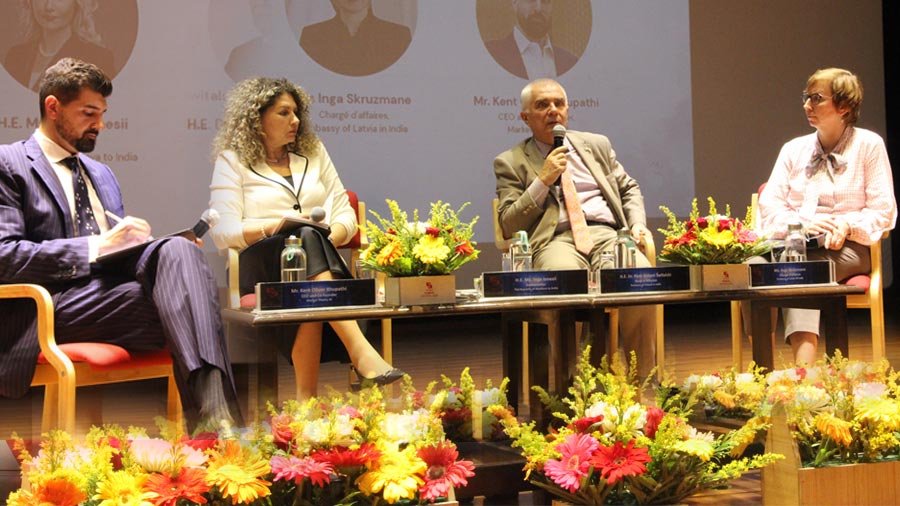
At the India–EU Diplomatic Dialogue organised by Diplomatist Magazine at Symbiosis International (Deemed University) on 15 October 2026, diplomats from Moldova, Poland and Latvia examined how the free trade agreement could translate into investment, innovation, stronger connectivity and deeper strategic engagement.
With negotiations on the India–EU free trade agreement concluded in January 2026, the focus is shifting towards implementation and the practical opportunities that the agreement could create. This was the central concern of the panel discussion at the India–EU Diplomatic Dialogue, where three European diplomatic perspectives converged on a common question: how can trade liberalisation become a broader partnership delivering tangible benefits to businesses and citizens?
Moderated by Kent Oliver Bhupathi, CEO and co-founder of Market Theory AI, the discussion featured H.E. Inga Ionesii, Ambassador of the Republic of Moldova to India; Dr Piotr Antoni Świtalski, chargé d’affaires a.i. of the Republic of Poland in India; and Ms Inga Skrūzmane, Chargé d’affaires at the Embassy of Latvia in India.
The three diplomats established three complementary perspectives. Moldova offered lessons from economic integration with the EU; Poland emphasised strategic cooperation, advanced technology and connectivity; and Latvia focused on tariff reductions, smaller businesses and digital innovation.
What can India learn from Moldova’s trade experience?
Bhupathi opened the discussion by asking Ionesii what India could learn from Moldova’s experience negotiating and implementing its trade agreement with the European Union.
Amb Ionesii responded that the principal lesson lay in recognising the scale of opportunity created by access to a larger market. Drawing on Moldova’s experience under the Deep and Comprehensive Free Trade Area, she explained that closer integration could encourage businesses to improve standards, diversify exports and expand production.
She also stressed that the agreement could support investment and technology exchange, allowing both sides to develop their economic and institutional capabilities.
Her response offered an important qualification to the enthusiasm surrounding trade liberalisation: the benefits would depend on how businesses and institutions used the opportunities available to them.
How can India–Poland strategic ties become more practical?
Turning to Poland, Bhupathi asked Dr. Świtalski what the next step should be in translating the India–Poland strategic partnership, established in 2024, into growing practical cooperation.
Dr. Świtalski said that stronger bilateral ties would reinforce the wider India–EU relationship. He expressed the hope that high-level political engagement would provide fresh momentum to economic cooperation, noting that he wanted bilateral trade—put by him at approximately US$6 billion—to double before 2030.
He identified defence, space, artificial intelligence, high technology and the green economy as priority areas. Importantly, he emphasised that Polish companies were interested in forming partnerships with Indian counterparts, rather than simply selling into the Indian market.
The conversation then turned to smaller businesses. Bhupathi asked Ms. Skrūzmane what, beyond tariff reductions, could help Indian and Latvian SMEs make the most of the agreement.
Ms. Skrūzmane identified verified information and direct commercial contacts as crucial requirements. Businesses need to understand regulatory conditions, local markets and the commercial culture of potential partners. She encouraged companies to participate in trade exhibitions and establish business-to-business relationships, arguing that trust is built through direct engagement.
Her response highlighted a practical challenge: even when trade barriers fall, smaller firms may remain unable to take advantage of new opportunities unless they know where to find partners and how to navigate unfamiliar markets.
Connectivity: the infrastructure behind trade
Dr. Świtalski added another dimension to the discussion by emphasising connectivity. He argued that the competitiveness of trade depends not only on tariffs but also on the reliability and efficiency of transport routes.
Referring to disruptions in West Asia, he noted how longer shipping routes can increase delivery times and complicate commercial relationships. He called for greater attention to the India–Middle East–Europe Economic Corridor and possible extensions towards the Baltic and Nordic regions, as well as Moldova.
He also highlighted the importance of air connectivity, suggesting that stronger direct links would support business travel and closer commercial engagement.
The intervention broadened the panel’s focus from trade rules to the infrastructure needed to make those rules effective.
Can traditional products find new markets?
The discussion also explored the role of sector-specific opportunities in building commercial relationships.
Bhupathi asked Amb Ionesii how Moldova planned to promote its wine-making tradition in India. She explained that high Indian import duties presented a challenge for Moldovan wines and described efforts to introduce the country’s products to Indian distributors through participation in trade exhibitions.
She noted that Moldovan companies had participated in a Mumbai exhibition and intended to continue presenting their products and engaging with potential Indian partners.
The exchange illustrated how market access, promotion and distributor relationships must work together if products are to establish a sustainable presence in a new market.
Green technology: from exports to joint ventures
Bhupathi then asked Dr. Świtalski where India and Poland could deepen cooperation in clean energy and green technologies.
Dr. Świtalski pointed to Polish companies working in hydrogen, green ammonia and battery recycling, explaining that they were interested in investment and partnerships with Indian counterparts. He also highlighted opportunities in space technology and medical equipment, including AI-enabled diagnostics.
His examples reinforced the distinction between conventional exports and deeper technological collaboration. Partnerships can allow companies to combine capabilities, develop solutions and participate in one another’s innovation ecosystems.
Digital cooperation and the promise of AI
In the final question, Bhupathi invited Ms. Skrūzmane to identify the most promising digital opportunities between India and Latvia.
She highlighted India’s UPI digital payments system as an innovation that had impressed her, and identified artificial intelligence and digitalisation as areas for further cooperation. She also referred to a Latvian-founded software business operating in India and serving more than 10,000 Indian enterprises.
The example demonstrated that bilateral cooperation need not be limited to goods moving between markets. Digital services and technology businesses can also establish cross-border operations, creating commercial links that extend beyond traditional trade.
Ms. Skrūzmane acknowledged that AI presents sensitive questions requiring cooperation, making it an area where international partnerships could be especially valuable.
A partnership built on implementation
Across the discussion, a consistent theme emerged: the India–EU free trade agreement is an important foundation, but its wider impact will depend on what follows.
Amb Ionesii highlighted the role of economic reform and institutional capacity. Świtalski called for stronger connectivity, strategic engagement and technological partnerships. Skrūzmane stressed the importance of information, business contacts and opportunities for smaller enterprises.
Together, their interventions suggested that the next phase of India–EU cooperation will require action across several fronts: helping businesses navigate new markets, improving transport links, supporting investment, and building partnerships in green technology, digital services and advanced manufacturing.
The dialogue also demonstrated the value of examining the European relationship through the experiences of individual countries. Their economies and priorities differ, but each offers a practical perspective on how closer cooperation can work.
The challenge now is to convert the promise of trade liberalisation into sustained relationships between institutions, companies and people. In that transition from agreement to implementation lies the opportunity to make the India–EU partnership more resilient, innovative and consequential.


Leave a Reply