

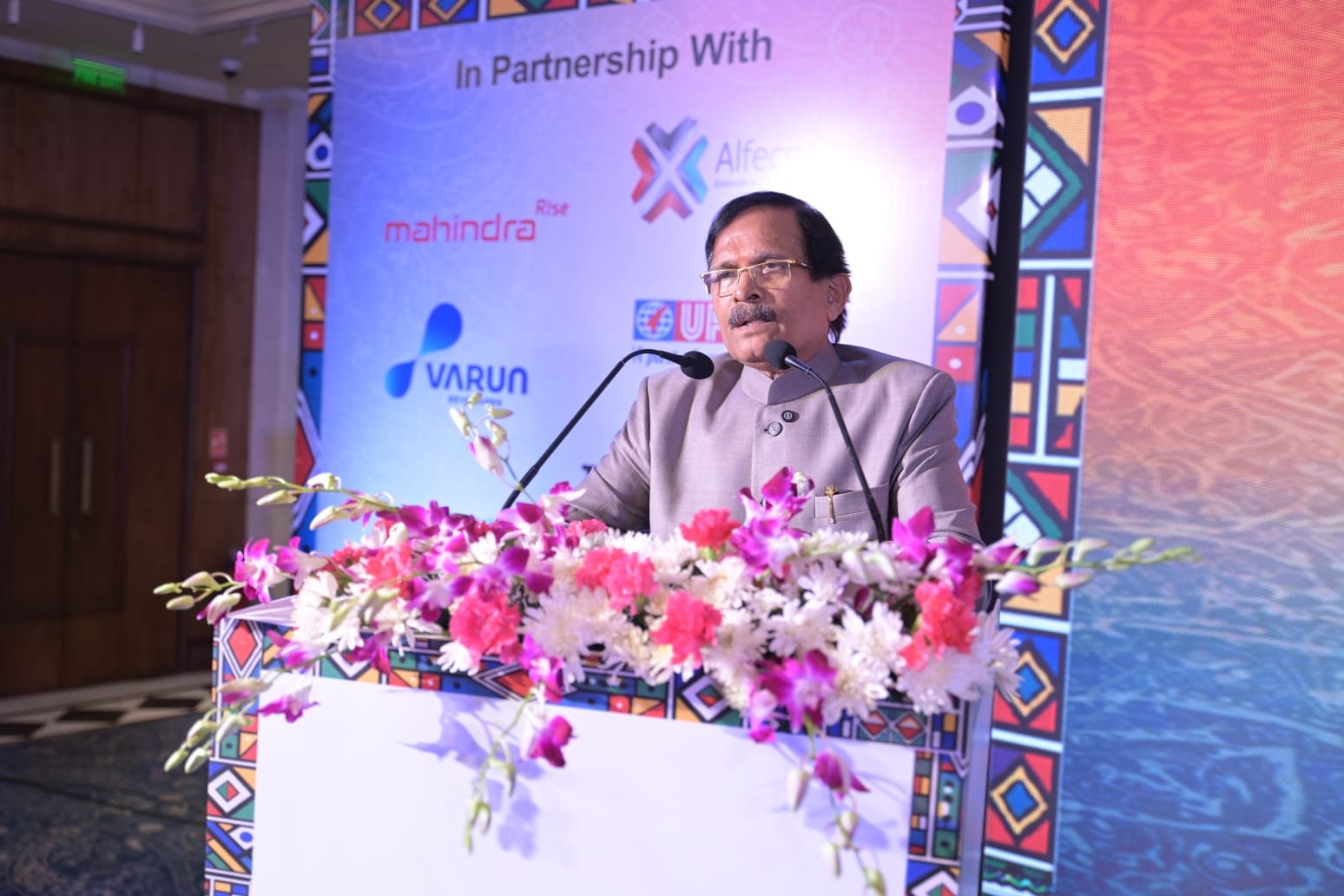
At a commemorative reception marking South Africa’s Freedom Day, Shri Shripad Yesso Naik, Hon’ble Minister of State for Power and New & Renewable Energy, Government of India, delivered a thoughtful address that underlined the depth of India–South Africa relations.
He highlighted the enduring historical connection between the two nations. Referencing figures such as Mahatma Gandhi and Nelson Mandela, he noted that both countries share “a long-standing and deeply rooted relationship, built on history, mutual respect, shared values, and a common commitment to democracy, equality, and inclusive development.”
He reflected on how “Mahatma Gandhi’s early work in South Africa laid the foundation for non-violent resistance,” while South Africa’s victory over apartheid “inspired millions around the world in their pursuit of justice and human rights.” This shared legacy, he emphasised, continues to shape contemporary engagement.
Over the decades, the relationship has evolved into a robust strategic partnership, with cooperation extending across bilateral and multilateral platforms such as BRICS, IBSA, and the G20. Highlighting recent high-level engagements, the Minister referred to the meeting between Narendra Modi and Cyril Ramaphosa during the G20 Summit in Johannesburg, noting that such interactions “reaffirm our shared commitment to strengthening bilateral ties.” He also expressed anticipation for South Africa’s participation in the upcoming 4th India–Africa Forum Summit.
Economic engagement, he observed, remains a key pillar of the partnership. With bilateral trade reaching approximately USD 18 billion, South Africa stands among India’s most significant trading partners in Africa. “There is significant potential to expand cooperation across sectors such as manufacturing, mining, healthcare, renewable energy, digital technologies, and financial services,” he noted, pointing to the breadth of opportunities ahead.
Defence and security cooperation has also seen steady progress, with joint exercises such as IBSAMAR and participation in naval engagements like Exercise MILAN enhancing interoperability and trust.
Yet, it was in the energy domain that the Minister placed particular emphasis. “Energy cooperation holds immense potential as a key pillar of India–South Africa relations,” he said, aligning South Africa’s energy priorities with India’s own transition journey. He highlighted India’s progress in renewable energy expansion and grid strengthening, while noting that both countries had reaffirmed their commitment to deeper collaboration during G20 energy discussions.
The partnership between NTPC Limited and Eskom was cited as a tangible example of this cooperation, providing “a strong framework for collaboration in operations, capacity building, and project development.” Looking ahead, he identified areas such as green hydrogen, renewable energy, and grid connectivity under the ‘One Sun One World One Grid’ initiative as promising avenues for deeper engagement.
Beyond economics and policy, the Minister also drew attention to unique and symbolic aspects of bilateral cooperation. The translocation of cheetahs from South Africa to India in 2023, he said, reflects “our shared commitment to biodiversity conservation and environmental stewardship.”
Equally significant are people-to-people ties. With a vibrant Indian diaspora of nearly 1.7 million in South Africa, the relationship is sustained by what he described as a “living bridge between our nations.” Initiatives such as the Gandhi-Mandela Centre of Specialisation for Artisans, along with ITEC and ICCR scholarship programmes, continue to strengthen these connections through education and capacity building.
The Minister also reaffirmed India’s commitment to a partnership that is “inclusive, sustainable, and future-ready,” and aligned with the vision of Viksit Bharat 2047 and Africa’s Agenda 2063.
Quoting an African proverb, he captured the spirit of the evening and the relationship itself: “If you want to go fast, go alone; if you want to go far, go together.”
It was a fitting note on which to conclude, one that reflected not just the journey of South Africa, but the shared path that India and South Africa continue to walk, together.


Leave a Reply