

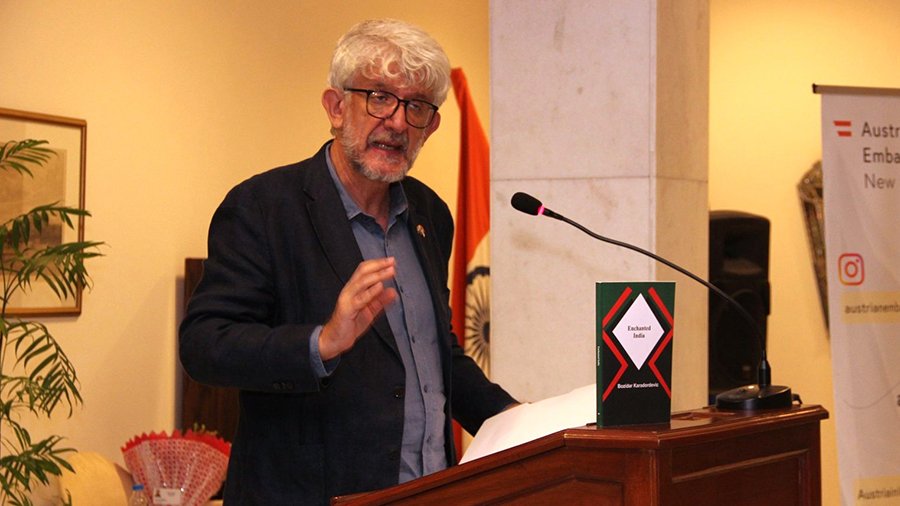
Nearly 130 years before modern diplomacy brought Serbia and India closer together, a Serbian traveller embarked on a journey that would leave behind one of Europe’s earliest literary portraits of India.
At the Literary Evening jointly organised by the Austrian Embassy and Diplomatist Magazine at the Residence of the Austrian Ambassador, on 25th June 2026, H.E. Mr. Siniša Pavić, Ambassador of Serbia to India, introduced the audience to this remarkable work, Enchanted India by Prince Božidar Karađorđević, first published in 1899.
More than a travelogue, the Ambassador described the book as an enduring literary bridge between Serbia and India, capturing the country’s landscapes, people and everyday life with remarkable sensitivity and respect.
“There are few better ways to approach another country than through literature,” he observed. “Books allow us to move beyond formal knowledge into a world of atmosphere, memory, perception and human experience. In that sense, literature performs a role very close to diplomacy. It invites us to see with patience, to listen carefully and to understand with humility.”
He then introduced the audience to Prince Božidar Karađorđević, an artist, writer and traveller who belonged to Serbia’s historic Karađorđević dynasty. Interestingly, when Enchanted India was first published in 1899, he was not yet a prince but simply a curious traveller exploring India through open eyes and an inquisitive mind.
The Ambassador explained that the book was originally written in French before being translated into English, with the English edition appearing even before the complete French publication. Only much later did it become available in Serbian, allowing new generations of readers to rediscover this extraordinary account of India.
Reflecting on the setting of the evening, Ambassador Pavić remarked that it was particularly fitting to speak about Enchanted India at the Austrian Embassy, since Prince Božidar’s work belongs to the great European tradition of travel writing, observation and cultural exchange.
He also noted that Delhi itself formed the perfect backdrop for revisiting the book.
“A city,” he remarked, “is shaped not only by its monuments but by the movement and daily lives of its people.”
That observation beautifully echoed Prince Božidar’s own style of writing.
Rather than focusing solely on grand architecture, the Serbian traveller paid equal attention to India’s fleeting moments—its evening fragrances, bustling streets, musicians, marketplaces and ordinary people.
Reading one of his favourite passages describing Delhi at dusk, the Ambassador transported the audience to an India where the evening air was scented with gardenias, amaryllis and lemon blossoms, while the sounds of tom-toms and tambourines drifted through brightly illuminated streets.
“It does not merely describe a city,” he reflected. “It evokes an entire atmosphere.”
The second excerpt shifted from Delhi to Bombay (now Mumbai), where Prince Božidar observed an elderly grain seller allowing sparrows to feed freely from his baskets while passers-by gently touched a sacred cow in reverence.
For Ambassador Pavić, the charm of the passage lay in its simplicity.
“The truest literary observations,” he remarked, “are often found not in great monuments but in ordinary moments.”
It is this quiet attention to everyday life, he suggested, that gives Enchanted India its enduring relevance. The book does not reduce India to an exotic spectacle; instead, it presents a civilisation encountered through patience, curiosity and respect.
Following the reading, Prof. D.K. Giri, who chaired the session, thanked the Ambassador for introducing many in the audience to a little-known literary treasure. Observing that Prince Božidar had travelled far beyond India into what was then regarded as the wider cultural sphere of the East, Prof. Giri remarked that Enchanted India offered readers an unusually expansive understanding of the region.
Turning from the book to the Ambassador himself, Prof. Giri posed a thoughtful question: after several years in India, what similarities had he discovered between Indian and Serbian society?
Ambassador Pavić’s answer was both personal and insightful.
Arriving in India during the COVID-19 pandemic, he explained, his earliest experiences were largely confined to interactions with his Indian colleagues and staff. Yet even during those challenging months, one striking similarity became immediately apparent.
“If you love someone,” he smiled, “you feed them.”
He described how both Indians and Serbians express affection through generous hospitality, placing food before every guest as a natural expression of warmth and friendship.
He went on to note another familiar trait, the shared love of music, celebration and lively gatherings.
More profoundly, however, he found the deepest similarities in the values that shape both societies.
Both nations, he observed, place immense importance on family, respect for elders, cultural traditions and historical memory. Their histories, too, reveal common experiences of preserving national identity, language and cultural heritage through periods of struggle and political change.
“These,” he concluded, “are extremely solid foundations for mutual understanding and cooperation.”
The conversation beautifully complemented the themes of Enchanted India itself.
Just as Prince Božidar Karađorđević had approached India with curiosity rather than judgement more than a century ago, Ambassador Pavić demonstrated that genuine diplomacy begins in much the same way, with careful observation, respectful listening and an openness to discovering how much people separated by geography often have in common.


Leave a Reply