

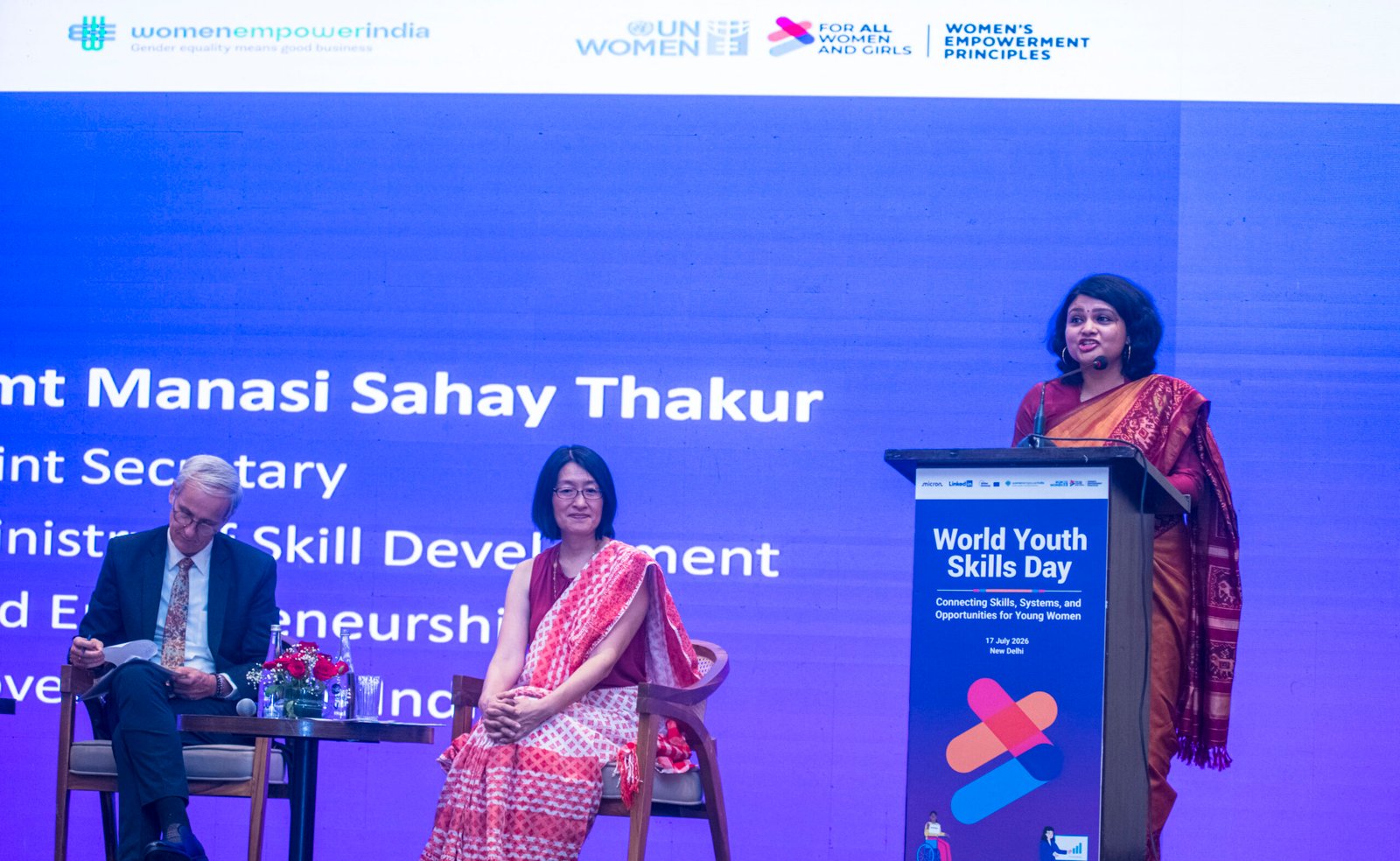
Marking World Youth Skills Day 2026, Ms. Manasi Sahay Thakur, Joint Secretary, Ministry of Skill Development and Entrepreneurship (MSDE), Government of India, placed women and girls at the heart of India’s journey towards becoming a Viksit Bharat by 2047. Speaking before government officials, industry leaders, development partners and young women from across the country, she emphasised that investing in women’s skills is not merely a matter of gender equality; it is a national economic imperative.
“A day like World Youth Skills Day reminds us that skills are the bridge between aspirations and opportunities, and between individual potential and national growth,” she remarked while setting the tone for an address centred on inclusion, leadership and the future of work.
Women at the Heart of India’s Growth Story
Referring to India’s demographic advantage, Ms. Thakur underlined that women constitute nearly half of the country’s youthful population and therefore must occupy a central place in national development strategies.
“If we have to realise the vision of Viksit Bharat by 2047, girls and women have to be at the centre of our skilling, employment and entrepreneurship efforts. It is not just gender sensitivity; it is an economic imperative. It is a national imperative.”
She noted that despite remarkable progress, many young women continue to encounter significant barriers while entering the workforce. These include limited digital access, mobility constraints, lack of mentorship and workplaces that are not always welcoming or inclusive.
For this reason, she argued that skilling must extend well beyond technical training. “When I say skills, I do not just mean technical skills. I also mean financial literacy, communication skills and digital fluency. Together, these empower women with financial independence, better decision-making and expanded life choices.”
According to her, the objective must shift from preparing women merely for employment to equipping them for lifelong careers and leadership roles.
Breaking Barriers in Non-Traditional Sectors
One of the strongest messages of her address focused on increasing women’s participation in emerging and traditionally male-dominated sectors such as artificial intelligence, green technologies, semiconductor manufacturing and advanced manufacturing.
She argued that these sectors represent the future of India’s economy and that women’s participation is essential for sustaining long-term growth.
“We need women in the sectors that will define the future of work. It is not just about learning technical skills; these environments build confidence, problem-solving abilities and leadership qualities that remain with you throughout life.”
To reinforce this message, Ms. Thakur shared her own journey.
A mechanical engineer by training and the first engineer in her family, she recalled growing up in a traditional family where pursuing engineering invited criticism from many quarters.
“People questioned my parents, asking why they were allowing their daughter to study mechanical engineering. They said it was not a field for girls. But if India has to develop, women must enter these non-traditional sectors. Men alone cannot take the country forward.”
Her personal story resonated strongly with the young audience, illustrating how perseverance and family support can overcome deeply rooted stereotypes.
Creating an Ecosystem That Works for Women
Moving beyond individual success stories, Ms. Thakur stressed that the responsibility lies equally with institutions.
Rather than asking why more women are not joining skill programmes, policymakers, she said, must ask whether the skill ecosystem itself has been designed with women at its core. “Have we designed our skill ecosystem keeping women at the heart and centre of it?”
She explained that an enabling ecosystem goes far beyond classrooms. Safe transportation, accessible training centres, childcare support, digital connectivity and welcoming learning environments all play a critical role in enabling women to participate fully.
“The more society supports women,” she observed, “the more society progresses.”
Government Initiatives Driving Inclusive Skilling
Highlighting the Ministry’s ongoing reforms, Ms. Thakur spoke about several initiatives aimed at strengthening India’s skill ecosystem.
She referred to the Ministry’s flagship programmes that seek to modernise Industrial Training Institutes (ITIs), deepen industry partnerships and ensure that training aligns with the evolving demands of employers.
She also highlighted the Ministry’s emphasis on creating safe and inclusive learning environments for women, particularly within technical institutions, while expanding opportunities through women-focused Industrial Training Institutes (ITIs) and Jan Shikshan Sansthans, where women constitute a significant share of beneficiaries.
Equally important, she said, is making vocational education aspirational among young people.
“Our focus is not just to train more young people but to make skilling more aspirational. Rather than pursuing a degree without employable skills, young people should see ITIs as institutions where they can become future-ready for India’s growth.”
Gender Mainstreaming: A Systemic Shift
A central theme of Ms. Thakur’s address was the Ministry’s commitment to mainstreaming gender across India’s skilling ecosystem. Rather than treating women as beneficiaries of isolated schemes, she emphasised that gender inclusion must become an integral part of policy design and implementation.
To this end, the Ministry of Skill Development and Entrepreneurship has constituted a Gender Mainstreaming Committee, which she has the privilege of leading.
“We are trying to ensure that every new initiative is viewed through a gender lens so that young women are not at the margins, but at the core and the heart of everything we do.”
She explained that the Ministry is continuously evaluating its programmes to ensure they respond to the realities faced by women and girls, from infrastructure and safety to accessibility and long-term employability.
Strengthening India’s Skill Ecosystem
Highlighting the Government’s ongoing initiatives, Ms. Thakur referred to programmes aimed at modernising India’s vocational education ecosystem through stronger collaboration with industry.
She noted that the Ministry is working to transform Industrial Training Institutes (ITIs) into centres of excellence by strengthening industry partnerships, modernising infrastructure and ensuring that training reflects the changing demands of the global economy.
“Our objective,” she explained, “is not to prepare youth based solely on what government believes is required, but to work closely with industry so that young people acquire the skills employers genuinely need.”
She also pointed to the Ministry’s efforts to expand opportunities for women through women-focused Industrial Training Institutes and Jan Shikshan Sansthans, where women account for a significant majority of beneficiaries.
While recognising that enrolment has improved, she acknowledged that sustaining women’s participation and ensuring successful employment outcomes remain equally important challenges.
Industry Must Become a Co-Creator
One of the strongest calls made during the address was directed towards the private sector.
Ms. Thakur urged industry to move beyond its traditional role as an employer and instead become an active partner in designing India’s future workforce.
“Government cannot do it alone. Industry must move beyond being merely employers and become co-creators of skills and co-creators of enabling environments.”
She stressed that apprenticeships, internships, workplace exposure, mentorship programmes and inclusive hiring practices are essential for building confidence among young women entering technical professions.
Such collaborations, she noted, not only improve employability but also strengthen institutions by ensuring that training remains relevant to rapidly evolving technologies and market requirements.
Communities Have an Equally Important Role
Beyond government and industry, Ms. Thakur highlighted the crucial role families and communities play in shaping opportunities for girls.
She encouraged parents to believe in the limitless potential of their daughters and to support them in pursuing careers beyond conventional expectations.
“Families must believe that their daughters are capable of reaching the moon and the stars.”
She argued that genuine transformation can only occur when governments, educational institutions, employers, communities and families work together to create an environment where women can thrive.


Leave a Reply