

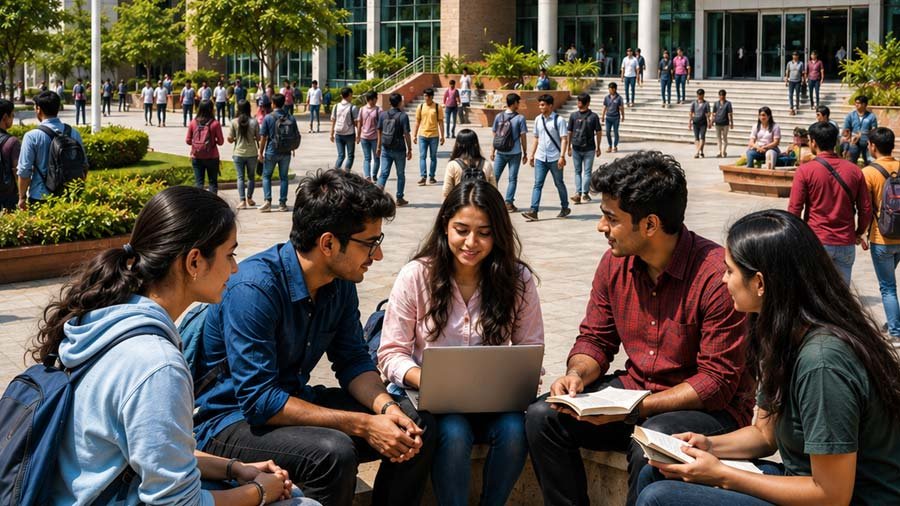
“The classroom should be an entrance into the world, not an escape from it.”
— John Ciardi
Introduction
The Gyan Bhumi, or the Land of Knowledge, was an epithet used for Bharat’s most prestigious universities during the pre-colonial era. Nalanda, Taxila, and Vikramshila Universities attracted scholars from across the globe. The question, therefore, arises: what happened to these exceptionally renowned institutions?
Manuscripts were burnt, scholars were killed, and the entire nation was forced to adopt an educational system it had never anticipated. Foreign invasions, empire-building, civil wars, and the colonisation of the Indian subcontinent brought the country to its lowest point. However, Bharat, now India, eventually became home to some of the world’s greatest scholars, artists, scientists, mathematicians, and record-breaking achievers across diverse fields, enabling the nation to secure a place at the most sought-after global forums shaping the future of the world.
It is somewhat ironic that certain sections of the media and the usual critics question the increasing inflow of international students who have chosen India to pursue higher education. Although India’s educational glory remained dormant for centuries due to repeated oppression, its legacy began to be rewritten with the establishment of world-class institutions such as the IITs, National Law Universities, JNU, and the University of Pune (now renamed Savitribai Phule Pune University), popularly known as the “Oxford of the East.” These institutions have significantly enhanced India’s global academic standing and earned recognition in international rankings, including the QS Asia University Rankings.
The Cost Architecture
The Indian education system has withstood the test of time over several decades, consistently emerging as one of the world’s most resilient and knowledge-driven systems. Quality education has remained the cornerstone of both ancient and modern Indian educational institutions. As the country prioritised academic excellence, affordability became an added advantage for international learners. Students from both the Global North and the Global South found in India a nation where “value for money” is not merely a marketing phrase but a lived reality.
While the Western education sector is often characterised by exorbitant tuition fees and expensive accommodation, the Indian education system offers comparatively affordable tuition structures and student-friendly living costs, making quality education accessible to a wider international community.
The Cultural Amalgamation
India is an amalgamation of diverse cultural identities, offering international students a truly holistic and immersive experience. The country has wholeheartedly welcomed individuals from different walks of life, enabling students to feel comfortable and at ease while living away from their families. This sense of belonging is further strengthened by the warmth of Indian society, which embraces international students by including them in festivals, cultural celebrations, and religious gatherings.
The subcontinent’s rich cultural heritage creates a nurturing learning environment that is essential for students living away from their homeland, allowing them to flourish academically as well as personally.
The Geopolitical Overview
India ranks among the world’s largest economies, reflecting its emergence as a major economic power. It is home to rapidly growing metropolitan cities such as Mumbai, Delhi NCR, Chennai, Bengaluru, and several Tier-II cities, all of which have thriving IT hubs, pharmaceutical industries, manufacturing sectors, and vibrant start-up ecosystems that contribute significantly to the country’s economic growth.
India has consistently upheld the principle of strategic autonomy in international affairs and continues to maintain cordial relations with countries that may otherwise be in conflict, including Russia and Ukraine, as well as the United States and Iran. This balanced diplomatic approach creates a stable and secure environment for international students pursuing their education in India.
Furthermore, the rapid growth of emerging industries and the expansion of start-ups under the Government of India’s Startup India initiative have significantly enhanced employment opportunities for young graduates. The inclusive recruitment practices adopted by many organisations also provide reassurance to students seeking career opportunities upon completing their academic journey.
Education as Part of Soft Power Diplomacy
India’s colonial past introduced English into its educational landscape, and over time, the language evolved into one of the world’s most widely recognised mediums of instruction. The education system gradually transitioned from the traditional Gurukul model to the modern Indian education system.
Today, several international universities, including Deakin University, the University of Wollongong, and the University of Southampton, have established campuses in India, enabling students to earn internationally recognised degrees at comparatively affordable costs. These institutions attract students from Africa, Central Asia, South Asia, and Southeast Asia.
In addition, student exchange programmes, Model United Nations conferences, government-led educational initiatives, and youth forums have become important instruments for promoting the internationalisation of education. Increasingly, governments recognise education as an effective instrument of soft power diplomacy. The concept suggests that intellectual generosity can foster national development and global engagement, offering a compelling alternative to traditional approaches based on power and domination.
Challenges
In today’s globalised world, the increasing commercialisation of education poses the risk of transforming learning into a market commodity. Educational institutions often compete aggressively to attract international students, sometimes treating them as consumers rather than learners, thereby diluting the intellectual purpose of education.
Private institutions and franchise campuses may, at times, compromise educational quality in pursuit of commercial gains, neglecting their broader responsibility towards student welfare.
Moreover, concerns relating to student safety, stringent visa regulations, and immigration policies continue to present challenges for the international student community. Language barriers arising from regional languages, adaptation to local communities, climatic conditions, and access to familiar cuisine are among the additional challenges faced by many international students.
Nevertheless, ongoing reforms such as the National Education Policy (2020), digital initiatives facilitating student mobility, government-sponsored scholarships, and enhanced safety measures continue to strengthen India’s position as an increasingly attractive destination for international education.
Conclusion
On the global stage, India is steadily emerging as a hub of future-ready education. The National Education Policy (NEP) 2020, together with NITI Aayog’s recommendations for transforming higher educational institutions into global classrooms, reflects the forward-looking vision of policymakers striving to establish India as a Global Knowledge Centre.
India’s commitment to providing quality education at affordable tuition costs resonates strongly with students across the world, promising access to learning opportunities irrespective of economic or social background.
The vision of creating a truly global classroom places a dual responsibility upon the nation. India must honour its rich educational heritage while simultaneously aligning its institutions with evolving global standards and the expectations of twenty-first-century education.
References:
Government of India. (2020). National Education Policy 2020. Ministry of Education. https://www.education.gov.in/sites/upload_files/mhrd/files/NEP_Final_Engli sh_0.pdf
Altbach, P. G., & Knight, J. (2007). The internationalization of higher education: Motivations and realities. Journal of Studies in International Education, 11(3–4), 290– 305. https://doi.org/10.1177/1028315307303 542
Varghese, N. V., & Malik, G. (2021). India’s National Education Policy 2020 and its implications for higher education. International Higher Education, 106, 12–15. https://doi.org/10.36197/IHE.2021.106. 05
Vickers, E. (2010). Education and social change in South Asia. Compare: A Journal of Comparative and International Education, 40(5), 681–686. https://doi.org/10.1080/03057925.2010.503372
NITI Aayog. (2025, December). Internationalization of higher education in India: Report. Government of India. https://niti.gov.in/sites/default/files/2025-12/Internationalisation_of_Higher_Education_in_India_Report.pdf Nye, J. S., Jr. (2004).
Soft power: The means to success in world politics. PublicAffairs. https://www.almendron.com/tribuna/wp-content/uploads/2020/02/joseph-s-nye-jr-softpower.pdf


Leave a Reply