

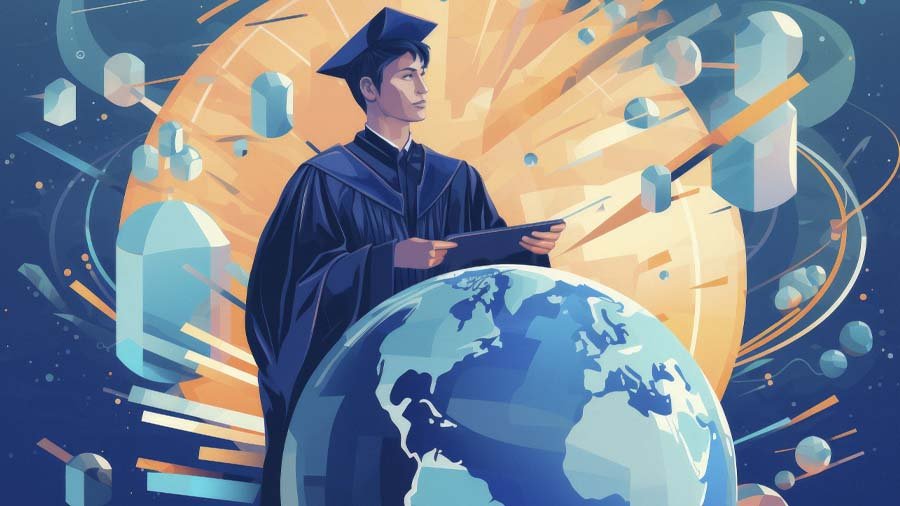
“Education should not be based on or limited by a nationalist agenda. Education must cultivate the wisdom to reject and resist violence in all its forms. It must foster people who intuitively understand and know—in their mind, in their heart, with their entire being—the irreplaceable value of human beings and the natural world. I believe such education embodies the timeless struggle of human civilisation to create an unerring path to peace”
– Dr. Daisaku Ikeda, The World Is Yours to Change
As the world is grappling with myriad problems, trying to find solutions at the national, bilateral or multilateral levels, one cannot help but think about the role of education and its purpose. It is time to move beyond national, religious, ethnic, race and gender boundaries because the threats and problems the world, the environment or humankind faces are real and interconnected. There is no time for the blame game or flexing one’s muscles of superiority or hegemony or power, but pull up together and work together as ‘One World, One Family’, a strong ethos that India has been following.
India’s BRICS presidency in 2026 gives New Delhi a rare chance to turn rhetoric about “education for the future” into concrete South South cooperation as well as bridging the gaps between the Global South and the Global North. Its presidency creates a chance that reshapes classrooms, campuses and skills systems across the Global South as well as brings the Global North close. The opportunity is significant—but so is the risk that education remains trapped in communiqués, tussles among the members of the Global North on proving whose education system is the best and elite pilot projects instead of becoming a lived reality for ordinary students and young workers.
Under its chairship, India has framed BRICS 2026 around “Building for Resilience, Innovation, Cooperation and Sustainability”, explicitly tying youth, education and skills to this broader agenda. The Ministry of Youth Affairs and Sports notes that the BRICS Youth Track will focus on pillars including “education and skills, youth entrepreneurship, science and innovation, social participation, inclusion, health and sports, environment and sustainability, interfaith dialogue, and youth exchange.” MY Bharat’s BRICS 2026 initiative further commits Indian youth to contributing one million hours of volunteer service between July and December 2026—under the Serve BRICS banner—linking education to community engagement and experiential learning. This framing matters. It positions education not as a narrow sectoral issue but as central to resilience against climate shocks, technological disruption and geopolitical fragmentation, rather than a side event at summits. It also helps in lifelong bonds that move beyond boundaries and prejudices.
An existing BRICS education architecture that India can finally use
India is not starting from a blank slate. BRICS states have already built an architecture for education cooperation.
In 2021, under India’s earlier BRICS presidency, education ministers adopted a joint declaration resolving to “enhance academic collaboration in higher education and India’s Technical and Vocational Education and Training (TVET)” among BRICS countries. They agreed to facilitate mobility of students and faculty, promote joint and dual degrees between BRICS universities, and “recognised Technical and Vocational Training and Education as a priority area for every BRICS country.”
India used that platform to highlight domestic digital tools—PM e VIDYA, SWAYAM, SWAYAM PRABHA, DIKSHA and Virtual Labs—as potential foundations for cross border education. PM e VIDYA, described by the Ministry of Education as a “comprehensive initiative that unifies all efforts related to digital/online/on air education to enable multi mode access to education,” integrates platforms such as DIKSHA, SWAYAM and educational TV/radio channels to reach millions of learners. DIKSHA has evolved into a “One Nation One Digital Platform” providing K–12 content across NCERT, CBSE, NIOS and state boards, including audiobooks and Indian Sign Language resources to support children with visual and hearing impairments. SWAYAM offers MOOCs in higher education and exam preparation, while SWAYAM PRABHA’s 34 DTH channels are explicitly designed to deliver curriculum aligned content to students in remote areas without reliable internet. BRICS MOOCs (Massive Open Online Courses) are free or low-cost digital classes offered by member nations to share knowledge. They let learners study business, technology, and global policy across Brazil, Russia, India, China, and South Africa. It can further include the other member states as well.
At the multilateral level, BRICS education ministers have also engaged UNESCO. In April 2023, ministers from Brazil, Russia, India, China and South Africa “agreed to join forces with UNESCO to support education progress globally through coordinated actions and advocacy,” and invited UNESCO “to play a central role in supporting their collective action in education.” UNESCO’s report BRICS: Building education for the future concludes that BRICS countries “have made effective use of innovative policies to improve the quality of education and for expansion of technical and vocational training and higher education,” while warning that mass higher education is still uneven and quality gaps remain.
The question, then, is whether India’s 2026 presidency will finally use this architecture to deliver outcomes beyond declarations.
Three tests for India’s presidency: institutions, digital equity and labour markets
First, India should turn the BRICS Network University (BRICS NU) into a genuine Global South hub, not just a loose consortium of flagship institutions. BRICS NU now includes universities from the original five plus new members, such as New Valley University in Egypt, signalling expansion into Africa and the Arab world. Under its chairship, India can push for joint master’s programmes in climate resilience, digital public infrastructure and public health, co taught by BRICS NU institutions and rooted in Southern contexts.
This requires regulatory courage at home. The National Education Policy and recent guidelines on internationalisation give India space to fast track recognition of joint and dual degrees, simplify visas and credit transfers for BRICS NU students, and bring tier 2 public universities and polytechnics into the network rather than restricting participation to IITs and central universities. Doing so would operationalise the 2021 pledge on mobility and joint degrees, and prevent BRICS cooperation from becoming another elite club.
Second, India must decide whether digital will close or widen the learning gap across BRICS. At the 8th BRICS Education Ministers meeting, India emphasised that “online learning and digital delivery of education have emerged as important means for achieving education sector development goals,” while warning of the “need to reduce and eventually eliminate the digital divide.” Under its presidency, New Delhi can move from showcasing PM e VIDYA and DIKSHA to co developing shared BRICS open courses—in English, Hindi, Portuguese, Russian, Chinese and Arabic—on topics like renewable energy, agro ecology, critical minerals governance, AI ethics and health systems. Other subjects on traditional and non-traditional issues, such as water, food, economies, civilizational culture, sociology and international relations studies would be important to understand each other’s views. It will be equally important to study the Global North from all its aspects, with the focus on building an understanding and reducing the gaps.
Another important goal would be to bring equal access to all children and adults in rural or poor areas, so that no one gets left behind. That means setting joint low bandwidth standards, drawing on India’s use of SWAYAM PRABHA, community radio and offline content for learners without stable internet, so that BRICS MOOCs work in rural places such as Jharkhand and interior provinces of Russia or China, South Africa, Brazil, Iran, Saudi Arabia, etc., not just in urban broadband corridors. It also means embedding digital equity in the youth agenda—India’s first BRICS Youth Coordination Meeting in 2026 highlighted “education and skills, youth entrepreneurship, science and innovation” as priority areas, and youth representatives have begun exchanging best practices on education and digital inclusion. If these discussions feed into joint digital standards and shared content rather than stand alone youth statements, BRICS 2026 could mark a shift from demonstration platforms to everyday tools.
Third, India needs to tie its TVET, youth volunteering and sectoral tracks to real labour markets. BRICS ministers have already recognised TVET as a priority and committed to collaboration in this field. The Youth Track 2026—structured around Working Group Meetings, Thematic Engagements, Serve BRICS Volunteering Activities, Youth Development Forum, Youth Council Meeting, Youth Summit and the Youth Ministerial Meeting.
Serve BRICS, with its goal of one million youth volunteer hours, can either be a feel good campaign or a skills linked platform. The difference lies in whether India connects volunteering to TVET pathways and sectoral cooperation. If young electricians, solar technicians, nurses and logistics workers from BRICS countries are given short term placements in communities and projects tied to the 11th BRICS Energy Ministers’ Meeting and other sectoral tracks, education cooperation will start to look like realistic pathways from training to employment. If the volunteering stays at the level of generic social service, the structural TVET challenge will remain untouched.
Keeping education a global public good, not a geopolitical prop
UNESCO’s partnership with BRICS was premised on the idea of education as a global public good, with ministers explicitly asking the organisation to “play a central role” in supporting their collective action. India’s own emphasis on strategic autonomy and a multipolar world gives it credibility to insist that BRICS education initiatives remain inclusive and non bloc, open to collaboration with African Union universities, Latin American networks and European as well as American partners where interests align. As India stands in a good position between Global South and Global South, evident from the various presence in multilateral summits including the recent G7 one, it will be prudent on New Delhi’s part to play the role as a global lynchpin to bring both the worlds together and give the youths a chance to learn both sides of the world (Global South and Global North) and stories and focus on building genuine peace where it is not just absence of war or armed peace but genuine peace and understanding.
The real measure of India’s BRICS presidency will be whether education emerges as its most concrete legacy. If New Delhi uses 2026 to deepen South South cooperation as well as South-North cooperation through BRICS NU, shared digital content, TVET mobility and youth volunteering grounded in real community needs and labour markets, it will have moved education from the margins of summit diplomacy to the centre of a more resilient Global South. If it settles for statements, conclaves and symbolic youth events, “Building for Resilience, Innovation, Cooperation and Sustainability” will remain a slogan—and the generation whose future depends on BRICS education policies will be left navigating the same old divides, with little to show for another year of multipolar talk.
The time is crucial as the world is in a turbulent flux with no mercy from nature. It is the right time and opportunity for India to proactively bring South-North together and help bridge the gaps, including the civilizational ones, and education is the best medium that helps in breaking the barriers of the mind.


Leave a Reply