

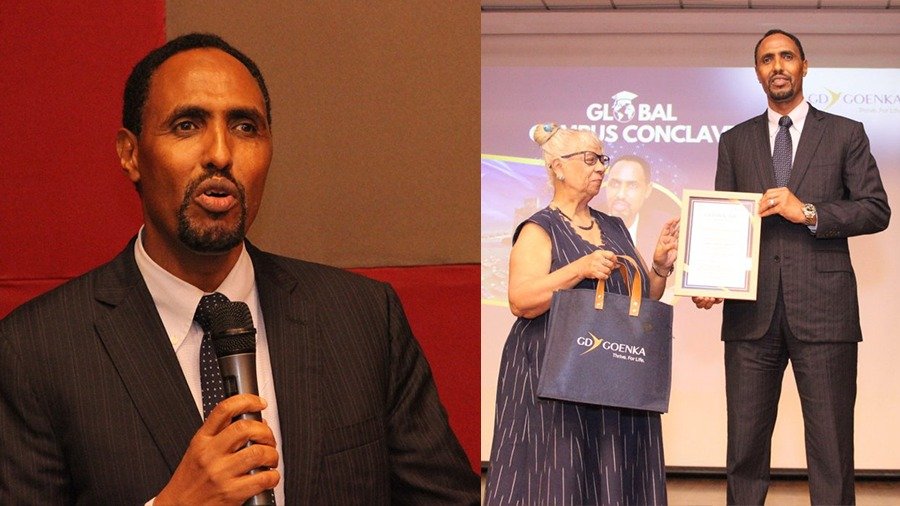
At the Global Campus Conclave, H.E. Dr. Abdullahi Mohamed Odowa, Ambassador of the Federal Republic of Somalia to India, reflected on the enduring India–Somalia relationship, the role of education in nation-building, and how his own journey from a modest background to diplomacy shaped his belief in the transformative power of learning.
Education, for H.E. Dr. Abdullahi Mohamed Odowa, Ambassador of the Federal Republic of Somalia to India, is much more than a pathway to employment. It is an instrument of nation-building, a bridge between societies and, ultimately, a force capable of transforming the trajectory of an individual’s life.
Addressing the Global Campus Conclave in New Delhi, Ambassador Odowa connected the India–Somalia relationship with the larger question of how education shapes nations and their citizens. India and Somalia share longstanding historical and people-to-people connections, with diplomatic relations established in 1960. The relationship has evolved over the decades across trade, education, healthcare and other areas of cooperation.
For Somalia, India has also been an important educational destination. Somali students have travelled to India to pursue undergraduate and postgraduate studies, through both scholarships and private sponsorship. The educational links have extended into Somalia’s political and professional leadership as well. President Hassan Sheikh Mohamud is an alumnus of Barkatullah University in Bhopal, where he pursued postgraduate studies and was later conferred an honorary doctorate.
But Ambassador Odowa’s message went beyond bilateral statistics and institutional relationships. He spoke about the deeper connection between education and the nation-state.
According to him, that relationship can move in two very different directions.
“There is a strong link between education and nation-states. That link could be either a positive loop or it could be a negative one.”
When countries invest in education, he argued, they produce knowledgeable, skilled and ethical citizens who can strengthen institutions, contribute to the economy and improve public services. Those improvements, in turn, create greater capacity to invest further in education.
“By investing in one individual, you are investing in the nation in general.”
It is this idea of a virtuous cycle that lies at the centre of the Ambassador’s argument. Education does not simply benefit the individual sitting in a classroom; its impact extends to families, institutions, economies and societies.
The reverse, he cautioned, can also become a cycle. When education is neglected, countries risk producing fewer skilled citizens and weaker institutions. Economic difficulties can then deepen poverty and reduce the resources available for education, further complicating the process of nation-building.
For Somalia, this relationship between education and national development has particular significance given the profound disruption caused by decades of conflict. Yet Ambassador Odowa did not present Somalia’s experience only through the lens of difficulty. Instead, he emphasised something equally important: resilience.
“Human creativity, human resilience is also teaching us that we should not give up; we should always strive.”
The statement was not merely theoretical. The Ambassador drew upon his own life to illustrate what education and resilience can achieve.
He recalled growing up in a modest family and described how the civil war disrupted his education when he was in the eighth grade. Much of the educational infrastructure around him was destroyed, but he refused to abandon his aspirations.
With the support of his family, he continued his education, travelling to different countries and eventually pursuing a PhD. His professional journey subsequently took him through academia, teaching, research and government consultancy before leading him into diplomacy.
His story, therefore, became a personal case study of the argument he was making to the students in the room.
“Even if the environment is sometimes against you, that resilience kind of makes you drive.”
For Ambassador Odowa, the role of education is also visible in the everyday work of diplomacy.
A contemporary diplomat, he noted, is required to perform multiple roles. Diplomats may assist students travelling abroad, help patients seeking medical treatment, support travellers and families with consular requirements, and simultaneously participate in high-level negotiations involving political tensions, conflict, terrorism and war.
Such responsibilities demand more than technical knowledge.
They require an education that is transformative and experiential, one that develops not only professional skills but also the qualities necessary to work with people and navigate difficult circumstances.
He described the ideal education as: “High quality, transformative, skillful, experienced” education, one that also teaches “humility, patience and observation.”
That observation is particularly relevant in diplomacy, where understanding people, contexts and perspectives can be as important as possessing information.
The Ambassador’s remarks also highlighted the importance of India as an educational and human connection for Somalia. Beyond the movement of goods and services, the movement of students, professionals and patients creates relationships that can endure across generations.
India’s relationship with Somalia has historically been shaped by Indian Ocean connections, including trade and people-to-people exchanges, and those links continue to form part of the bilateral relationship today.
But it was his message to the young people in the audience that provided the most personal conclusion to his address.
Ambassador Odowa asked the students to consider how many people they knew who had come from ordinary or working-class families and, through education, changed the direction of their lives.
For him, that possibility is one of education’s greatest strengths.
Education can alter an individual’s circumstances. Individuals, in turn, can strengthen institutions. And stronger institutions can help shape stronger nations.
The Ambassador’s own journey, from a modest upbringing and disrupted schooling to academia, research, public service and eventually diplomacy, offered perhaps the most compelling illustration of that philosophy.


Leave a Reply