

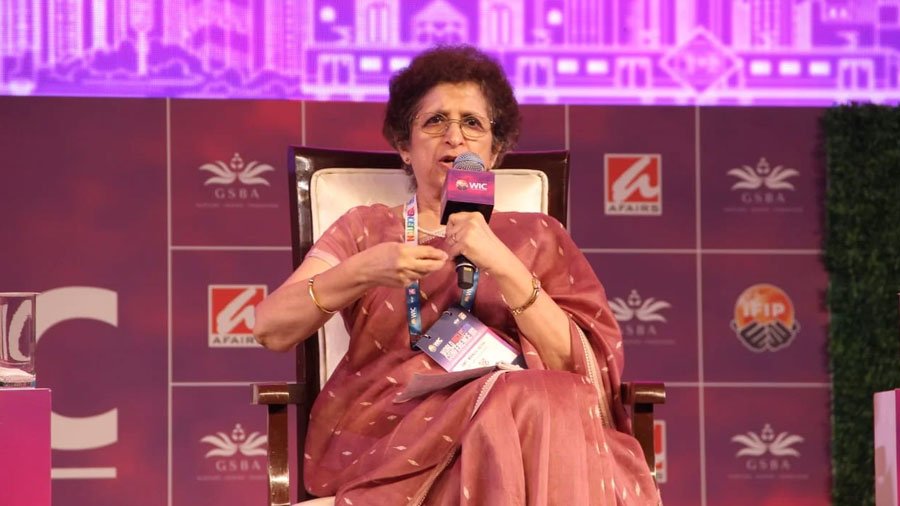
Education has long been one of India’s most effective tools of diplomacy, fostering goodwill, building capacities and strengthening partnerships across the Global South, said Ambassador Manju Seth, former Ambassador of India to Madagascar and Comoros, during the Diplomatist Magazine-curated session, The Diplomatic Dialogue on Global Learning, Equity & Internationalisation, at the World Inclusion Conference 2026.
Addressing diplomats, education leaders, policymakers and students, Ambassador Seth underlined that inclusion in education extends far beyond access to classrooms. It encompasses affordability, accessibility, quality, diversity among learners and educators, and the collective responsibility of ensuring that no one is left behind.
“Inclusivity covers the entire spectrum: ability, accessibility, affordability and the availability of quality education. Our goal should be to ensure that every learner has the opportunity to learn and grow,” she said.
While acknowledging that achieving universal inclusion remains an ongoing challenge, she said platforms such as the World Inclusion Conference play a vital role in identifying practical solutions and encouraging collaboration.
Turning to the role of diplomacy, Ambassador Seth highlighted India’s longstanding commitment to educational cooperation with developing nations through scholarships, capacity-building programmes and institutional partnerships.
She recalled that initiatives such as the Indian Technical and Economic Cooperation (ITEC) Programme, launched in 1964, and the Indian Council for Cultural Relations (ICCR) scholarship programme have enabled thousands of students and professionals from Asia, Africa, Latin America and other regions to pursue education and training in India.
“For decades, India has invested in education and capacity building across the Global South. These programmes have opened doors for countless young people who otherwise would not have had access to quality education and professional training,” she observed.
Ambassador Seth noted that India’s education landscape has evolved significantly, with Indian institutions gaining international recognition and attracting an increasing number of overseas students. She also referred to the opportunities created through the National Education Policy, including greater internationalisation, academic collaborations, dual-degree programmes and student exchange initiatives.
Describing education as a key pillar of foreign policy, she said academic engagement creates enduring people-to-people ties and strengthens India’s global outreach.
“Education is a powerful element of diplomacy. It builds goodwill, creates lasting partnerships and strengthens relationships between nations in ways that extend far beyond classrooms,” she remarked.
She also highlighted India’s pioneering digital initiatives to expand access to education, particularly in Africa. Referring to the Pan-African e-Network and its successor, the e-VidyaBharati and e-ArogyaBharati (e-VBAB) Network, Ambassador Seth said these initiatives have transformed access to higher education and telemedicine by connecting leading Indian institutions with partner countries through digital platforms.
Drawing from her diplomatic tenure in Madagascar, she shared firsthand experience of how these programmes benefited students, professionals and healthcare providers by making quality education and medical expertise accessible remotely.
“Technology has democratised education. Today, geographical distance is no longer the barrier it once was. Through digital platforms, quality education can reach learners wherever they are,” she said.
Ambassador Seth called for continued investment in educational diplomacy as a means of promoting global inclusion, knowledge sharing and international understanding.
Recalling India’s civilisational philosophy of ‘Vasudhaiva Kutumbakam’ — the world is one family, she emphasised that education should remain central to India’s engagement with the world.
“I hope inclusivity continues to be the guiding principle of Indian diplomacy as we share our knowledge, our educational strengths and our traditional wisdom with the world,” she concluded.


Leave a Reply