

Background
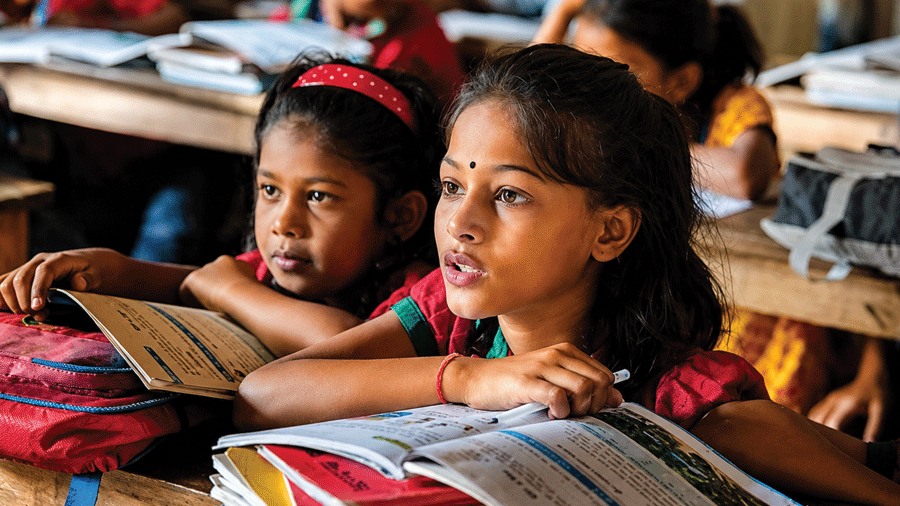
“Education for All” (EFA) and “Leave No One Behind” (LNOB) movements are twin pillars of the global educational equity programme. “No Child Behind” is inclusive in the “Leave No One Behind.” All is driven primarily by the United Nations Educational, Scientific, and Cultural Organisation (UNESCO) and the 2030 United Nations Sustainable Development Goals (UNSDG), simply abbreviated as SDG. These frameworks aim to eradicate disparities, ensuring every child and everyone—regardless of gender, location, or socioeconomic background—receives an inclusive, high-quality education. The frameworks are rooted in the World Declaration on Education for All (1990), launched in Jomtien, Thailand; the Dakar Framework for Action (2000); and the SDG 4 (2015) (UNESDOC Digital Library). Achieving these goals heavily depends on addressing unique and specific regional and country challenges, with its global focus. ‘Education for All’ entails ensuring equitable, accessible, and high-quality education for every individual, regardless of their gender, socioeconomic status, ethnicity, geographic location, or physical abilities (UNESCO Office Bangkok and Regional Bureau for Education in Asia and the Pacific [1163], , 2023). This framework is a global agenda that focuses on three core areas, namely universal accessibility, equity and inclusion, and quality learning.
Conceptually, “education for all” involves inclusive transformation of all physical and learning aspects of the school, such as curriculum, learning outcomes, continuous assessment, teacher training and pedagogy. These would create an education system that responds to the needs of all children in a common and conducive learning environment. This kind of education is provided regardless of the background or abili, or gender, so that everyone has the right to receive an equitable and quality education. “No child and no one behind” presupposes an education which ensures that access to, and opportunities for children, adolescents, youth and adults in education are just and fair by reduction and elimination of disparities and discriminations based on a child’s or an adult’s background. Inclusivity and equity are core parts of quality education and contribute to positive impact on the learning outcomes of all learners, especially for those most affected by the learning crisis, such as disadvantaged and marginalised communities, vulnerable groups, and those who have never been to school or dropped out of school early.
In some parts of the world, ravaged by conflict and war and terrorism, like Nigeria and Afghanistan, girls and women are the most vulnerable, leading to their abduction, rape, and outright school closures. In India, the caste system still restricts educational access and outcomes for girls and women, even in the 21st century. In worrisome cases, lower-caste girls face heightened rates of early marriage and domestic responsibilities. Moreover, fears of caste-based violence, harassment en route to school, or a ruined reputation often compel families to pull their girl-children out of school (Bhagavatheeswaran, et al., 2016). Since the dawn of the 21st century, presumably, such cultural practice should have been reduced, or eliminated, given India’s technological development and global influence.
Framework Core Areas
The government of some countries adopt the Universal Basic Education (UBE), which ensures free, compulsory, and continuous access to foundational schooling. While globally emphasised, implementation varies significantly from country to country. For instance, countries like Nigeria, Finland and Kenya have adopted the UBE model to eradicate poverty and boost literacy (Yusuf & Ajere, n.d.). Other countries like Kenya, Malawi and Uganda have also abolished primary school tuition fees. In this way, these governments are encouraging mass enrollment, even though infrastructure and teacher shortages often challenge the quality of universal delivery (World Bank Group, 2025). It is obvious that more needs to be done by governments, especially in developing countries, to provide the necessary infrastructure and adequate teaching staff to meet the quality education envisaged by UNESCO. Also, wealthy and elite citizens need to play a crucial role by establishing schools, not only for-profit motives but also for free quality education in their communities.
Conclusion
Education for all, leaving no child and no one behind, is a global initiative that recognises that access to education is a fundamental human right. However, without equity, quality and inclusion, millions would remain trapped in cycles of poverty and illiteracy. To mitigate this, the UNSDGs prioritise inclusive and equitable and quality education as Goal 4. Whether this will be achieved in the next four (4) years remains an issue of concern, but every country will need to continue to pursue the goal beyond 2030.


Leave a Reply