

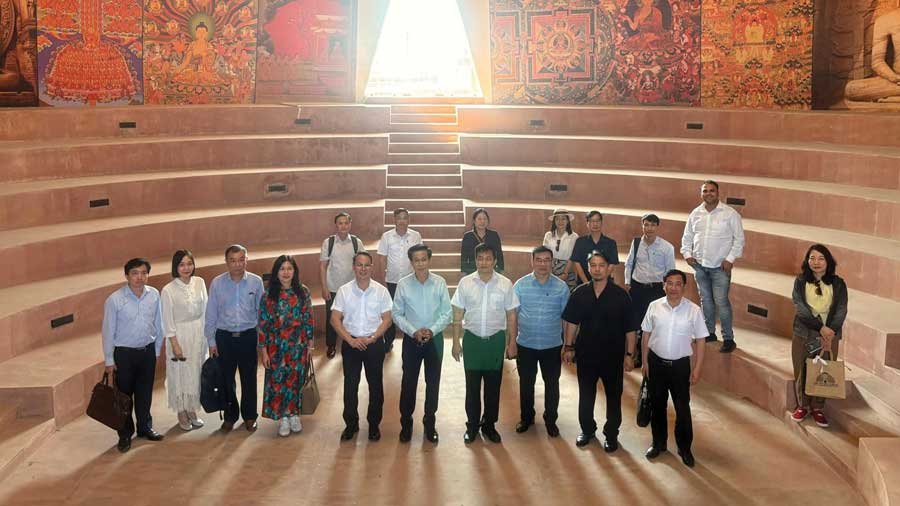
Beyond trade, defence and strategic dialogue, both countries increasingly recognise that investing in knowledge partnerships, institutional collaboration and human capital development will determine the long-term trajectory of their relationship. Universities, research institutions and centres of learning are no longer viewed merely as academic spaces; they are becoming instruments of diplomacy, innovation and sustainable development.
This vision received renewed momentum during the State Visit of General Secretary and President Tô Lâm to India in May 2026, when education and capacity building featured prominently among the outcomes.
One of the most significant outcomes was the signing of a Memorandum of Understanding between Nalanda University and the Ho Chi Minh National Academy of Politics. While the agreement focuses on academic cooperation, training and capacity building, it carries a symbolism that extends well beyond higher education. Nalanda, one of the world’s oldest centres of learning, represents centuries of intellectual and Buddhist exchange across Asia, while the Ho Chi Minh National Academy of Politics plays a central role in leadership development and public policy education in Viet Nam.
Another landmark initiative announced during the visit was the establishment of India Studies Chairs at universities in Da Nang and Ho Chi Minh City under the Indian Council for Cultural Relations (ICCR). These academic positions represent an important investment in long-term intellectual engagement by promoting teaching and research on India’s history, politics, economy, philosophy, literature and contemporary development. Beyond introducing Indian studies into university curricula, the initiative is expected to stimulate collaborative research, academic publications, conferences and student exchanges, creating a stronger community of scholars specialising in India–Viet Nam relations.
For students and researchers, the India Studies Chairs will serve as gateways to a deeper understanding of India’s growing role in the Indo-Pacific and the Global South. Equally, they provide Indian scholars with opportunities to engage more closely with Vietnamese academia, encouraging comparative research on governance, economic transformation, regional integration and sustainable development.
Civilisational heritage also found an important place within the education agenda. Among the noteworthy outcomes of the State Visit was the agreement to collaborate on the digitisation and preservation of ancient Cham manuscripts preserved in Viet Nam. These manuscripts, many of which contain Sanskrit influences and reflect centuries of interaction between the Indian subcontinent and the ancient Champa Kingdom, represent an invaluable historical archive documenting the spread of religion, language, literature and maritime trade across Southeast Asia.
The digitisation initiative combines India’s expertise in archival preservation with modern digital technologies to safeguard these fragile manuscripts for future generations. Beyond conservation, the project will enable wider scholarly access to rare historical material, encourage collaborative research between historians and linguists, and deepen understanding of the civilisational links that continue to underpin contemporary India–Viet Nam relations. It is a compelling example of how heritage preservation can also serve as an instrument of academic diplomacy.
While cultural and historical cooperation remains important, the future of the bilateral relationship will increasingly depend on preparing a highly skilled workforce capable of driving innovation-led growth. India and Viet Nam have both identified science, technology, engineering and mathematics (STEM) as priority areas for cooperation. As their economies become more technology-driven, opportunities are expanding for collaboration in engineering, digital technologies, artificial intelligence, semiconductors, biotechnology, renewable energy and advanced manufacturing.
Academic exchanges are expected to play a central role in this transformation. Universities and research institutions from both countries are increasingly exploring partnerships that promote joint research, faculty mobility, curriculum development and innovation ecosystems. Such collaborations enable students to acquire international exposure while allowing institutions to combine complementary strengths in research, technology and entrepreneurship. Capacity-building initiatives, technical training and professional development programmes further strengthen this ecosystem by equipping young professionals with
globally relevant skills.


Leave a Reply