

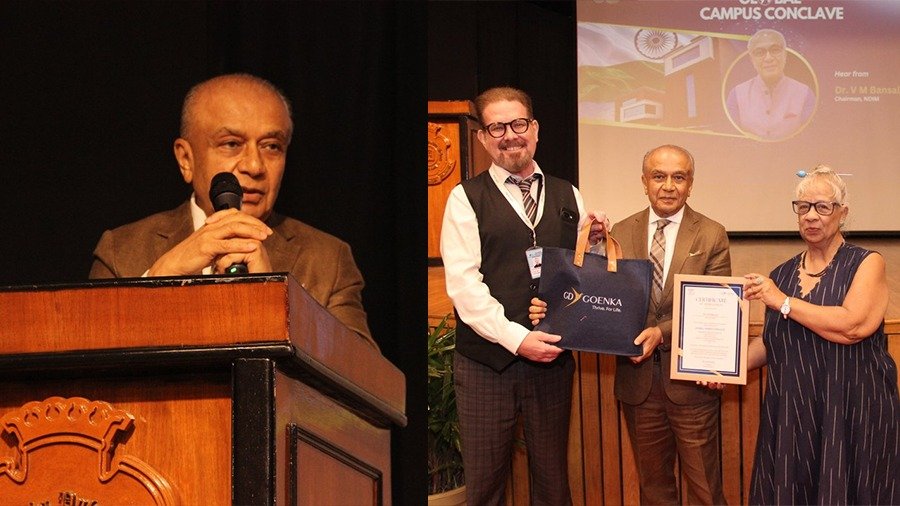
Dr. V. M. Bansal, Chairman, New Delhi Institute of Management (NDIM), emphasised the need to rethink higher education around employability, cross-cultural competence, industry exposure and the skills of tomorrow at the Global Campus Conclave, organised by Diplomatist Magazine and GD Goenka Group on 18 August 2026 at GD Goenka The Flagship School, Vasant Kunj, New Delhi.
For Dr. V. M. Bansal, the purpose of management education extends far beyond classrooms, textbooks and conventional qualifications. At the Global Campus Conclave, he made a strong case for an education system that anticipates the future rather than merely responding to the present.
Drawing on NDIM’s long-standing engagement with industry and international partners, Dr. Bansal spoke about the importance of cross-cultural learning, employability, technology-led education and the need to prepare students for a rapidly changing global economy.
Beyond the textbook
Dr. Bansal began by highlighting NDIM’s international and institutional collaborations, including its engagement with the UK India Business Council and its long-standing association with Japanese institutions.
He recalled NDIM’s work with the Japan Centre of Excellence, which, according to NDIM’s published material, was established as part of the institute’s effort to develop global learning and stronger India-Japan industry connections. NDIM has also developed a Korea Centre of Excellence focused on Korean language, culture and business etiquette.
For Dr. Bansal, these initiatives are not merely about international exposure. They represent a fundamental principle of management education: students must understand how business operates across cultures.
“We feel that an MBA is totally incomplete without cross-cultural learning and without maximum industry hand-holding of students.”
He argued that the best textbooks alone cannot equip young people for the realities of an increasingly interconnected workplace.
“The best of books can’t teach you what the world of tomorrow is needing.”
The employability question
One of the strongest themes of Dr. Bansal’s address was the relationship between India’s demographic dividend and employability.
India’s young population is frequently described as one of the country’s greatest advantages. But, he cautioned, demographics by themselves do not guarantee prosperity. The real question is whether young people receive the education, skills and opportunities necessary to participate meaningfully in the economy.
“Unless the young population is groomed in the proper manner, given the right communication skills and prepared for jobs, the demographic dividend can become a challenge rather than a boon.”
This, he said, should be a fundamental question for every higher-education institution:
“If we are running these higher education programmes, are we making students employable?”
For NDIM, he explained, industry linkage has therefore remained at the heart of its management programmes. NDIM’s published materials emphasise extensive industry interaction, corporate mentoring and technology-integrated management education.
From today’s leaders to tomorrow’s leaders
Dr. Bansal also challenged educators to think beyond the immediate demands of the employment market.
The objective, he suggested, should not simply be to produce graduates who can secure their first job, but professionals whose skills remain relevant as the economy, technology and geopolitics evolve.
“Are we grooming leaders of today, or are we grooming sustainable leaders?”
Clarifying that he was not using “sustainability” merely in its conventional environmental sense, he posed a more fundamental question: will the skills imparted today remain useful tomorrow?
His answer was a call for institutions to anticipate change.
“I can do that only if I keep an eye on tomorrow and give you tomorrow’s skills today.”
This philosophy is reflected in NDIM’s focus on emerging technologies and technology-integrated management education. Its published programme material lists areas including AI/ML and data science, digital marketing, treasury and investment management, operations and supply chain management, finance, HR and international business.
Preparing leaders for emerging sectors
Dr. Bansal pointed to data protection, cybersecurity and renewable energy as examples of fields in which management graduates will increasingly need specialised knowledge.
He referred to India’s Digital Personal Data Protection framework as an emerging area of opportunity for professionals. The Digital Personal Data Protection Act, 2023 was enacted in August 2023, while the government notified the DPDP Rules, 2025 in November 2025. Implementation is phased, with several substantive provisions scheduled to take effect 18 months after the November 2025 notification.
Rather than waiting for such developments to become mainstream, Dr. Bansal argued, educational institutions should begin preparing students in advance.
“Unless we create sustainable leaders, we cannot prepare them for the future.”
He made a similar argument in the area of renewable energy. Engineers may develop and operate renewable-energy technologies, he observed, but organisations will also require managers and administrators capable of leading these businesses and projects.
NDIM’s published material confirms its Centre of Excellence in Renewable Energy and its efforts to provide management students with specialised exposure to renewable energy and sustainability.
Learning the language of global business
One of the most compelling examples Dr. Bansal offered was NDIM’s engagement with Japan.
He explained that the institute does not view international placements simply as an opportunity to teach students another language. Instead, it seeks to familiarise students with the business culture, workplace practices and professional etiquette of the countries in which they hope to work.
NDIM’s published material documents its Japan Centre of Excellence, its engagement with Japanese organisations and its focus on Japanese language, business etiquette and corporate exposure. It also states that the institute has been licensed by the National Skill Development Corporation to train manpower for Japanese companies.
Dr. Bansal said the approach has translated into employment opportunities with Japanese companies in India.
“Our business culture and Japanese business culture are very different. If I groom students according to your business culture, you will be very happy to pick them up.”
He described the same philosophy behind NDIM’s engagement with Korea, where students are introduced not only to language but also to Korean culture and business etiquette. NDIM’s published prospectus confirms the institute’s Korea Centre of Excellence and its focus on preparing students for opportunities with Korean organisations.
Education with responsibility
Dr. Bansal also spoke about NDIM’s institutional philosophy. He emphasised that the institute has deliberately remained focused on management education rather than pursuing expansion simply for its own sake.
According to NDIM’s published material, the institution traces its origins to 1992 and describes itself as operating through a non-profit charitable education society.
For Dr. Bansal, this creates a particularly strong responsibility towards every student.
“Even if one student doesn’t get the proper job, we feel that we have done an injustice to the family, and we stay committed to them.”
It is this sense of accountability, he suggested, that should lie at the heart of higher education.


Leave a Reply