

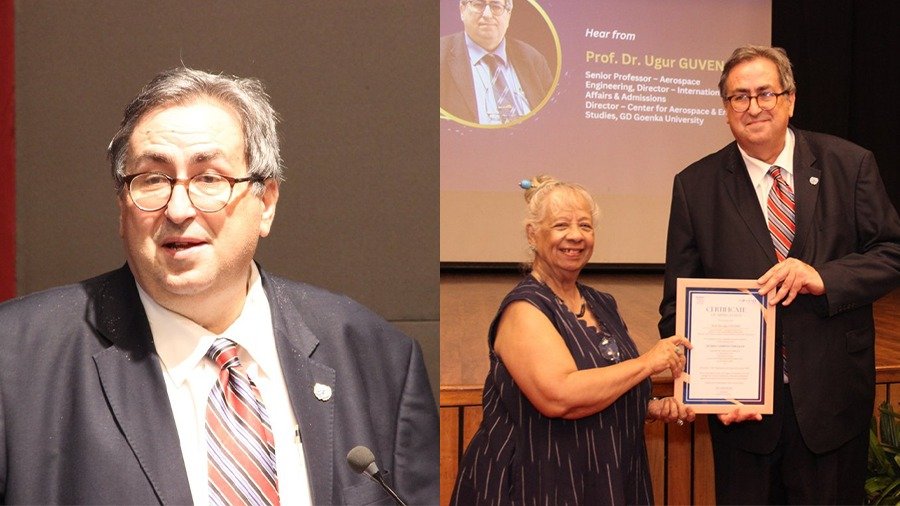
At the Global Campus Conclave, aerospace and nuclear engineer Dr. Ugur Guven challenged students to look beyond technological progress and take responsibility for building the peaceful, connected world that technology alone cannot create.
Dr. Ugur Guven spends much of his professional life thinking about places most of us can only imagine, nuclear rocket propulsion, deep-space missions and the possibility of interstellar travel. But at the Global Campus Conclave, his message was surprisingly close to home.
It was not about rockets. It was about people.
Addressing diplomats, academicians, educators and students at the conclave jointly organised by Diplomatist Magazine and GD Goenka Group, Dr. Guven — Professor and Director at GD Goenka University — turned the conversation from the future of technology to the future of humanity.
His argument was simple: education may be the most powerful form of diplomacy available to the next generation.
When diplomacy struggles, education can build bridges
Speaking after a series of presentations on international education, culture and diplomacy, Dr. Guven said he had been prompted to rethink his own remarks after listening to the speakers before him.
His concern was the state of international affairs.
Across different regions of the world, conflicts, geopolitical tensions and divisions continue to challenge the ability of nations to find common ground. Yet, he argued, there is another form of international engagement that often succeeds where formal diplomacy can struggle: academic exchange.
“I think the key to the future is education. I think it’s the most powerful diplomatic tool.”
For Guven, the logic is straightforward. Countries whose students, academics and researchers regularly interact with one another develop relationships that go beyond official diplomatic channels.
“The countries which have good educational academic exchange between them, in terms of students, in terms of faculty, in terms of researchers, usually get along very well with each other.”
Education creates familiarity. Familiarity creates understanding. And understanding can become the foundation for cooperation.
He even drew on a popular idea from his childhood in the United States, the so-called “Golden Arches theory”, the informal notion that countries with strong economic and social connections are less likely to go to war.
Dr Guven suggested that the idea could be reimagined for today’s world.
If economic interdependence can create relationships between countries, educational interdependence can create relationships between generations.
“Countries which actually exchange education between each other, exchange knowledge between each other, exchange cultural ties between each other, can create a very good relationship.”
The generation that inherited technology
From diplomacy, Dr Guven turned directly to the students.
He described himself as part of Generation X, recalling his own school years in Florida during the 1980s, when mobile phones, the internet and today’s ubiquitous digital technologies did not yet exist.
His point was not nostalgia. It was responsibility.
His generation, he said, grew up having to solve problems without the technological conveniences that today’s students take for granted.
“We grew up in an age where we had to make things happen by our hands, by our minds. We didn’t have any other choice.”
That generation helped build much of the technological infrastructure that defines contemporary life, from personal computing and telecommunications to the internet and wireless technologies.
But Dr Guven believes the next generation has inherited something more important than technology: the responsibility to decide what to do with it.
“We gave you a world full of technology. Now it’s up to you guys to take that world and make it a better place.”
And here came the most important part of his challenge.
Technology, he acknowledged, is an area where previous generations have achieved extraordinary things. But humanity has not been equally successful in building peace, stability and global harmony.
“We did fail when it comes to peace. We did fail when it comes to stability. We did fail when it comes to global harmony.”
That admission transformed his address from a celebration of technological progress into a challenge to young people: do better than we did.
The unfinished project of the future
Dr Guven’s vision of the future is therefore not simply one of faster computers, better spacecraft or more sophisticated artificial intelligence.
It is a future in which technological achievement is matched by social and human progress.
“I challenge all of you to be the builders of the future world, which will be a better world than today.”
For a scientist whose own work explores technologies that could eventually enable humanity to travel far beyond Earth, the idea of being a “builder of the future” carries particular weight.
His professional work at GD Goenka University focuses on aerospace and nuclear engineering, including research into nuclear space propulsion and deep-space missions. The university’s Aerospace Department notes that research under his supervision includes advanced nuclear space propulsion techniques and gaseous-core rocket engine concepts for deep-space missions.
Yet at the conclave, he deliberately brought the conversation back from the stars to the students sitting in front of him.
Education without borders
One of the strongest themes of Guven’s address was the importance of international mobility.
Representing GD Goenka University’s international education ecosystem, he spoke about the institution’s network of international partners and opportunities for students to study, travel and exchange ideas across borders.
He emphasised that mobility should not be viewed merely as an opportunity to earn an international qualification. The deeper value lies in experiencing another society.
“The reason we do that is because we want our students to go out and find what’s happening in other parts of the world.”
For Dr Guven, spending time in another country changes the way a student sees the world.
A student does not simply learn about another culture from a textbook. They begin to understand how people in that country think, communicate and approach problems.
That, he argued, creates a significant intellectual advantage.
From the classroom to the world
Guven also pointed to the opportunities available to GD Goenka students through the university’s international network, which extends across numerous countries and regions.
The university describes its international partnerships and student-mobility programmes as part of its broader effort to create a globally oriented education ecosystem. Its current leadership profile also identifies Guven as Director – International Affairs, International Admissions & Marketing, and Center for Aerospace & Energy Studies.
He encouraged students to take advantage of such opportunities, and suggested that international exposure should begin early.
Mobility, he argued, should not be restricted to university students. School students too can benefit from exchanges that allow them to experience other countries and cultures.
“Having a chance to be outside of a country, and not only at university level, also at high school level, this is what makes things different.”
For the students of GD Goenka The Flagship School in the audience, he even suggested exploring possibilities for school-level international exchange.
The sky is not the limit
Perhaps the most fitting part of Guven’s address came when he spoke about what education can make possible.
His own career, spanning aerospace engineering, nuclear engineering, international academic cooperation and research into interstellar travel, is itself an example of how far an educational journey can take an individual. GD Goenka’s official profile describes his specialisation in nuclear rocket propulsion and interstellar travel, alongside his extensive academic and international work.
His message to students was therefore one of possibility.
“You can be from any background, but with education, there is nothing that you can’t reach.”
And then, in a line that resonated strongly with the spirit of the conclave:
“The sky is the limit. It only depends on your capacity. It only depends on your willfulness.”
For an aerospace scientist, the metaphor was particularly appropriate.
But Guven’s “sky” was not merely a reference to space. It represented the limitless possibilities available to students willing to learn, travel, collaborate and take responsibility for their future.
From global education to global citizenship
Dr Guven’s address ultimately brought together many of the ideas explored throughout the conclave.
The diplomats spoke about international relations. Cultural representatives spoke about encounters between societies. Education leaders discussed global learning and mobility.
Guven connected all three.
International education, he argued, is not simply about producing globally employable graduates. It is about producing globally minded citizens.
Students who study abroad, work with international peers, conduct research across borders and experience other cultures develop an understanding that cannot be acquired entirely within the boundaries of one country.
And that understanding, in turn, can become a form of diplomacy.
“What better way to do that than global education?”
It was a fitting question for a conclave centred on the future of education.
Dr. Guven’s challenge to the students was ultimately not to build the next rocket, the next smartphone or the next technological breakthrough, although he clearly expects them to do that too.
It was to build something more difficult.
A world better than the one they inherited.
“We created the world that we live in today. In some ways, we did it quite well in terms of technology. In some ways, we did really bad in terms of peace and democracy. I think now I challenge all of you to be the builders of the future world, which will be a better world than today.”
For a rocket scientist who spends his professional life looking towards the farthest reaches of space, his most important destination may have been the one he placed in front of the students: a better Earth.


Leave a Reply