

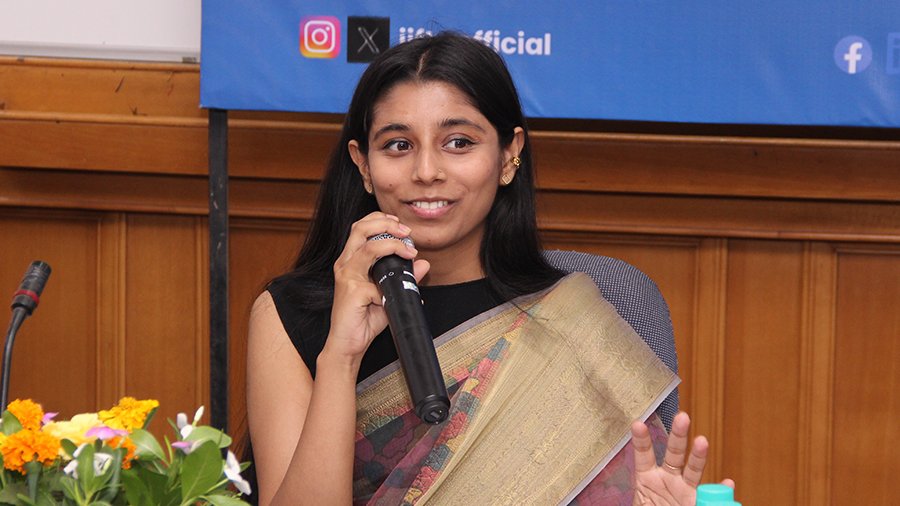
Bringing a sharp, candid, and youth-driven perspective to the discussion at “The Global South Speaks: India’s Leadership in BRICS and Beyond” held on April 28 at the Indian Institute of Foreign Trade (IIFT), organsed by Diplomatist Magazine, Sakshi Shree, Non-Resident Kelly Fellow at the Pacific Forum, offered a nuanced assessment of BRICS, one that balanced both its promise and its internal contradictions.
She began by situating BRICS within a long-standing structural imbalance in the global economy. Recalling early projections associated with economist Jim O’Neill, she pointed to a persistent asymmetry: “Growth has largely remained in the Global South, while capital continues to be concentrated in the Global North.” Despite two decades of transformation, she argued, this gap has not meaningfully closed. “We began with a gap, and we are still navigating that same gap today,” she noted, underscoring the enduring relevance of BRICS as a corrective platform.
However, Sakshi Shree was equally clear that BRICS is not without its challenges.
A central concern she raised was the issue of internal coordination, particularly in light of asymmetries within the grouping itself. Referring to the economic weight of members, she observed that disparities, especially the outsized influence of larger economies, risk distorting the multilateral character of the forum. While she did not dismiss the value of diversity, she drew a critical distinction: “The challenge is not diversity, it is dishonesty with diversity.”
This striking formulation captured one of the most compelling threads of her intervention. According to her, the problem lies not in the differences among BRICS members, but in the reluctance to openly acknowledge and institutionally address those differences. “When we paper over structural imbalances instead of designing mechanisms that ensure genuine plural weightage, we create fragility within the system,” she argued.
She further pointed to ongoing geopolitical tensions among member states, including unresolved border disputes and strategic mistrust, as factors complicating deeper cooperation. In this context, she emphasised that functional collaboration, on trade, development, or technology, must take precedence over unresolved political differences if BRICS is to remain effective.
Another area of concern she highlighted was the lack of consensus within BRICS on key global issues, including counter-terrorism and reform of the United Nations Security Council.
Divergences on such matters, she suggested, reflect deeper structural and political contradictions within the grouping, particularly when member states themselves occupy different positions within existing global power hierarchies.
Yet, despite these challenges, Sakshi Shree was careful not to dismiss the potential of BRICS. On the contrary, she identified its unique strength in its ability to bring together countries with complex and even adversarial relationships. Citing the example of regional rivals engaging within the same framework, she remarked, “This forum can hold what few others can; it creates space for dialogue even among those who have been on opposing sides.”
At the heart of this possibility, she argued, lies the concept of sovereignty. For BRICS members, sovereignty is not a uniform construct, but a shared aspiration shaped by different historical and political experiences. “Some nations bring economic sovereignty, others technological or political strength, but what unites them is a shared experience of having their sovereignty overlooked or conditioned by global institutions,” she explained.
This shared experience, in her view, forms the underlying glue of BRICS. It is what enables countries with divergent interests to still find common ground within the grouping. “It is this shared architecture of experience that brings BRICS together,” she emphasised.
At the same time, she cautioned that this foundation must be protected through consistency and credibility. “When a forum remains silent on violations of sovereignty within its own membership, it risks undermining the very principle that brought countries to the table,” she noted, calling for greater alignment between stated values and collective action.
Her remarks ultimately pointed to a broader truth about BRICS: that its future will depend not just on expanding membership or economic weight, but on strengthening internal trust and institutional integrity. The grouping’s ability to manage asymmetry, acknowledge differences, and uphold its core principles will determine whether it evolves into a truly transformative platform or remains constrained by its contradictions.


Leave a Reply