

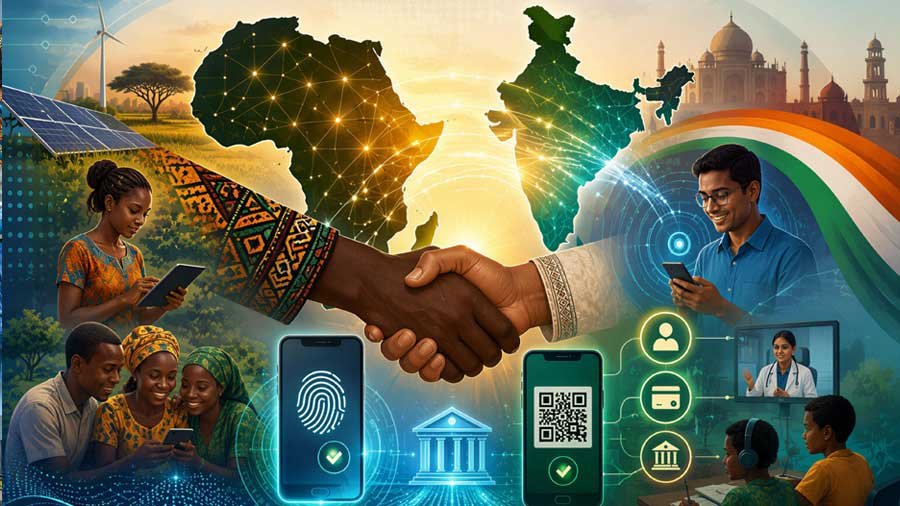
The nature of the partnership that exists between India and Africa has undergone a significant change. Their historical partnership was defined by a shared purpose against colonialism and developmental cooperation, while this new partnership is built on strategic alignment through technology and digitalisation. Digital Public Infrastructure (DPI) has been identified as the new form of infrastructure in a world characterised by digitalisation. India has exported systems like the Aadhaar card, the Unified Payments Interface (UPI), and India Stack to Africa, marking a new era of technological exchange.
In the past decade, India has engaged in extensive activities with Africa. From 2010 to 2024, India has provided more than US$13 billion worth of concessional credit and grant money to African nations. It is, therefore, one of the largest developmental partners on the continent. The bilateral trade between India and Africa has touched US$82 billion, while projects like the International Solar Alliance have helped improve bilateral cooperation in renewable energy. The most remarkable aspect of this partnership is India’s desire to share DPI with Africa.
DPI can be defined as basic digital infrastructure through which governments, enterprises, and citizenry can engage in a meaningful manner. The DPI framework in India is built on open-source, interoperable, and scalable platforms with the goal of making all services accessible to all. Contrary to the Western model, which revolves around big technology corporations, the Indian model places much emphasis on accessibility and technological sovereignty. That is why many African countries see India as a good partner in digitalising their economies without the risks of relying on foreign companies and debt-infused projects.
The digital realm is increasingly being influenced by geopolitical contestation. In the case of the US, it has been advocating for a corporate-based model where digital ecosystems and data are owned by the major technology companies. On the other hand, China, through its Digital Silk Road project, has been investing massively in telecommunications, smart cities, and surveillance systems in the developing world. While these projects have greatly improved connectivity, there are growing fears about data security and surveillance.
India has carved out its own path through its “Digital Non-Alignment” strategy. By adopting the spirit of the original Non-Aligned Movement, this strategy allows developing nations to harness digital technology without losing sovereignty over their data and governance structures. Instead of exporting proprietary solutions, India has come up with open-source models that can be adapted based on the social and legal needs of individual countries. Through Digital Non-Alignment, India’s status as a reliable technology partner of the developing world has been enhanced considerably.
The foundation of all this diplomatic activity is India Stack. The first component of this initiative is Aadhaar, which is the largest biometric identification system in the world and gives a unique identification number to every citizen. With Aadhaar, Indians have a digital identity that allows them to access services digitally. The next level is the Unified Payments Interface (UPI), which was launched in 2016 and allows people to conduct digital payments in real time using their phones.
A significant export from the digital infrastructure of India has been the Modular Open Source Identity Platform (MOSIP), which was established in 2018 at the International Institute of Information Technology, Bangalore. The platform is designed to help countries build their own affordable and secure digital identification infrastructure. By using an open architecture, governments can adapt and connect different modules based on local requirements and can avoid any vendor lock-ins.
In Africa, MOSIP has found significant use. Several African countries lack proper infrastructure for the registration of people’s identities, which results in people missing out on banking, healthcare, education, and welfare systems. One country that has seen success with the MOSIP project is Ethiopia, which has successfully deployed the Fayda digital identity system using MOSIP. As part of the project, which is backed by World Bank funding, around 90 million people are expected to be enrolled in biometric IDs by 2030. The project also covers refugees. Togo also adopted MOSIP after successfully implementing digital payment systems during the COVID-19 pandemic to deliver welfare benefits to people.
Digital identity is the base for governance, and digital payments are important for economic engagement. The Indian UPI has emerged as one of the most efficient payment mechanisms in the world, with billions of transactions being made annually. In India, the UPI has been promoted through NIPL (NPCI International Payments Limited) in several countries around the world. Namibia collaborated with India to create a national real-time payment system based on UPI, and Mauritius adopted UPI and RuPay services to facilitate cross-border transactions.
India’s digital diplomacy also attaches great importance to developing human resources. Under the ITEC (Indian Technical and Economic Cooperation) Programme, many Africans have been educated in information technology and digital governance. Initiatives like the Pan-African e-Network and the e-VidyaBharati platform have facilitated tele-education and telemedicine services.
The creation of the first overseas campus of the Indian Institute of Technology Madras in Zanzibar, Tanzania, in 2023 marked an important step towards such cooperation. The campus focuses on education in the fields of Data Science and Artificial Intelligence, and it is hoped that through such initiatives, Africa’s innovative spirit will be enhanced. Investing in the education of locals and providing them with technical expertise will help build self-reliance rather than fostering dependency.
Another initiative that India took on the world stage during its tenure as the 2023 G20 host country is its push for the adoption of the G20 Framework for Systems of Digital Public Infrastructure. To support such initiatives, India, in collaboration with the United Nations Development Programme, created the Global Digital Public Infrastructure Repository as well as suggested the concept of the One Future Alliance.
Nonetheless, the diffusion of DPI technology among African countries is beset with various difficulties. Most of the countries in Africa lack adequate data protection policies, cybersecurity measures, and regulatory structures. The use of large-scale biometric and financial systems poses security threats in terms of attacks and misuse of data. Public confidence is another potential problem in view of the past institutional failures.
The potential for imported technologies in digital platforms to create an unequal society can also be cited as a challenge because there is no adaptation for those in rural areas and the poor who do not have access to smartphones. Hence, the involvement of civil society organisations is important to ensure public benefit.
In the end, it is clear that only through the development of an African stack by African innovators can India-Africa collaboration prove successful. Although there is a basis provided by India’s open-source platform, sustainable transformation must be created locally in Africa.
The export by India of technology like Aadhaar, UPI, and India Stack is not only an instance of technical collaboration but also of the new South-South diplomacy that embraces openness and capacity building. As African countries fast-track their process of digitalisation, the partnership between Africa and India could become one of the most important platforms for digital development.
References:



Leave a Reply