

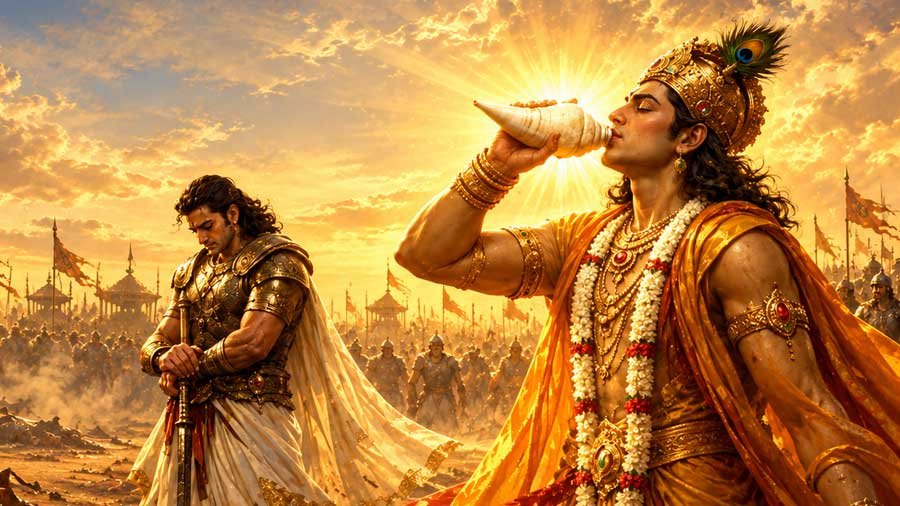
In the Mahabharata, one of the war’s decisive moments turns on a sentence that is almost true. Krishna has already gone as envoy and failed. The rules of combat have been bent against the Pandavas. Drona, the old teacher, will not fall while he believes his son lives. His confidence hangs on one man’s word. Yudhishthira’s reputation for truth is so complete that it can be used against Drona only if Yudhishthira himself speaks. So Krishna asks him to say that Ashvatthama is dead, then to add, too quietly for the battlefield, that it is only the elephant of that name.
Yudhishthira is, in the epic’s own words, “fearing to utter an untruth, but earnestly desirous of victory.”¹ He speaks. Drona lowers his weapons. The chariot that had floated four finger-breadths above the earth, held up by the habit of truth, touches the ground.
The Mahabharata does not stop at the question of whether a lie can win a war. It asks what is left of the man who tells it. That is a different question from the one Homer asked of Odysseus, and a different question again from the one Sun Tzu asked of commanders. A recent film of the Odyssey has folded the older Greek story into a modern unease that finds a striking parallel on the Kurukshetra field, even if it never belonged inside Homer’s Trojan Horse.
Homer’s Cunning
The Horse is not in the Iliad. That poem ends with Hector’s funeral, the war still suspended between biē — brute force — and the human cost of that force. The stratagem appears only in the Odyssey, and when it does, Homer remembers it as a feat. In Book 4, Menelaus praises Odysseus for keeping the men inside the Horse from giving themselves away.² In Book 8, Odysseus asks the bard to sing the same episode, then weeps.³ The tears register what the war cost. They are not a confession that the ruse was a crime.
Mêtis is usually translated as cunning. For the archaic Greeks it meant more: foresight, adaptability, the intelligence that finds a way around an enemy who cannot be overpowered. Odysseus is its exemplar. To deceive a sworn enemy was not, by itself, a moral fall.
Greek culture did revere xenia, the sacred obligation of hospitality under Zeus. The suitors in Ithaca damn themselves by devouring a household that is not theirs. But xenia bound host and guest. It did not police a siege. Homer never suggests that the ethics of the dinner couch should govern the last night of Troy.
Later tellings blurred that line. Virgil, writing from the losing side, recast the Horse as Greek treachery. Christopher Nolan, in his 2026 Odyssey, fuses two moral spheres that Homer keeps distinct in his treatment of the story. A military ruse is made to look like a violation of hospitality: armed men hidden inside a gift. Odysseus is haunted less by the voyage home than by the way the war was ended. It is a powerful modern reading. It is not Homer’s. What Nolan turns into guilt, Homer presents as intelligence.
Sun Tzu’s Discipline
If Homer locates deception in a person, Sun Tzu locates it in the art of command. “All warfare is based on deception.”⁴ The Horse would have served him as a textbook case: show one thing, prepare another. He is easily misread in the West as a prophet of ruthlessness. His point is disciplined rather than ruthless. Deception is a way of keeping war from being ruled by the passions that make it ungovernable. The Iliad opens with the wrath of Achilles, and honour and glory can drive the killing that follows. Sun Tzu warns that no ruler should raise an army merely out of anger.⁵ Anger and the pursuit of glory, by contrast, are to be subordinated to political judgement.
The test, for him, is not whether a ruse is elegant. It is whether the ruse serves a political end at a bearable cost — breaking an opponent’s calculations, shortening a campaign, spending less force. Deception is neither a virtue nor a vice. It takes its meaning from the purpose it is made to serve.
States still work this way. Before D-Day the Allies let Germany believe the blow would fall at Calais rather than Normandy. The deception did not make the Allied cause illegitimate; it helped make the landing possible. Cyber operations, covert action and strategic ambiguity belong to the same family of instruments. Sun Tzu would have recognised the method. He would have judged it by what it achieved, not by whether deception itself carried a moral stain.
The Chariot Touches the Ground
The Mahabharata will not grant that last consolation. Krishna’s counsel is not a celebration of trickery. He turns to upāya — expedient means — after diplomacy has failed, when the ordinary rules of dharma have themselves been turned into a weapon against those who observe them.
That timing matters. The epic is not advising princes to start with a lie. It is describing the moment when strict adherence to truth will hand the war to an opponent who has already abandoned the ordinary rules of combat. Yudhishthira knows this, and still cannot say the sentence cleanly. The murmur about the elephant is not cleverness. It is the last scrap of a vow he cannot bear to drop.
The text is exact about the sequel. Victory arrives. So does the mark. The chariot’s descent is almost comic in its precision — four fingers, then the dust — and that is why it is devastating. Nothing cosmic announces that dharma has been abandoned. A vehicle simply meets the ground. The man who needed to win is no longer quite the man whose truthfulness had held him above the earth.
Homer lets cunning outwit force and treats it as intelligence. Sun Tzu turns that intelligence into disciplined strategy and judges it by the political purpose it serves. The Mahabharata recognises the necessity of such means, then adds a remainder the other two traditions do not make central: even a just war, ended by a necessary deception, can alter the person who uses it. Nolan gives Odysseus that remainder and calls it conscience. The older Indian poem is less interested in remorse as a mood. It is interested in the fact that something measurable is lost.
Necessity Is Not Innocence
The danger sits at both ends of the argument. One fantasy is that power can be used with clean hands. The other is that once a rule has been broken, the rule was never serious. Deception will sometimes be required. That does not make it weightless, and it does not make it a creed.
Homer, Sun Tzu and the Mahabharata are not three versions of the same lesson. They do not translate. In one tradition deception is an expression of intelligence; in another, an instrument of state; in the third, a stain that necessity cannot wash out. Civilisation does not depend on doing without the first two. It depends on refusing to forget the third — and on the honesty to remember that necessity is not the same as innocence.
Footnotes



Leave a Reply