

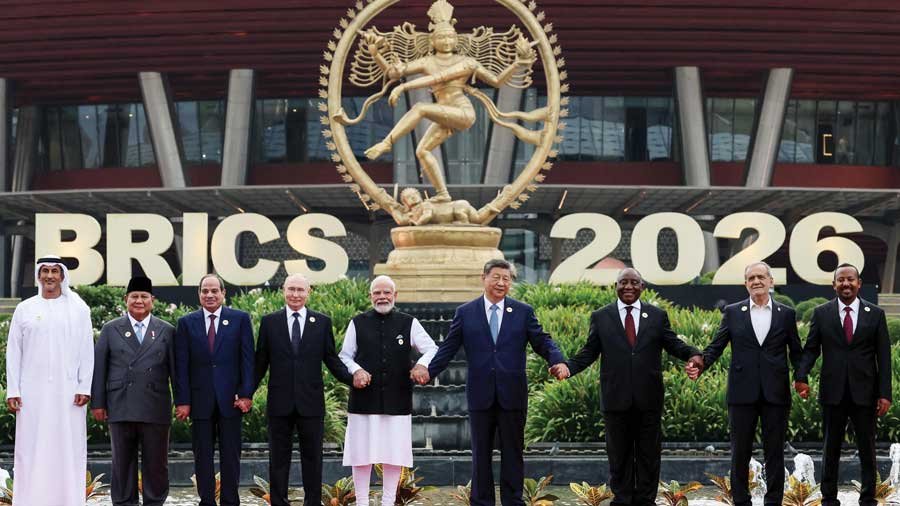
BRICS is at the centre of a profound historical correction, one that encompasses both transformation and consolidation, in the gradual transfer of economic weight from the West to the East. It reflects the growing importance of emerging markets and developing economies (EMDEs) as centres of global growth and development, with the New Development Bank (NDB) emerging as a crucial facilitator. Yet a persistent structural imbalance remains: around 50 per cent of the world’s population accounts for only about 25 per cent of global economic trade. This disconnect between demographic weight, and economic influence remains one of the defining inequities of the international system.
Against this backdrop, the BRICS New Delhi consensus emerging from the 2026 BRICS Summit reflects a strong political determination to consolidate the gains of the grouping and give greater institutional shape to what Prime Minister Narendra Modi has described as BRICS’ “coming of age”. The Delhi Declaration brings together, in considerable detail, the multiple dimensions of cooperation that India sought to advance during its Presidency, while building upon initiatives undertaken by previous BRICS presidencies. Its significance lies not simply in the breadth of issues covered, but in the effort to convert BRICS from a platform of political coordination into a more structured instrument of collective agency.
One of its most consequential features is the collective opposition to unilateral actions that disrupt trade, undermine global supply chains, and threaten the safety and freedom of navigation. This assumes particular significance when geopolitical conflicts are increasingly spilling over into the economic, maritime, and technological domains. The Declaration consequently moves the BRICS discourse beyond the traditional language of reforming global institutions towards the more immediate concerns of economic security, resilience and the protection of legitimate trade and connectivity interests.
From Institutional Reform to Collective Agency
The Declaration places renewed emphasis on reform of the United Nations system, including a “structural update” of the UN Security Council. It opposes unilateral tariffs, non-tariff barriers and coercive economic measures, while calling for greater participation by Least Developed Countries. These political commitments were reinforced by the extensive institutional groundwork undertaken during India’s Presidency, including more than 400 meetings across 30 cities.
The reaffirmation of multilateralism is broad and deliberate. BRICS called for revitalising the UN General Assembly and strengthening the Economic and Social Council, while reiterating the need for reform of global financial governance, including IMF quota and governance reform and reference to the 2025 World Bank Shareholding Review. It also opposed trade-restrictive practices and reaffirmed the importance of Most-Favoured-Nation treatment and Special and Differential Treatment for developing countries. The Declaration’s reference to the Asian-African Bandung Conference as an important reference point further connects the contemporary BRICS project with the longer history of the Global South’s search for a fairer, more inclusive and representative international order.
The political message was equally clear on questions of peace and security. On West Asia and the Middle East, the Declaration emphasised de-escalation, dialogue and diplomatic solutions rather than military escalation. It expressed deep concern over escalating tensions in the region and Gaza, acknowledged the Palestinian people’s right to self-determination and welcomed the ceasefire in Lebanon. At the same time, BRICS expressed alarm at the sharp increase in global military expenditure and the growing risks of nuclear confrontation and conflict.
For India, perhaps the most consequential diplomatic outcome was the stronger language on terrorism. The Declaration’s condemnation of the Pahalgam terrorist attack of 22 April 2025, together with stronger language on terrorism, terrorist financing and safe havens under the BRICS Counter-Terrorism Working Group, represents an important diplomatic outcome for New Delhi. It demonstrates that India was able to place its security concerns within a broader BRICS consensus rather than treating terrorism exclusively as a bilateral or regional issue.
The emphasis on women, peace and security also added an important dimension to the political agenda. The Declaration reiterated the importance of women’s equal, safe and meaningful participation in decision-making at all levels of peace and security processes and governance, while highlighting the role of the BRICS Women’s Business Alliance in promoting women’s entrepreneurship and economic participation across BRICS countries.
From Geopolitics to Development
Perhaps the most distinctive feature of the Delhi Declaration is the breadth of its developmental agenda. BRICS cooperation is no longer confined to geopolitics, institutional reform or de-dollarisation. It increasingly encompasses the practical architecture of development – health, agriculture, disaster resilience, climate, energy, science, education, technology and social protection.
Health cooperation, for instance, has moved beyond pandemic preparedness towards non-communicable diseases, mental health, medical products and digital health architecture. The reference to traditional, complementary and integrative medicine reflects an attempt to incorporate diverse developmental experiences into the pursuit of universal health coverage. Similarly, the proposed BRICS-AGRIN network could provide an institutional mechanism for cooperation on agriculture, food security, technology and resilient food systems. This is particularly relevant to the Global South, where food security is increasingly intertwined with climate change, supply-chain disruptions and geopolitical uncertainty.
The Declaration also gives greater space to disaster resilience and cooperation with the Coalition for Disaster Resilient Infrastructure (CDRI), potentially connecting the BRICS climate agenda with implementation on the ground. This represents an important shift, from climate commitments towards resilience-building. The emphasis on energy cooperation, the BRICS STI Framework Programme and the BRICS Climate Research Centre Platform points towards a more systematic science-and-technology ecosystem. Particularly significant is the proposed BRICS Laboratory for Trade, Climate Change and Sustainable Development, which could bridge the traditionally separate agendas of trade, climate action and sustainable development.
Space is another area in which BRICS cooperation is becoming more substantive. The grouping appreciated the achievements of the Remote Sensing Satellite Constellation in harnessing space technology to address global challenges. Discussions at the BRICS Heads of Space Agencies meeting in Bengaluru also highlighted the importance of space-debris mitigation and the long-term sustainability of outer-space activities. At the same time, BRICS reinforced its opposition to the weaponisation of outer space and acknowledged the updated draft treaty on the Prevention of an Arms Race in Outer Space (PAROS).
The same institutional deepening is visible in education and human-capital development. The BRICS Network University seeks to strengthen the knowledge economy and academic cooperation, while the emphasis on Early Childhood Care and Education extends BRICS cooperation into the foundations of human-capital development. China’s proposal for greater cooperation in engineering training during its forthcoming presidency could take this further by connecting education with industrial and technological capacity-building.
The people-centric dimension of BRICS was also visible in the emphasis on traditional knowledge systems and youth dialogue. The Declaration commended the efforts of the BRICS Business Forum, the BRICS Think-Tank Council and the BRICS Academic and Civil Forum. The establishment of the BRICS Online Archival Database and the Chair’s initiative on the stocktaking of Memoranda of Understanding point towards a more data-driven and institutionalised BRICS, supported by greater institutional memory.
Building an Economic Architecture
The economic dimension of the Declaration is equally significant. The instruction to the BRICS Payment Task Force (BPTF) to accelerate work on efficient cross-border payment mechanisms is one of the more consequential economic elements. The emphasis appears deliberately pragmatic: rather than immediately pursuing a single BRICS currency, the focus is on improving payment connectivity and reducing transaction frictions. The reference to special economic zones further links financial cooperation with real economic activity.
The advancement of BRICS Multilateral Guarantees (BMG) indicates an effort to create mechanisms that can support investment and reduce risk. At the same time, the Declaration’s recognition of ageing as a policy challenge, and its attention to pension regulation and supervision, shows that BRICS is beginning to address the demographic pressures accompanying economic development.
Taken together, these initiatives suggest that the economic future of BRICS may lie less in creating a parallel global financial system overnight and more in building, incrementally, the connective infrastructure of a more diversified global economy. Payments, guarantees, investment, supply chains, special economic zones, technology and human capital are the building blocks of such an architecture.
This is also why the most important feature of the Delhi Declaration may be what it does not do. It does not reduce BRICS to a project of opposition to the West or to a campaign for de-dollarisation. Instead, it seeks to broaden the grouping’s agenda into areas where its members have tangible common interests and where cooperation can generate practical outcomes. That is a more sustainable basis for collective agency.
China, Russia and the Internal Balance of BRICS
The international dimensions of the summit are equally revealing. Just before arriving in India, Xi Jinping called for viewing India-China relations from a “strategic height” and a “long-term perspective”. Much of the Chinese media coverage of the summit concentrated on President Xi’s articulation of India and China as “partners and not rivals”. The possibility of BRICS entering a new “Golden Decade”, alongside Xi’s five-point agenda covering open and inclusive artificial intelligence, trade and investment facilitation, digital-industry cooperation, smart manufacturing and science-and-technology talent development, has attracted considerable attention.
This narrative presented BRICS and the expanded “Greater BRICS”, or “Golden BRICS”, as principal frameworks for the future direction of Global South cooperation. Xi also reiterated the importance of Global South countries in defending the international rule of law.
Yet this selective emphasis contrasts with another consequential development emerging from the summit: the evolution of India-Russia relations. Russia appears to be emerging as a stronger and more autonomous pillar within the grouping. Its unequivocal support for India’s bid for a permanent seat on the UN Security Council, coupled with greater openness towards expanding bilateral trade, carries significance well beyond the immediate summit.
The shift is particularly important in the economic domain. The disruption caused by the Ukraine war and Western sanctions has already compelled Russia to diversify its sources of imports and develop alternative supply chains. The post-summit trajectory suggests that this adjustment could increasingly acquire a bilateral India-Russia dimension. Moscow’s willingness to expand trade with India incrementally across a wider range of goods, sectors and economic mechanism, which could provide New Delhi with greater strategic space within BRICS.
The emerging picture, therefore, is not simply one of China shaping the BRICS agenda. Rather, Russia’s growing economic engagement with India and its political backing for India at the United Nations point towards a more pluralistic internal balance within the grouping. This could strengthen India’s ability to ensure that BRICS evolves from a platform disproportionately shaped by the priorities of its largest powers into a broader coalition based on negotiated interests and partnership. China may dominate the media narrative, but Russia’s behaviour is creating additional strategic space for India. The absence of Brazil’s President, which was represented by Foreign Minister Mauro Vieira, during this year’s summit, meanwhile, is a reminder that sustaining cohesion among an increasingly diverse membership will itself be an important test for the grouping where national priorities override multilateral commitments.
From a Pyramid of Privilege to a Pyramid of Partnership
PM Modi’s conceptualisation of BRICS as a platform for greater voice, agency and representation for the Global South therefore acquires added significance. His vision seeks to transform a “Pyramid of Privilege” into a “Pyramid of Partnership” replacing concentrated power with distributed agency and hierarchy with greater representation.
What is clear from the Delhi Summit is that the evolution of BRICS is no longer simply a story of five emerging economies seeking greater representation in existing global institutions. Its expanded membership and growing agenda suggest the emergence of a broader political and economic coalition seeking to reshape the terms on which globalisation, development and multilateral governance are negotiated.
The real test, however, will lie in implementation. A declaration can articulate ambition; institutions, financing, trade, technology and sustained political coordination must give that ambition substance. India’s imprint on BRICS at 20 may ultimately be measured not by how many issues found their way into the Delhi Declaration, but by whether the grouping can convert this remarkable breadth of consensus into durable instruments of cooperation.
That is the larger significance of BRICS’ “coming of age”: not the creation of another bloc, but the gradual construction of a platform through which a larger part of the world can exercise voice, agency, and partnership in shaping the international order.


Leave a Reply