

A degree may get you into the room. What determines whether you remain there is your ability to learn, adapt, create value and continue growing.
For decades, a degree has been regarded as the passport to success. It represented knowledge, expertise and readiness for professional life. Parents aspired to see their children graduate from prestigious institutions, employers relied on academic credentials as a benchmark for recruitment, and society often equated qualifications with competence.
Degrees continue to matter. They provide the foundation upon which professional expertise is built. We would not trust a surgeon without medical training, an engineer without technical expertise or a teacher without a sound understanding of pedagogy. Degrees bring rigour, discipline and professional credibility. In many professions, they remain indispensable.
However, in today’s rapidly evolving world, they are no longer enough.
A growing challenge illustrates this reality. Every year, thousands of graduates enter the workforce armed with impressive qualifications, yet many struggle to secure meaningful employment. At the same time, employers frequently report difficulty finding candidates who possess the skills required for today’s workplace. The gap is seldom one of qualifications alone; it is increasingly one of applying knowledge, communicating effectively and adapting to unfamiliar situations.
As an educator and school leader for over three decades, I have often been asked what students should study to secure their future. Earlier in my career, the answer seemed relatively straightforward. Today, I believe the more important question is not what students should study but what kind of learners they should become.
A World We Cannot Predict
When I reflect on education two decades ago, I often ask myself: could we have imagined a world where artificial intelligence would become an everyday assistant, and teams would collaborate seamlessly across continents?
If we could not predict today’s reality, it would be unrealistic to assume that we know exactly what degrees today’s children will require twenty years from now.
That is why education cannot merely prepare students to earn degrees or secure their first job. It must prepare them for a future that none of us can fully predict.
Knowledge will evolve. Technology will continue to advance. Careers will be redefined. The one constant will be our ability to learn, adapt and thrive amidst uncertainty.
A degree is evidence of what a person has learned at a particular point in time. It is an important milestone, but it is not a guarantee of future readiness. As industries, technologies and workplace expectations evolve, the real differentiator is the willingness and ability to keep learning long after graduation.
Whether it is doctors adapting to advances in medicine or teachers embracing evolving pedagogies and technology, professional excellence depends on continuous learning, upskilling and reskilling. This holds true for engineers, lawyers, architects, entrepreneurs, and business leaders as well.
A qualification may help secure the first interview. Employability depends on demonstrating capability, while long-term relevance depends on learning, adapting and creating value throughout one’s career.
Over many years of interviewing educators, I have often noticed that candidates explain subject concepts confidently but struggle when discussions move to contemporary issues such as sustainability, the circular economy or the ethical implications of emerging technologies. The gap is rarely one of knowledge; it is the ability to analyse, evaluate, create and transfer that knowledge to unfamiliar situations.
The New Competitive Advantage
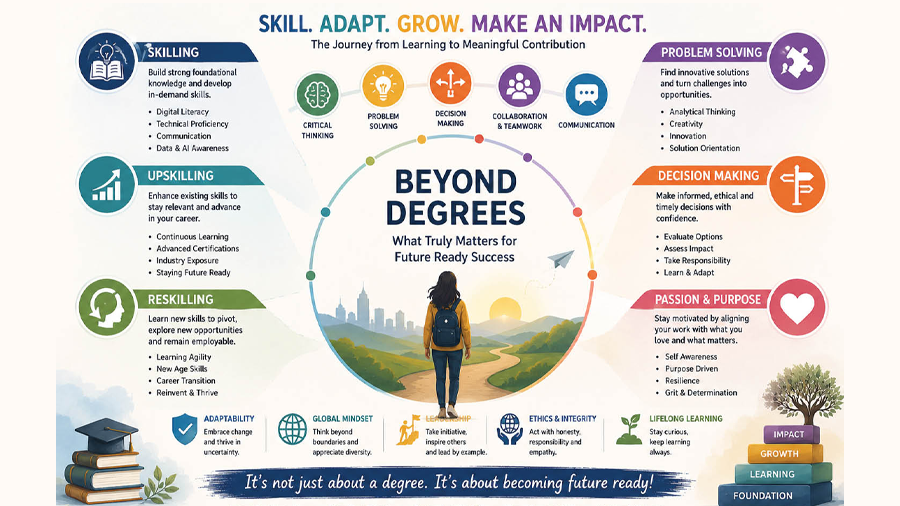
Digital technologies and artificial intelligence have democratised access to knowledge. Professional qualifications continue to provide depth and credibility, but success increasingly depends on how effectively individuals apply knowledge, think critically, communicate and continue to learn.
This does not make degrees irrelevant. On the contrary, professional qualifications remain indispensable in many fields because they provide depth, rigour, ethics and accountability.
The World Economic Forum’s Future of Jobs Report 2025 identifies analytical thinking, resilience, flexibility, leadership and lifelong learning among the capabilities that employers will increasingly value in the years ahead. ¹ ¹ Remaining relevant will therefore depend on a commitment to continuous learning, upskilling and reskilling throughout one’s career.
Future readiness will therefore depend on our capacity to adapt confidently and turn learning into practical solutions for real-world problems.
Ultimately, it is not knowledge alone but the ability to apply it, adapt to change and create value that will distinguish successful professionals.
From Classrooms to Life
Problem-solving, communication, creativity, collaboration, emotional intelligence and self-management are not merely soft skills; they are life skills that enable individuals to navigate uncertainty, make informed decisions and contribute meaningfully in an increasingly VUCA (Volatile, Uncertain, Complex and Ambiguous) world.
As educators, we therefore need to create learning experiences that mirror the complexity of the real world. Real-life challenges rarely belong to a single subject. Climate change, public health, sustainable development and entrepreneurship require knowledge across disciplines, the ability to evaluate different perspectives and the confidence to work collaboratively towards meaningful solutions.
This philosophy is reflected in India’s National Education Policy (NEP) 2020, which advocates competency-based, multidisciplinary and experiential learning. ²
Likewise, the International Baccalaureate’s Creativity, Activity and Service (CAS) programme encourages students to apply classroom learning to authentic situations while developing leadership, collaboration and reflection. Integrating the Sustainable Development Goals further strengthens students’ understanding of real-world challenges.
During the COVID-19 pandemic, our IB Diploma Programme students independently organised an online TEDx event. Beyond the event itself, they developed leadership, teamwork, initiative, communication and resilience; lessons no examination could have measured.
When Skills Create Opportunity
Around the world, young innovators continue to show that meaningful impact comes from combining knowledge with initiative, creativity and problem-solving.
One such example is Vinisha Umashankar, a young innovator from Tamil Nadu, whose solar-powered ironing cart addressed the daily challenges faced by street-side ironing vendors while promoting clean energy. ³ Equally inspiring is the story of Nisarg Adhikari, a young ethical hacker who identified vulnerabilities in the CBSE portal. His technical competence, curiosity and initiative not only highlighted a critical security issue but also led to an opportunity with IIT Kanpur. ⁴
These examples remind us that knowledge and skills are most powerful when they complement one another. Curiosity sparks learning, passion sustains it, and creativity transforms ideas into solutions that create value for society.
Preparing for Tomorrow
If artificial intelligence is one of today’s greatest disruptors, the next competitive advantage may well be the qualities that make us uniquely human.
Technology can process information, but it cannot replace empathy, ethical judgement, integrity, resilience, creativity or the ability to inspire others. These qualities will define leadership in the years ahead.
As educators, our responsibility extends far beyond helping students earn degrees. We must nurture learners who are curious, adaptable, resilient, compassionate and confident enough to solve problems that do not yet exist.
Degrees will continue to matter because they provide the foundation for professional expertise. Yet they are only the beginning. A degree may secure the first opportunity; sustained success demands character, creativity, adaptability and the willingness to keep evolving.
Ultimately, degrees may open doors, but it is the ability to keep learning, embrace change and create meaningful value that determines how far we go.
References:


Leave a Reply